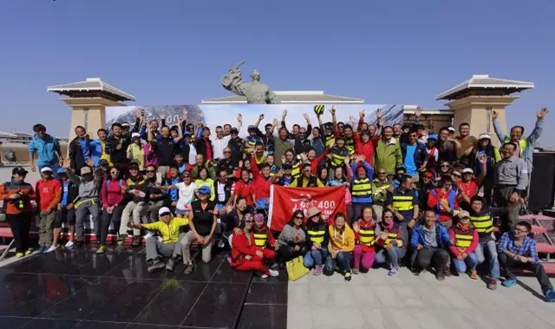
During the National Day holiday in 2015, while most people were immersed in their vacation travels, an off-road racing event called the “800 Li Desert Extreme Race” was unfolding with great fervor in the northwestern deserts and Gobi.At 6:48:52 AM on September 28,asarmoured cavalry, galloping on horseback, reported that all teams were assembled, Mr. Garland, the race director, waved his flag to announce the start of the race, the first UTG800 Li Desert Extreme Race officially commenced at the Ashoka Temple in Guazhou, Gansu.Dozens of elite runners from both China and abroad completed the grueling 400-kilometer crossing of complex terrains within 150 hours,making it, to date,the longest-distance extreme off-road race in China. Glacial mountains and snowfields, ancient ruins and river valleys, rolling hills and Yardang landforms,Gobi deserts,、saline-alkali sandy lands,and other terrainsemerged one after another,with majestic and awe-inspiring natural landscapes continuously unfolding,,on thispristinemountain-and-riversanctuaryof nature,the participantsenduredbothphysicalandmentaltrials,and the domestic and international finishers were awarded different ranks of ancient Chinese military governor titles based on their placements. These “governors” of the first UTG 800 Li Desert Extreme Race undertook a true journey through physical endurance, spiritual challenge, cultural immersion, and extreme adventure in China.CompletedYet another in their respective livesOf transcendence.
 Zhao Ziyu, the champion of this edition,With astonishing strength,Among a gatheringOf elite runnersFrom both China and abroad,Managed to stand outAs a dark horse.Zhao Ziyu successively overtook“Running Back to China,”A Chinese expert who had completed a ten-thousand-kilometerUltramarathon, and Italian trail running starMassimo. From then on, she maintained her leadingAdvantageThroughout, and with a time of 92 hours, 52 minutes, and 58 seconds, successfully completed the full 402.2-kilometer course. She claimed the championship of the inaugural UTG Eight Hundred Li Desert Race, finishing a remarkable 57 hours and 7 minutes ahead of the cutoff time (150 hours). Her outstanding performance left everyoneAstonished,And she was also honored with the title of “General Champion” in the men’s category. Chinese athlete Bai Bin and American athlete, with times of 96 hours, 26 minutes, 46 seconds and 98 hours, 59 minutes, 39 seconds respectively, secured second and third places.“After seven days and six nights of relentless progress, a total of eighteen heroes emerged victorious. The significance of this “800-Li Heroes’ Journey” lies not in covering distance, but in transcending the spirit. This route is a heroic path for the brave, as well as an extraordinary journey for every ordinary person who followed or participated in this event.”A uniquely grueling course blendingBryon PowellA journey through millennia of culture
The inaugural UTG Eight Hundred Li Desert Extreme Race designed
The longest domestic race route, spanning 400 kilometers in total, passing through the world’s only national-level extremely arid desert ecological reserve. Eighty percent of the course lies within uninhabited desert areas, featuring a variety of complex terrains including Gobi, yardang landforms, hills, saline-alkali land, sand dunes, canyons, glaciers, rivers, and alpine meadows. In addition, the course crosses three counties and cities in Gansu—Guazhou, Dunhuang, and Subei—where climatic conditions are extremely variable. Guazhou, known as the “World Wind Repository,” has recorded historical maximum wind speeds of up to Force 12. The temperature difference between day and night in this region is alsoSignificant.
The inaugural UTG Badain Jaran Desert Ultra designedadomestically longest race route, spanning 400 kilometers in total. It passes through the world’s only national-level extremely arid desert ecological reserve, with 80% of the course located in uninhabited desert areas. The route features a variety of complex terrains including Gobi Desert, yardang landforms, hills, saline-alkali land, sand dunes, canyons, glaciers, rivers, and alpine meadows. In addition, the course crosses three counties/cities in Gansu—Guazhou, Dunhuang, and Subei—where the regional climate is also highly variable. Guazhou is known as the “World’s Wind Warehouse,” with a recorded maximum historical wind force of level 12. The temperature difference between day and night in this area issignificant, with a historical extreme high temperature of 42.8°C and an extreme low of -29.1°C, the diurnal temperature range can exceed 70 degrees.Such rarehuman interferencemakes this natural racing course truly one of a kind in the world. Yetfaced with such harsh natural conditions, all participants must navigate entirely on their own, carry their own gear, provide their own supplies, and complete the 800-li (approximately 400 km) desert crossing within the 150-hour cutoff time — a level of difficulty that is truly daunting.
The UTG is also a profound journey interwoven with millennia of culture. The race area contains over 60 ancient city ruins and beacon towers, including two UNESCO World Heritage Sites (Suoyang City and Xuanquan Posthouse), four national-level cultural heritage protection units (Yulin Grottoes, Damuzi Mother-and-Son Memorial Arches, Kunlun Barrier, and Dong Qianfo Cave), once a hub of ancient culture, commerce, and military strategic importance.With the successful inscription of the Silk Road on the World Heritage List, the Suoyang City and Xuanquan Posthouse sites in Gansu have been officially listed as World Cultural Heritage Sites. These two sites are compulsory passages in the 800 Miles of the Desert, making the UTG 800 Miles of the Desert Extreme Race a truly rare dual-world-heritage off-road endurance event, both domestically and internationally.
“Stunning and grueling!” said champion Zhao Ziyu about UTG. Cai Jingjing, an outstanding female runner of Singaporean Chinese descent and the first-runner-up in the women’s division of the first UTG,encountered getting lost, hypothermia, and discomfort during the race. She said,“This has been the most unforgettable journey of my life!” “This race is something incredibly meaningful. Whether it’s the people who care about me or the magnificent natural landscape, they’re all worth running for!”” Chinese participant Li Shuhua, who was among the last to finish, said upon reaching the finish line: “The organizers must have been lying — this course is 100% wilderness.”
Due toa sudden blizzard that struck in the early hours of the 30th, with temperatures plummeting below -10°C, participantson the third day truly experienced the unpredictability of China’s Gobi Desert, going through the extremes of summer heat and winter cold within a single day. French racerBenoit Laval wrote on Facebook after the race:We experienced daytime temperatures of40degrees, nighttime lows of minus10degrees, blizzards, two crossings of3400-meter high-altitude areas, and ran acrossNvastly different terrains, including sand dunes, deep valleys, endless flatlands, and some surfaces that were simply so extreme it’s hard to imagine how any human could run — or even walk — on them. I was misled by the navigation for nearlyGPSkilometers.20A time of42hours to cover400kilometers might not seem like much running, but we really were running. Imagine having to carry a4-kilogram backpack out in the wilderness, not to mention rest breaks.400Kilometers are just the theoretical distance — in reality, due toGPSnavigation issues, there’s definitely an5%increase.3000A mere few meters of elevation gain is just theoretical— in reality, it’s definitely more than double that.
Competing athletesall agreed that this course, with its complex and ever-changing terrain, rich and profound Chinese historical culture, and the breathtakingly majestic scenery along the way, was absolutely astounding. They had never experienced anything like it in previous races and unanimously deemed it a one-of-a-kind, world-class extreme cross-country course.
Rich in profound Chinese culture Tiger Talisman medals conquer runners
Beyond the cultural significance inherent in the course itself, the detailed design elements of the UTG event also showcase Chinese cultural motifs at every turn. The northwestern deserts of Gansu were strategic frontier strongholds in ancient China, where successive dynasties stationed military governors with troops to guard the borders. The organizing committee came up with a creative idea, drawing inspiration fromthe military tally issued by Emperor Qin Shi Huang to the commander stationed at Yangling after unifying China,and meticulously designed a finisher's medal in the form of a tiger talisman that can be split into two halves.“Tiger Talisman”medal. Before the race begins, all participants receivefrom the hands of Race Director Mr. Garland,onehalf of the talisman, and then after completing the course, they earn the other halfat the finish line.Only when the two halves are joined together does it form the complete tiger talisman, symbolizing a full course completion.The “tiger talisman” was historically used by ancient emperors as a token to mobilize troops. Once this medal made its debut, it instantly stirred upthe excitement and fighting spiritof the brave participants.The medal, rich in distinct Chinese historical and cultural elements, especially intrigued and captivated international runners,earning widespread praise.Chinese athlete Zhao Wei said after finishing the race, “Just for this tiger talisman, enduring four days and nights of scorching heat, facing snowstorms, trekking through the Gobi Desert, and crossing the desolate wilderness— it was totally worth it!” Byron Powell, the American runner who won third place in this event, couldn’t wait toas soon as he crossedthe finish line, eagerlyholding upone half of the tiger talisman, askingRace DirectorGarland:“Hey ‘Emperor’,“‘where’s my other half?” He then put the two halves together to form the complete talisman and took a commemorative photo. All domestic and international runners showed great enthusiasm and eagerness for the tiger talisman medal, while those who had to drop out and couldn’t take home the complete talisman expressed deep regret, with many saying they would come back to compete again to claim their own “other half.”’Where’s my other half?” Then they would put the two halves of the tiger tally together to complete it and take a commemorative photo. All runners from both China and abroad showed great eagerness and excitement about the tiger tally medal, while those who had to drop out and couldn’t take home the complete tally expressed deep regret, with many saying they would come back to compete again to win their “other half.”
"Made in China”International Professional Off-Road Race High-Tech Safeguards
When most long-distance off-road races in China focus on the 100-kilometer format as the mainstream, the inaugural UTG Badain Jaran Desert Ultra Trail boldly pioneered the industryby creating China’s first ultra-long distance off-road race—a 400-kilometer course that was unprecedented, and even rare in well-established international off-road racing scenes. It brought an "Made in China" international professional off-road event to runners both at home and abroad.
The organizer of the Badain Jaran Desert Ultra Trail—Beijing Xingzhi Tansuo Event Management Co., Ltd. (hereinafter referred to as "Xingzhi Tansuo") strivesto enable participants to achieve breakthroughs in both physical endurance and mental resilience through an immersive experience, while fostering deeper exchanges between China and top global off-road events by bringing together elite runners from around the world.
Xingzhi Tansuo hasbeen working in the Maha Yanqi Gobi Desert in Guazhou, Gansu for a decade, leading nearlytwohundred thousand entrepreneurs, scholars, cultural figures,andaspiringyouthon the Journey of Xuanzang. With ten years of accumulated experience, the company now operates at top domestic and even world-class standards in areas such as event organization, safety assurance, and logistical support.Building on this foundation,a high-level, professional international off-road race has been successfully launched.To ensure the professionalism of this edition, the organizing committee has consistently adhered to international standards and employed high-tech measures to safeguard the event’s security.,Position tracking, results management, and security operations have all run smoothly,,ensuring protection for every participant. The course features rest stations approximately every 35 kilometers forovernight stays,with checkpoints set up every 12 to 15 kilometers, totaling10 rest stations and 33checkpoints.Medical staff, logistics personnel, command teams, media crews, results officials, and volunteers remain on duty throughout the night to handle any emergencies and ensure service quality. Ninety percent of volunteers are proficient in English, stationed at every checkpoint and rest area. According to data published by the organizing committee, the ratio of support staff to participants is 7:1—rare even by international standards.checkpoints, with medical, logistics, command, imaging, timing staff, and volunteers standing by overnight to handle all kinds of emergencies and ensure service. 90% of the volunteers have English service capabilities, stationed at every checkpoint and rest area. According to data released by the organizing committee, the ratio of support staff to participants in this event was 7:1—an exceptionally high level even by international competition standards.
Additionally, drawing on a decade of event management experience and collaborating with long-term partner Neusoft Group, the organizing committee leveraged high-tech tools to provide the inaugural UTG Badain Jaran Desert Ultra Trail with advanced satellite tracking and live ranking systems. In the rear command center in Guazhou County, two large screens clearly display each participant’s location, distance from others, pace, stoppage time, and real-time ranking. Checkpoint staff also use relay radios to report athlete and station conditions to the command center in real time, allowing quick responses to any incidents. Thanks to this advanced satellite tracking technology, when runners Kojiro Goto and Tsukasa Shibata took shelter in a valley and issued a distress signal after getting lost due to hypothermia, rescue teams were able to locate them swiftly under the guidance of the command center's positioning data and provide assistance. Such comprehensive safeguards are rarely seen even in many international competitions, highlighting the ultra-high operational standards of the Badain Jaran Desert Ultra Trail.
As a challenging and culturally rich international event, one of the key significances and values of this race lies in not only advancing the development of outdoor extreme sports in China,has significantly elevated the level and visibility of domestic outdoor extreme sports events, while also providing more opportunities for internationally renowned trail running elites to come to China for competition and exchange, bringing China's rich culture and magnificent nature to the world. Guo Fengzhou, known as the "Father of Taiwanese Ultramarathons" and founder of the Soochow International Marathon, commented after personally attending this edition of the race: "The Badaling Ultra is the toughest ultra-trail race in the world. The organizing committee has already reached a 'professional-level' standard." Race director Garland and the international participants allsaid that the Badaling Ultra will become a world-class trail running event. In the future, more and more domestic and internationaltrail running elites will take on this 400-kilometer course, which boasts profound historical and cultural significance as well as complex terrain and weather conditions, pushing their limits, challenging themselves, and conquering the "400-mile Hero’s Road."”.