For outdoor enthusiasts, knot tying is one of the essential skills to have.
Skillfully using knots not only adds an extra layer of safety during activities but also proves helpful in everyday life: organizing items, packaging, camping, as backup shoelaces, or securing flags—there are many uses.
The following short GIFs clearly demonstrate how to tie several commonly used knots. Let’s learn together~
2. Single Figure-Eight Knot
Used at the end of a rope for rock climbing protection or rappelling to prevent the rope from slipping through a belay device or descender and causing accidents, or as a mid-rope protection node. However, the biggest drawback of the figure-eight knot is that it becomes difficult to untie after being under heavy load, and it’s also hard to tie a load-bearing double figure-eight knot with one hand.
3. Double Figure-Eight Knot
The purpose of the double figure-eight knot is to create a fixed loop. Thanks to its strength and reliability, it is highly trusted for safety purposes and is often used by mountaineers as a life-saving knot. However, its loop size cannot be adjusted, and it can be hard to untie when under tension or when wet.
4. Bowline Knot
The bowline knot has a wide range of uses, hence its title as the “king of knots.” It is strong yet easy to untie, never slips or deforms. It is mainly used to secure one end of a rope to an object or a person as a connecting and protective knot, and can also be used to tie or hoist items.
5. Double Snake Knot
CONSTRICTOR—The double snake knot is suitable for situations where a rope needs to be secured around a wooden post, such as reinforcing a tent or tethering a horse.
6. Sheet Bend Knot
The sheet bend is also a knot used to join two ropes. Unlike the fisherman’s knot, it can connect two ropes of different thicknesses and materials. It is one of the oldest knots. Its characteristics include simple tying, solid reliability, and ease of untying. It can be used to connect ropes of different materials and thicknesses. The yellow rope in the image is thicker and stiffer.
7. Fisherman’s Knot
The fisherman’s knot is a knot used to join two ropes. The difference from the sheet bend is that the fisherman’s knot is suitable for temporarily joining two thin ropes of similar thickness and material. Note that it can easily slip on nylon ropes, and if you want a secure hold, you need to add a double or triple overhand follow-through.
The result looks like this after tying.
8. Overhand Knot
This method allows you to create a knot with a connector loop using a single strand of rope.
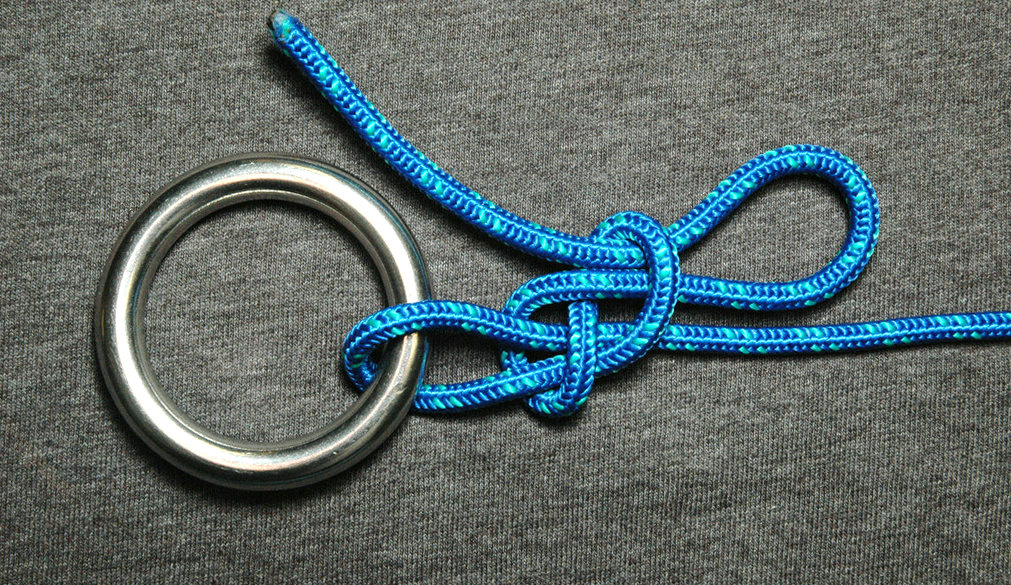
9. Lanyard Knot 1
Mainly used for tying to a carabiner. In daily life, if you want to hang something on your bag’s handle, you can also use this method.
10. Lanyard Knot 2
Similar in use to the previous knot, but slightly more complex to tie.
Did you learn these simple knot-tying methods?
Practice makes perfect—take out a rope and try tying them a few more times.
Such a practical skill, share it with your friends~
*Cover image: Nipic @ Qing Shi Bu Jian He