A Romantic Encounter in the Dunhuang Desert: Camel Rides and Ancient Ruins for Wedding Photos
Text and photos / or Travel China Magazine
When it comes to “Dunhuang,” many people’s first thoughts are likely the jagged caves nestled between mountain cliffs, housing solemn yet whimsical statues of flying apsaras and bodhisattvas; or the echoes of camel bells along the Silk Road, and the surreal sight of desert and springs coexisting amid swirling sands.
China has no shortage of ancient cities steeped in history, but few places match Dunhuang in blending sacred religious ambiance with the vibrant, worldly atmosphere of bustling trade.
As a key hub along the Silk Road, Dunhuang’s mix of Han and Hu cultures lends it a strong exotic charm. Yet, how many soldiers’ longing gazes and lovesick tears have been buried in this boundless expanse of desert?
Longing to return alive through Jade Gate Pass, wrapped in solitude
The famous Eastern Han Dynasty general Ban Chao was dispatched on a mission to the Western Regions by imperial decree, serving for over 30 years. In his twilight years, with hair turned white and eyesight dimmed, Ban Chao was overwhelmed by homesickness and petitioned the emperor to return to his beloved homeland: “Though Qi and Lu are a thousand li apart within the Central Plains, how much more so for those in the farthest reaches of the frontier? Can a humble servant not yearn to return to his roots?”
After years apart, the journey from the distant lands to the capital Chang’an was perilous and arduous—the distance was surely more than just a thousand li. But as long as one could “return alive through Jade Gate Pass,” it meant having reached the land of Han—all anxieties would settle, just like the decades of unchanging desert winds finally calming the moment one passed through the pass.
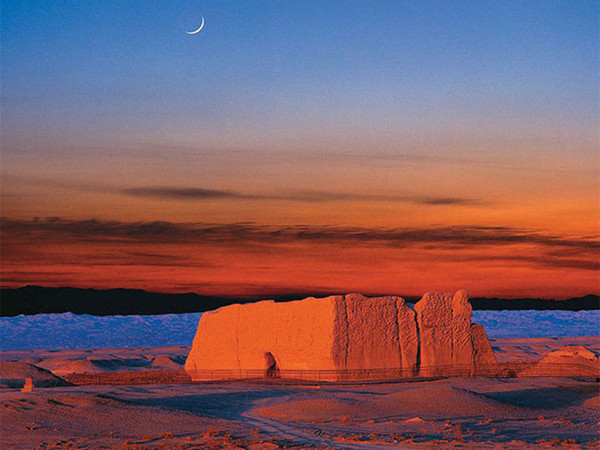
Jade Gate Pass, also known as “Little Square City,” earned its name because of its square, plate-like shape and its role as a crucial route for camel caravans transporting jade in ancient times. Legend has it that a trading caravan once rode here under the cool moonlight but unfortunately strayed into the nearby “Horse-Losing Trail.”
This overgrown, swampy wasteland has always struck fear into travelers, with its treacherously shifting terrain even confusing seasoned horses.
Just as everyone was at their wits’ end, a wild goose, carefully fed water and fodder, suddenly perked up, soared into the sky, and guided them to safety.
After several twists and turns, to repay the goose’s kindness, the caravan leader decided to embed a fine piece of luminescent black jade at the top of the gate. Thus, even on pitch-dark nights, travelers could look up and see the soft green glow from the pass, ensuring they wouldn’t lose their way.
In such a desolate borderland, facing this vast, seemingly abandoned expanse of time and space, the Tang Dynasty poet Wang Zhihuan couldn’t help but sigh profoundly in his famous poem “Ballad of Liangzhou”: “Beyond the western passes flows the Yellow River to the white clouds’ height; / A lonely city looks out ’gainst the Ten-Thousand-Foot Mountains’ might. / Why should the Qiang flute mourn the willows’ willow tune? / The spring wind never crosses the Jade Gate Pass.” Now, the Qiang flute is silent, the willow twigs broken, but the Jade Gate Pass still stands firmly amidst the towering mountains, witnessing the cycle of history.
Jade Gate Pass Scenic Area
Transportation: The location is remote; it is recommended to hire a private car. You can also visit nearby sites such as the Han Dynasty Great Wall and the Heichang City.
Phone: +86-(0937)882-1984
Business Hours: 8:00–18:00 (Hours may vary slightly depending on monthly daylight hours; please confirm by phone before your visit)
Admission: RMB 40 (a combined ticket for Jade Gate Pass, Han Dynasty Great Wall, and Heichang City)
Encounter Dunhuang: A Desert Love Story
Of course, rankings are subjective, but perhaps everyone can agree that using the “desert” as a metaphor for life’s journey is incredibly fitting.
The late writer Sanmao was also a remarkable woman deeply drawn to the desert. In her essay collection “Stories of the Sahara,” she described how her husband José not only fully supported her plan to move there but even went ahead to secure a job at a phosphate mine in the desert: “When he was willing to suffer in the desert for love, I had already decided to wander the ends of the earth with him forever.”
Her romantic confession made many readers envious, but even if you don’t choose to live in such an arid environment, Dunhuang—with its stunning desert landscapes—still offers plenty of highlights for couples to explore and experience together.
A Land of Love Promises: What Couples Can Do
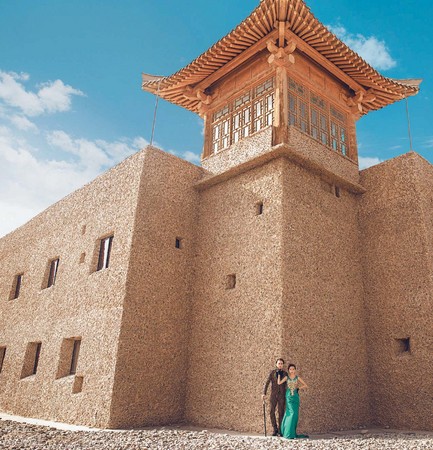
Similar to the recent trend of “island weddings” popularized by celebrities, more and more couples are now traveling to cities in Gansu Province such as Lanzhou, Jiuquan, and Dunhuang to take wedding photos. Against backdrops of rugged rocks, withered trees, and sand dunes, their bond seems even stronger and more enduring.
Aside from the popular “Mingsha Mountain · Crescent Lake” scenic area, off-the-beaten-path spots near Dunhuang—such as the otherworldly “Devil’s City” Yadan National Geopark, the grape pergolas of Yangguan Town, and the legendary Sky-Horse Pools (Wowa Pool)—have also become sought-after locations for wedding shoots, serving as unique pre-wedding stops for couples about to tie the knot.
Additionally, Dunhuang offers unique borderland tourism resources, allowing couples to engage in a wide range of activities beyond their initial expectations—a border adventure that is both an exploration and a quest for “love,” depending on how the two of you design a sweet and memorable itinerary.
Yadan Geological National Park: Dancing with the Devil
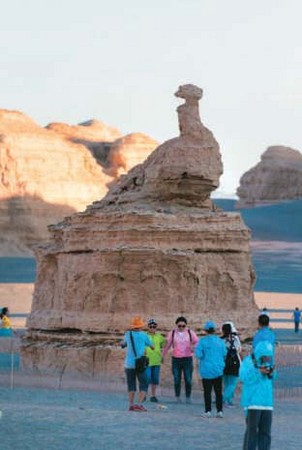
Commonly known as “Devil’s City,” Yadan National Geopark is a uniquely fascinating destination on the outskirts of Dunhuang. It features a variety of landforms shaped by water erosion, wind-carving, and landslides, with giant rock formations often taking on bizarre and striking shapes.
Holding hands and watching the brilliant sunset in “Devil’s City” is an intimate and private delight for couples.
Price: RMB120
Note: The location is remote; it is recommended to hire a private car. However, once inside the scenic area, you will need to transfer to a dedicated sightseeing vehicle.
Riding Camels, Sailing on the Road
As the Western saying goes: “There are three things in this world that cannot be hidden: love, smoke, and a man riding a camel.” Perhaps drifting smoke is hard to conceal, but a man on a camel appears even more majestic; as for love, it combines the softness of the former and the strength of the latter.
Compared to other leisure activities in the “Mingsha Mountain & Crescent Lake” scenic area, riding camels is a highly cost-effective experience. Guided by staff, the entire caravan of camels proceeds like a well-disciplined army, slowly trekking over undulating dunes of yellow sand. By the end of the ride, any restlessness or frustration will drift away with the wind and the echoes of hoofbeats.
Location: Mingsha Mountain and Crescent Lake Scenic Area, accessible by taking Bus No. 3 from downtown.
Price: RMB100 per ride

Share
This article is published by HowToTrip. Sharing and reposting are welcome — please credit the source.
Article URL: https://www.howtotrip.net/views-9526
Related Articles
- Shaoxing's "Grandpa Gourd" hangs the gourds back up: "If there are too many people, we'll interact less — just take a quick look from afar"
- Chinese authorities announce "reciprocal adjustment" to Japan visa fees — single-entry visa jumps from 2,250 to 16,750 yen!
- The "health stones" carried by a traveler were found to have radiation levels exceeding safety limits by a thousand times, potentially endangering fellow passengers on the same flight. Customs issues warning!
- Shenzhen Airport Issues Late-Night Notice: Unidentified Aerial Object Detected, Causing Widespread Flight Delays!
- “They only said it cost money after I opened the box and washed it!” 200g of grapes sold for 60 yuan on a high-speed train—12306 responds!
- Can't buy an airline ticket? Denied exit? Blocked from boarding? A large number of Chinese tourists have mysteriously become "discredited individuals"
- Adverse weather and economic fluctuations impact Colombia's coffee market
- Beach bathing area responds to 2 yuan/30 seconds fee for freshwater foot rinsing: Clearly priced!
- Taking off with an improperly closed cabin door? Wing malfunction? Multiple flights made emergency returns mid-journey!
- Experience the gifts of nature! A countdown of the world’s ten most stunning coastlines