A Japanese bar specializing in sake with various side dishes featuring Matsusaka beef

Text/Photos byUnrestrained (pen name)
As the weather turns cooler and cold fronts sweep southward, it's not only a great time to nourish your body but also perfect for enjoying a little drink. If you're in Japan, nothing beats sipping on authentic Japanese sake to warm up. As you get tipsy and chat away with friends about anything and everything, it’s simply delightful—just thinking about it feels comforting.
On this trip to Dotonbori in Osaka, Unrestrained visited a sake-focused bar called “Sake bar M300.” Not only is the sake delicious, but the side dishes, mainly featuring Matsusaka beef, are exquisite and tasty. The staff are incredibly warm and welcoming, with many of them being Taiwanese too. The head chef even treated Unrestrained to two pieces of Matsusaka beef sushi rolls—it’s such a friendly place that Unrestrained felt compelled to share it with everyone.

The location of “Sake bar M300” is excellent, right by the Dotonbori canal. Next door is Ichiran Ramen, a must-try for Taiwanese visitors to Japan, as well as the famous retail chain—Don Quijote. If you’re strolling along the Dotonbori canal, you’ll easily spot Sake bar M300.
Actually, the first floor houses “Sake bar M300,” while the second floor is a Matsusaka beef yakiniku specialty restaurant called “M’s Yakiniku.” Both belong to the same dining group, “Matsusaka Beef Specialty M,” but they have different concepts, hence the separate names. Both names are displayed on the signboard. The yakiniku upstairs also focuses on Matsusaka beef, and it’s said to have quite good reviews.

▲ Signboard and exterior of Sake bar M300 (Photo/Matsusaka Beef Specialty M Facebook)
Walking past the colorful Dotonbori riverside, you climb the stairs to Sake bar M300, where the entrance curtain has a very Japanese vibe.

The interior is mainly decorated in wood tones and can only accommodate 12 guests, all seated facing the counter so you can clearly watch the chefs prepare the food. Though the space is small, it allows for more interaction between customers, staff, and the chefs behind the counter, adding a touch of warmth to the dining experience.


Next to the seats is a large transparent refrigerator filled with all the sake varieties the bar offers.

If you line up all the different types of sake, it looks like this—wow, what a sight.

Since it’s a sake bar, naturally, the various types of sake are the highlight. You should definitely try a few. If you’re like Unrestrained and not very familiar with sake but just want to sample a bit, you can order a combo that lets you try three different kinds of sake (as shown in the menu below), which is also a popular option recommended by the staff.
● ETtoday News Cloud reminds you: Don’t drink and drive, and don’t drive after drinking.

If you prefer to order a single type of sake, that’s also possible. You can ask the staff for recommendations, and the professional servers will explain in detail the origin, brewing method, and flavor profile of each sake. They also speak Chinese, as there are many Taiwanese staff members here. If you’re not in the mood for sake, the bar also offers other alcoholic beverages (like beer, whiskey, or fruit wines) as well as non-alcoholic drinks.
The set of three small cups of sake that Unrestrained ordered included these three varieties. The staff presents the selected sake in front of the customer, arranges the glasses neatly, and then pours each one to show you—a performance that felt quite novel to not-so-frequent drinker Unrestrained.


The alcohol content of the three sakes is around 13% to 15%. From right to left, the taste shifts from dry (kan) to sweet (amakuchi). The white one on the far left is nigori-zake (unfiltered sake), which is a type of sake. Regular sake is filtered twice, while nigori-zake is filtered only once, giving it a milky white appearance, with some rice sediment, a richer texture, and a sweeter taste.

All three are very smooth and delicious, with sweet flavors that many women are likely to enjoy. The sake trio menu changes periodically, and the bar also displays the options at the counter for customers to reference.

After a few sips, thoughts naturally turn to side dishes. As part of a Matsusaka beef specialty restaurant group, there are plenty of popular side dishes centered on Matsusaka beef, and not ordering any feels almost like a missed opportunity.
The “Grilled Matsusaka Beef Sushi” was the most impressive among the dishes we ordered this time. Though it was also the most expensive at 480 yen per piece, it was absolutely worth it.

The Matsusaka beef is lightly grilled with a torch for just a couple of minutes, resulting in a rare to medium-rare doneness. The slightly charred surface still reveals the beef’s tender red hue. One bite and you’re met with soft, juicy meat, evenly distributed fat, and a slight springiness. Paired with the sushi rice, it’s satisfying enough to enjoy in its pure, minimally seasoned form—highly recommended.
Next up is another delicious Matsusaka beef sushi, generously given to us by the head chef. Just looking at it is a feast for the eyes. Priced at 350 yen per piece.

The marinated and grilled Matsusaka beef is generously spread over a sushi topped with an egg omelet. It’s such a joy to eat because there’s so much Matsusaka beef—the flavorful meat is coated in a sweet and salty sauce that doesn’t overpower the rich umami of the beef itself.
There are also other types of Matsusaka beef sushi, such as Matsusaka beef flower sushi and Matsusaka beef box sushi, which are also great.

Aside from Matsusaka beef sushi, there are various Matsusaka beef dishes, starting with “Matsusaka Beef Mashed Potatoes” (300 yen).

Finely chopped Matsusaka beef is evenly mixed into mashed potatoes. When you take a bite, you not only get the warm aroma of potatoes but also bits of Matsusaka beef. The subtle saltiness pairs perfectly with alcohol, though it might feel a bit dry if eaten on its own.
“Citrus Soy Sauce Braised Matsusaka Beef,” 500 yen.
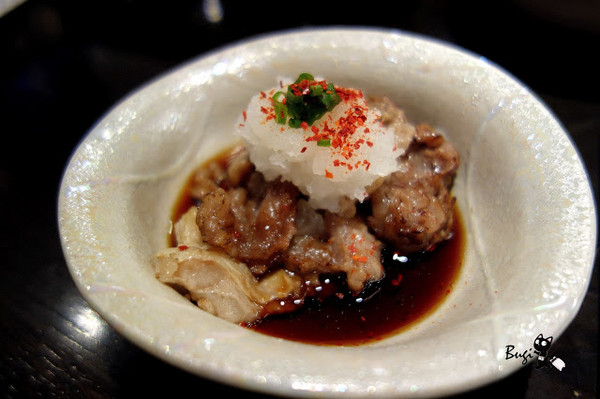
This Matsusaka beef stewed in citrus soy sauce has a hint of sweetness from the sauce, balancing sweet and savory flavors—it’s so good you could almost pair it with a bowl of rice. If you find it a bit too sweet, the grated radish on top helps cut through the richness.
The next dish is also Matsusaka beef stew (500 yen), but it’s more like a clear broth—no soy sauce is added, making the flavor even lighter. However, you can still taste the tenderness and aroma of the Matsusaka beef, which is also nice. But if I had to choose between this and the citrus soy-stewed version, I’d go with the citrus soy one.

The final drinking snack, “Grilled Squid Overnight-Dried” (300 yen), is also quite fun—a delicious and entertaining dish.

The squid used here is super small—one whole squid is only slightly longer than a palm from head to tail. When the overnight-dried squid is served, the chef also provides a small lit alcohol lamp. You grill the tiny squid over the flame before eating. The humorous head chef even demonstrated it for us personally.
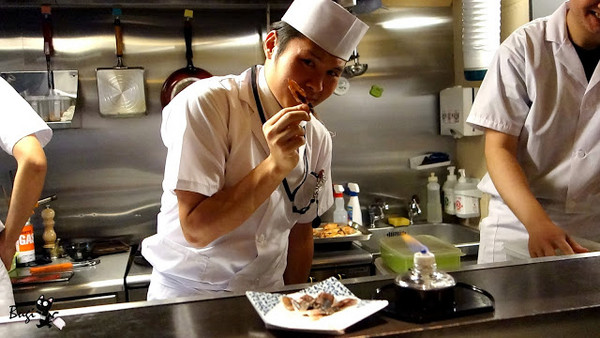
Under the flame, the little squid curls up and shrinks in size, taking about ten seconds or so. Once you see this transformation, it’s ready to eat. The flavor is salty with a slight bitterness but also carries the taste of the sea—it’s practically made to be a drinking snack (poor little squid).

That’s roughly what we ordered. While everything was delicious, what really stood out were the Matsusaka beef sushi. If I go again, I’d probably order nothing but the Matsusaka beef sushi XD.
Overall, the meal was mid-to-high priced—not super cheap—but you truly get to enjoy the deliciousness and refined quality of the food, as well as the care the restaurant puts into its dishes. The sake was great too, and the chef and staff were as friendly as friends, creating a warm atmosphere that satisfied both emotions and appetite. It’s a restaurant where you can truly relax and feel at ease.
※Related Information
Location: 1F, 7-17, Sakaemachi, Chuo-ku, Osaka City.
Located by the Dotonbori River, between Ichiran Ramen and Don Quijote.
Business Hours: 12:00–15:00, 17:00–24:00.
Menu and Pricing:http://www.matsusaka-projects.com/shoplist/sakebar_menu.pdf/

▲Sake Bar M300 Location Map (Image/Sake Bar M300 Official Website).
Want to see moreof Bujii’s solo travel experiences?
Welcome to joinBujii’s Fan PageandBujii’s Blog.
Deliciousness non-stop from morning to night.
Download the “ETtoday News Cloud APP” for the latest food info updates →
iOS:https://goo.gl/rmIDdx
Android:https://goo.gl/XPe8Uj
Share
This article is published by HowToTrip. Sharing and reposting are welcome — please credit the source.
Article URL: https://www.howtotrip.net/views-9238
Related Articles
- Shaoxing's "Grandpa Gourd" hangs the gourds back up: "If there are too many people, we'll interact less — just take a quick look from afar"
- Chinese authorities announce "reciprocal adjustment" to Japan visa fees — single-entry visa jumps from 2,250 to 16,750 yen!
- The "health stones" carried by a traveler were found to have radiation levels exceeding safety limits by a thousand times, potentially endangering fellow passengers on the same flight. Customs issues warning!
- Shenzhen Airport Issues Late-Night Notice: Unidentified Aerial Object Detected, Causing Widespread Flight Delays!
- “They only said it cost money after I opened the box and washed it!” 200g of grapes sold for 60 yuan on a high-speed train—12306 responds!
- Can't buy an airline ticket? Denied exit? Blocked from boarding? A large number of Chinese tourists have mysteriously become "discredited individuals"
- Adverse weather and economic fluctuations impact Colombia's coffee market
- Beach bathing area responds to 2 yuan/30 seconds fee for freshwater foot rinsing: Clearly priced!
- Taking off with an improperly closed cabin door? Wing malfunction? Multiple flights made emergency returns mid-journey!
- Experience the gifts of nature! A countdown of the world’s ten most stunning coastlines