Continuing from the last post, after walking along the Ganges and feeling tired, you can buy a cup of Indian tea and sit to rest on these colorful steps. You can also climb up one of the steps and wander into the alleys of Varanasi. The streets are extremely narrow, yet cows and motorcycles still manage to pass through. These winding lanes hide many surprises—you can even try Lassi here, which comes in a particularly wide variety of flavors, some topped with fresh fruit, to recharge before continuing your endless journey along the Ganges.
Sitting on the steps and taking in this view (@Varanasi, India)
It’s not hard to find stalls selling Indian tea (@Varanasi, India)
Drinking tea has become a habit for every Indian. A small cup costs INR 10, but I always end up having two to feel satisfied (@Varanasi, India)
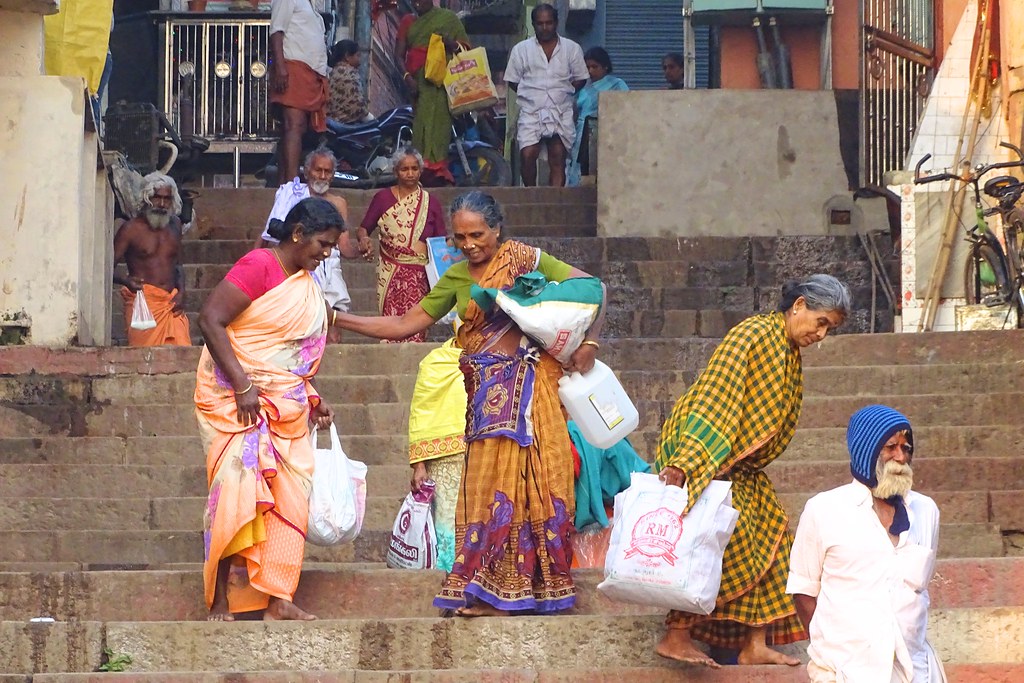 The steps by the Ganges are quite high, and Indian women—perhaps due to their body type or clothing—walk with unsteady steps, especially on these steps (@Varanasi, India)
Almost any step can lead you into a small alley. Standing on the steps, you can look down at the Ganges from above (@Varanasi, India)
When wandering the alleys, it’s essential to have Google Maps or a compass, but even if you get lost, just remember to head in the direction of the Ganges to find your way out (@Varanasi, India)
Lassi in Varanasi comes in a lot of flavors (@Varanasi, India)
This Blue Lassi shop is probably a must-visit for tourists (@Varanasi, India)
Religion plays a huge role in the lives of Indians. By the Ganges, there are temples everywhere, and you’ll often see sadhus—holy men—with long, white beards, dressed in bright orange robes and turbans, walking solemnly along the river or sitting on stones gazing at the Ganges. Some are actually waiting for tourists to take photos in exchange for a small tip. That day, I noticed a crowd gathering and went over to see what was happening. It turned out to be an elderly man dressed as a sadhu, playing a flute while two cobras danced in front of him.
This act is called “Sadhu,” which means holy man (@Varanasi, India)
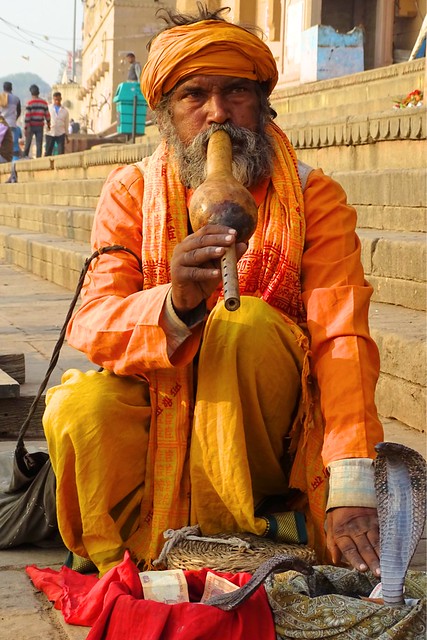
Snake charming (@Varanasi, India)
There are many stalls along the shore offering prayers and blessings. Normally I wouldn’t go near them, knowing they’d ask for money. But one evening, I was walking along the bank with a French guy, and he naively approached one. Before we knew it, the old man at the stall had painted color on our foreheads, then made us chant some scriptures or something, and then demanded INR 500. What’s the difference between that and robbery?
Stalls offering blessings along the shore (@Varanasi, India)
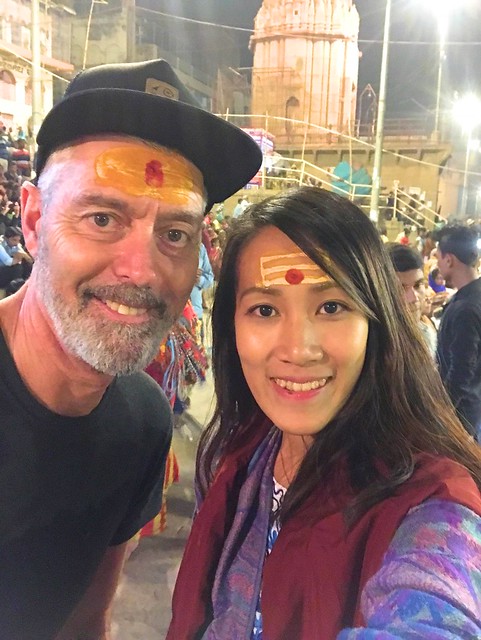
We were asked for INR 500, but in the end, the French guy actually paid INR 200 (@Varanasi, India)
Walking slowly along the Ganges not only consumes time, but as the sky darkens, the most unique experience is the evening ritual of singing praises to Lord Shiva and the Ganges. I’ve been lucky enough to witness it twice—once from a boat at a distance, and once up close. The biggest ceremony takes place at Dashashwamedh Ghat. Before it begins, the temple bells ring loudly, and the altar is already crowded with boats full of people who came to watch the ritual. Some walk between the boats selling tea or offerings. The steps along the shore are also packed with spectators. Priests bring fire to the crowd, and devotees pass their hands through the flames before touching their heads—a form of blessing and prayer. After sunset (around 5:30 pm), the ceremony officially begins. Five priests perform various rituals with fire on the altar, offering worship to the sacred Ganges. The event is accompanied by various chants, sometimes joined by the crowd. About half an hour later, the ceremony concludes, and the crowd on the shore, along with the boats on the river, gradually disperses.
Dashashwamedh Ghat is even crowded in the morning (@Varanasi,
India)
In the evening after sunset, crowds begin to gather around the ritual altar (@Varanasi, India)
The steps are also packed with people (@Varanasi, India)
Priests bring fire to bless the crowd—even seeing that I’m a foreigner, they still give me candy (@Varanasi, India)
The boats in front of the altar are also crowded, and from the boats you can watch the entire ceremony from a distance (@Varanasi, India)
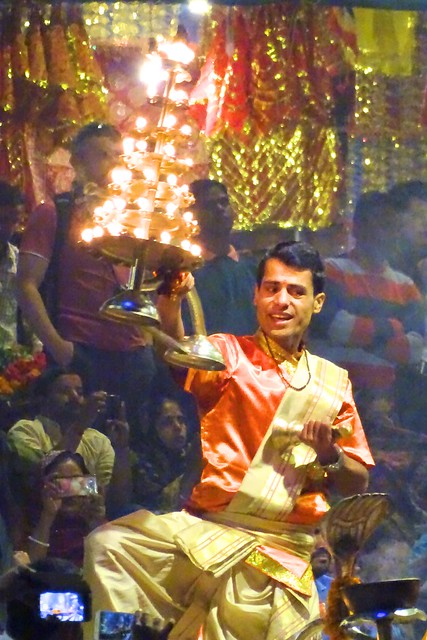
Watching the night ritual from the shore is more crowded, but you’re closer to the action (@Varanasi, India)
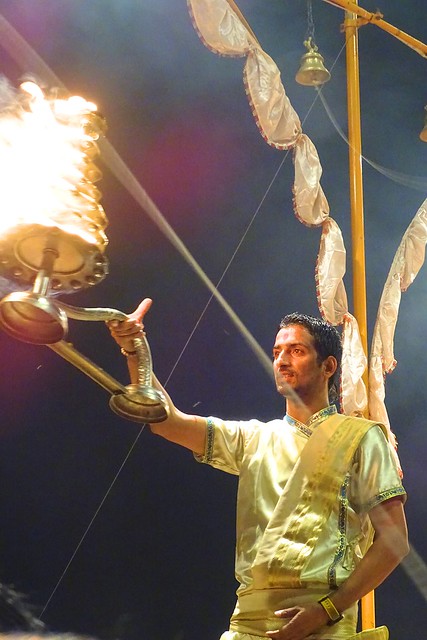
The whole night ritual is very noisy (@Varanasi, India)
Death
Even those who haven’t been to the Ganges have likely heard of the Indian tradition of cremating bodies by the river. When I saw it on TV as a child, I thought it was terrifying and dirty. While walking in Varanasi, even on bustling streets, you’ll occasionally see several people carrying stretchers, with bright orange or peach-colored cloth covering corpses. One day, I went alone to Manikarnika Ghat, the largest cremation ground by the Ganges.
View of Manikarnika Ghat from the boat—it’s the largest cremation ground in Varanasi (@Varanasi, India)
I heard the boatman say it takes two boatloads of wood to cremate one body (@Varanasi, India)
If no one told you, you might think the burning piles were just garbage. The cremation ground is crowded with people—some are even leisurely sipping tea, with goats, cows, and dogs wandering about. Bodies are brought to the site and sometimes, if there’s no pyre ready, they’re simply laid on the trash-covered ground and left waiting. The pyres are built with piled wood. When the bright cloth is lifted, the bloodless, stiff body underneath is revealed, wrapped in simple white cloth. It’s placed on the pyre, more wood is added on top, and the fire is lit. Standing close to the cremation ground, you can’t help but tear up from the smoke. Workers continuously pile on more wood, afraid the fire isn’t burning hot enough. Two hours later, the body turns entirely to ashes and is scattered into the Ganges, completing the sacred funeral.
The crematorium conducts the most funerals in the evening. Please note that out of respect, close-up photography is not allowed at the crematorium (@Varanasi, India)
That was the closest I've ever been to death, yet surprisingly, I felt no sadness or fear, because the atmosphere here made it all seem perfectly normal. In our culture, we tend to avoid talking about death—people steer clear of funerals and cemeteries, let alone casually walking into a crematorium and getting up close with dozens of bodies. The older generation in Hong Kong would definitely say “bad omen.” But isn’t birth, aging, sickness, and death just a natural part of life? Watching the bodies being ruthlessly burned, no one cared who the person was in life—rich or poor, good or bad, beautiful or ugly—before death, everyone is just a body. The shell turns to ashes and is scattered into the Ganges. Indians believe the Ganges can carry the soul into reincarnation, entrusting the unknown afterlife to this sacred river, completing a life that revolved around the Ganges.

If you like my articles and travel shares, please Follow my IG & FB!!!
Instagram: @mandykmli
Facebook: Where My Heart Goes – 小旅人文迪 (Wendi the Traveling Storyteller)
Blog: http://mandykmli.wordpress.com/