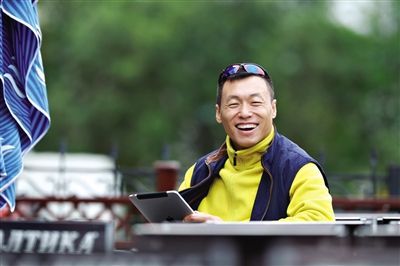
Hou Bin was born in the 1970s in Jiamusi, Heilongjiang Province, and lost his left leg in an accident at the age of nine.
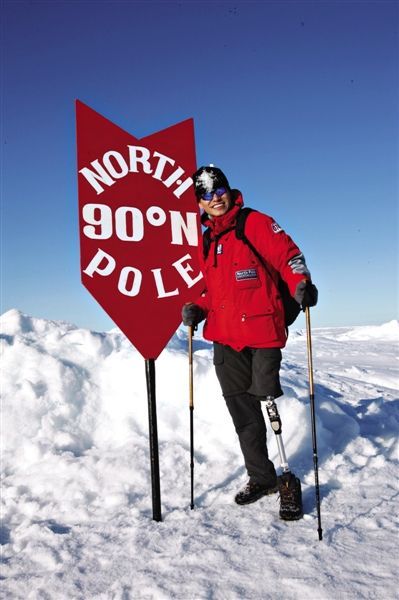
In August 2012, Hou Bin reached the North Pole.
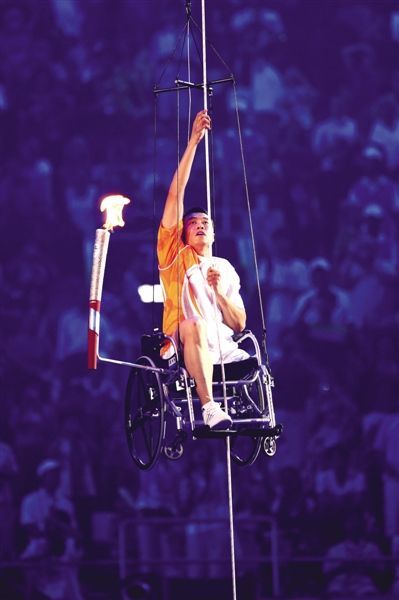
At the opening ceremony of the 2008 Beijing Paralympic Games, Hou Bin pulled himself and his wheelchair up to ignite the Paralympic cauldron using only his hands.
■ Explorer Profile
Hou Bin was born in the 1970s in Jiamusi, Heilongjiang Province, and lost his left leg in an accident at the age of nine. After working as a repairman in a welfare factory for three years, he began professional high jump training in 1993 and went on to become a triple Paralympic world champion in high jump. He ignited the cauldron at the opening ceremony of the 2008 Beijing Paralympic Games, served as an ambassador for the International Paralympic Committee, and delivered over a thousand motivational speeches. In 2011 and 2012, he participated in desert and Gobi trekking races and Arctic expeditions, respectively, and plans to set foot on Antarctica this November.
After 165 consecutive climbs and 169 movements, Hou Bin pulled himself up using a rope to ignite the main cauldron at the 2008 Beijing Summer Paralympics. The process was brief yet seemingly endless, and the moment has been replayed countless times. “But few people know that for the previous three Paralympics, I requested not to participate in the opening ceremony because I didn’t want it to affect my performance,” said this man from the northeast. “Sometimes life is truly interesting. What you lose earlier, if you work doubly hard, will be doubly rewarded later.”
““The road is always open—there are paths everywhere.”
Twenty years ago, Hou Bin was still working in a welfare factory in Jiamusi. “Back then, we generally thought there were only three things disabled people could do: massage, watch repair, and shoe repair. I did odd jobs in the factory and learned to fix watches.” There were many disabled people of similar age at the factory, some even in better physical condition. Hou Bin suggested, “Why don’t we try practicing sports?” No one else thought it was a good idea, so Hou Bin started training alone at the Harbin Sports School.
Hou Bin chose a discipline he liked: high jump. At the time, he didn’t even know whether the Paralympics had such an event. For someone who had lost a leg, it might be the most challenging event. He recalls the bitter winter days, when it was freezing cold and he often had only the gatekeeper and a mouse for company. “For four or five Spring Festivals in a row, I took the train back to Jiamusi on New Year’s Eve. There was a big clock outside the train station, and I arrived just as it struck six in the morning. When I got home, my mom had dumplings ready for me...”
In 2008, on the day of the Olympic Games opening ceremony, Hou Bin visited children with limb disabilities at a rehabilitation center in Sichuan. “Their mood was particularly low at the time. One little boy had lost a leg, just like me. I love talking and laughing, so I chatted and played with them.” After the Paralympic opening ceremony, as an ambassador for the International Paralympic Committee, Hou Bin gave thousands of motivational speeches, speaking at the United Nations and many schools for children of migrant workers.
Hou Bin is good at storytelling. “I don’t use scripts. Most of the time, I speak spontaneously, just plain words.” He often tells children, “The ones who reach the podium or the finish line are often not the ones with the best external conditions. I’m only 1.80 meters tall, and my physical conditions weren’t great for high jump. Paralympic events usually have no audience and no prize money, but I just kept practicing and practicing.” In fact, in 2008, there was another candidate to light the Paralympic cauldron. “He was better than me in every way, but I was more proactive than him.” His personal experiences offer many lessons: “Many people think their lives end when their sports career ends. But the road is always open—there are paths everywhere. I only have one leg, yet I’ve walked so many paths...”
“Go to the moon? They haven’t started selling tickets yet.”
“Don’t set too many obstacles for yourself.” This is something Hou Bin often says. In 2011, he participated in a 120km Gobi trekking challenge. “While walking in the desert, I got lost. Later, I realized that if I hadn’t taken that path, I wouldn’t have experienced the beauty and hardships along the way. Your feelings are so different from those who reach the finish line—you might as well be from a different generation. That’s why I signed up again this year.”

In May 2011, Hou Bin trekked across 112km of barren, desolate Gobi desert in Gansu, facing winds up to force 7.
Based on his physical condition, Hou Bin decided to hike for four days at a time, covering five or six kilometers per day, and complete the journey over five years.
In the desert and Gobi, with temperatures nearing 40 degrees Celsius, strong winds, unquenchable thirst, hidden camel thorns, blinding sandstorms, and endless dunes leading travelers astray, Hou Bin’s prosthetic leg initially couldn’t bend in the Gobi wind and sand, and later the joints failed, making walking impossible. “Every step I took, I fell, like a penguin,” rolling down dune after dune. “Even I thought it was spectacular.” During breaks, he would sit on a sand dune, clearing sand from the joints of his prosthetic leg. “Looking around at the barren landscape, with millennia of Gobi winds swirling, I still thought my country is so beautiful—beautiful in its aspirations.”
Hou Bin also went to the Arctic and is preparing to go to the Antarctic. Someone joked, “When are you going to the moon?” The cheerful man from the northeast replied, “They haven’t started selling tickets yet.” He weaves his travel stories into his speeches and quotes a famous line: “From today on, be someone who notices happiness. Be self-reliant, healthy, driven, helpful, and travel the world...” He laughed and said, “CCTV should interview me—I think I’m pretty happy.”
■ Explorer Dialogue
“My story might influence something.”
Reporter: Choosing sports means most people remain unknown, and putting in a lot of effort doesn’t necessarily earn you a medal.
Hou Bin: Not everyone in the military becomes a general either. I went through such tough training—an experience most people can’t imagine—and you discover your own huge potential. For many years, I performed in front of empty stands, but I feel life is an ever-evolving stage.
Reporter: Your speeches are full of positive energy.
Hou Bin: I often tell many Olympic champions, “You can share your Olympic story—come give a speech.” I see more positivity, spread more positivity, and get more in return. It’s a virtuous cycle. Don’t complain; push things in a positive direction. I also hope more people will care about the disabled.
Reporter: Do you think society pays enough attention to the disabled?
Hou Bin: The disabled are a large group in society, but their voices are too few. Public services for the disabled are improving, but attention is still lacking. I think the first step is understanding this group.
Reporter: How is the feedback from your audiences?
Hou Bin: Many people love listening to me. I love talking and telling stories—I’ve come this far step by step. I remember during a competition, my shoes weren’t good, and a friend bought me a pair from abroad. It was a small thing for him, but for me, it’s something I’ll be grateful for forever. Today, when I tell a child my story and give them a book, it might influence them somehow.
"If my leg is gone, so be it—I'm a Transformer."
Reporter: You mentioned that one of your dreams is to travel the world.
Hou Bin: Yes, I love trying new things and taking on challenges. I told my friends, "Let’s go to the Arctic." They all said, "But it’s so cold—how can we go?" So I just signed up myself. It’s a deep experience, with an element of adventure too. I even swam in the icy water—out of over a hundred guests, only about a dozen dared to jump in. I also climbed up a craggy mountain; many said I wouldn’t be able to get down. For some, it’s sightseeing, but others can find a sense of struggle and challenge in it. The outdoors is amazing—I’ve found that once people take their first step into outdoor activities, they often end up loving it, and their worldview and lifestyle undergo positive changes.
Reporter: Would you consider yourself a social activist now?
Hou Bin: Well, there’s certainly no shortage of activities. I’m about to attend the opening ceremony of the Shanghai Film Festival and walk the red carpet. Then two autism support centers in Shanghai have invited me to give speeches. Mostly, the parents are emotionally very fragile, so I go to talk with them and have heartfelt conversations.
Reporter: Do all these social activities affect your personal life?
Hou Bin: I feel the essence of life hasn’t changed, nor has the ordinary daily life. My professional identity is evolving, and I feel happier than ever. When I get home after events, I actually feel really energized about mopping the floor, ha. How to put it... I guess I’m still a bit restless—I need to reflect on that.
Reporter: Are you an especially optimistic person?
Hou Bin: Yes, there’s a saying: Whether life is wonderful or not doesn’t depend on whether it’s complete, but on being able to stay optimistic and live joyfully even with imperfections. One day, my son was playing on my prosthetic leg and suddenly said, "Dad, your leg is gone." I felt a real emotional whirlwind inside. But my leg is gone—so what? Accept it, adapt to it. Sometimes I’ll say to my son: I’m a Transformer.