Chen Penbin was born in 1979 into an ordinary fishing family in Beishan Village, Jishan Township, Yuhuan County, Zhejiang Province, and had only a primary school education. Since taking up extreme cross-country sports, he has won all domestic competitions and was the first Chinese to participate in one of the world’s toughest cross-country races — the Sahara Desert Marathon — and complete it. He is also the first Chinese to grace the cover of the American magazine Outside.
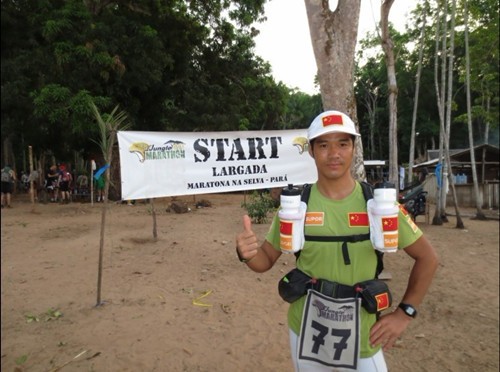
Chen Penbin has been dubbed various titles such as “Endurance Maniac,” “Extreme Sports Expert,” “King of Endurance in China,” and “Ironman of China.” Netizens in China’s outdoor community call him a “folk hero dedicated to his dreams.” As a fisherman with ten years of experience, Chen once described himself this way: “I am a man with dreams.”
Chen Penbin truly embarked on the path of extreme sports after a local sports competition in his hometown. At the age of 21, he did 438 push-ups in one go, shocking everyone present. From then on, he gradually felt the passion and joy of extreme sports. His innate endurance, combined with scientific and rational physical training, enabled him to excel in various outdoor challenge events.
Starting in 2001, Chen Penbin participated in various TV Guinness Challenge competitions. Carrying a 75-kilogram sandbag up 220 steps, carrying 5 gallons of space water while power-walking for 14 hours, “tire races on water,” and a full marathon in leather shoes... After 2003 came a continuous stream of international and domestic mountain outdoor challenges, Ironman races, and endurance competitions. In more and more competitions, Chen Penbin’s extraordinary endurance was repeatedly demonstrated. In 2009 alone, he won 26 championships in various outdoor endurance races.
In 2010, Chen Penbin began challenging the Seven Continents Super Endurance Runs, such as hiking 250 kilometers across the Xinjiang Gobi. In April 2011, he crossed the Sahara Desert in the Morocco Hell Ultra Marathon. Just two months later, he completed the 100-mile Western States Endurance Run in the United States with an outstanding time of 28 hours and 33 minutes. Entering 2012, Chen Penbin’s race schedule became even more astonishing: within just 20 days, he successively participated in the 241-kilometer Australian Endurance Race, the 246-kilometer Spartan Trail Ultra Marathon in Greece, and the Brazilian Amazon Jungle Super Marathon, achieving excellent results in all. Faced with Chen Penbin’s packed race schedule, many netizens began calling him the “Stainless Steel Man.”
“I’d Be Bored Without Competitions”
Participating in outdoor challenge races requires not only exceptional physical strength and endurance but also substantial funding and equipment. For Chen Penbin, whose life is not affluent, even with prize money from various competitions, it is difficult to gather the funds needed to compete. “If you think athletes competing in the world’s toughest marathons receive generous prize money, you’re wrong,” Chen Penbin admitted.
In past years, the prize money for these competitions could only be described as pitiful — the men’s champion received only 4,600 euros, the women’s champion 2,800 euros, and the team first place 3,200 euros. Compared to the nearly 10,000 euros in total expenses for training, transportation, equipment, and registration fees that many athletes invest, this amount is negligible. It’s worth mentioning that the registration fee also includes the cost of repatriating the athlete’s body. Chen Penbin believes that after seeing the organizer’s competition rules, many people would not risk their lives no matter how attractive the prize money. The athletes who take part do so purely because they love the sport.
Behind a series of astonishing achievements, Chen Penbin has been battling injuries. Since his first participation in the Seven Continents Extreme Endurance Grand Slam, he developed knee problems. Over the past three years, he has competed while undergoing treatment. “Competing is a part of my life. Without competitions, I’d be bored. Traveling to different places for races has shown me how big the world is and made me realize that in our short lives, we should see more of the world. Whether the community pays attention to me or not doesn’t matter — I just want to be happy!” Chen Penbin said in response to questions from reporters.
The Brazilian Amazon Jungle Super Marathon was the third international outdoor extreme competition Chen Penbin participated in since 2012. After six days of trekking, he crossed 254 kilometers of the Amazon tropical jungle and won second place, just one step away from setting a world record. After participating in three super marathons across three continents with a total distance of over 600 kilometers within 28 days, Chen Penbin only needs to complete a 100-kilometer cross-country event in Antarctica next year to become the first Chinese to complete top-level super marathons on all seven continents. Regarding this, Chen Penbin stated that although his left leg has been injured and he may face some challenges in the icy snow, he will make adequate preparations, bringing enough treatment medications and tools, and continue to challenge the Antarctic cross-country race next year.
After being nominated for the “2011 CCTV Sports Personality of the Year Award,” Chen Penbin once said: “For me, running is not just a hobby but also a part of life. It has enriched my life experiences, making life more colorful.” For Chen Penbin, winning a few more world championships and returning to his hometown in his later years to look at photos and recall his younger self is his simplest life plan. As Chen Penbin put it: “Nothing else can attract me besides running. Actually, I’m quite a typical homebody, aren’t I?”
What Is an Ultra-Marathon?
Sports physiologist David Blair defines an ultra-marathon as any running race that exceeds the standard marathon distance of 42.195 kilometers. Generally speaking, ultra-marathons have a standard minimum distance of 50 kilometers, with no upper limit.
The history of ultra-marathons is actually much earlier than that of standard marathons, but it has only been recognized by the International Association of Athletics Federations (IAAF) in recent years. In 1991, the IAAF officially recognized the 100-kilometer ultra-marathon as a regulated event. Since then, the 100-kilometer marathon has replaced the traditional marathon as the longest certified long-distance running event by the world athletics governing body. Meanwhile, the IAAF also sponsors its affiliated International Association of Ultrarunners annually, organizing the annual IAU 100-Kilometer World Challenge.
Under the same competition definition, ultra-marathons can be further divided into different types. Typically, they are divided into two categories — fixed time and fixed distance races. As the name suggests, fixed distance refers to a set running distance for participants, with rankings determined by the time taken to complete the course. Fixed time races determine rankings based on the distance covered within a set period (which could be 24 hours, 48 hours, 6 days, or more).
Journey running is another form of ultra-marathon that no longer takes the form of a competition. Journey runners often go solo, covering greater distances, and follow their own set plans, such as how many kilometers to run each day. Representatives of this type of runner are transcontinental runners, who typically aim to cross countries like Canada, the United States, or Australia.
Megarunners are the outliers among ultra-marathon athletes. They are not famous for being the fastest or covering the greatest distances, but for the sheer number of races they participate in. Henri Gautier from Nantes, France, is one such person — he has participated in over 200 marathon races with distances of 100 kilometers and above.
■ Common Ultra-Marathons Around the World
1. Morocco’s Marathon des Sables
The Marathon des Sables in Morocco takes place over six grueling days in harsh desert conditions, covering a total distance of 156 miles — equivalent to six standard marathons. The longest single stage reaches 52 miles. It is considered the most grueling marathon in the world. During the race, participants must carry all personal belongings and food in their backpacks. In the 2007 edition of the desert marathon, two participants tragically lost their lives during the event.
2. Arctic Marathon
The Arctic Marathon requires participants to run entirely across the frozen Arctic Ocean.
3. Tibet Marathon in India
The race is held at an altitude of nearly 11,500 feet, making it the highest-altitude long-distance running event in the world.
4. Badwater Ultramarathon in Death Valley, Nevada
This race starts at Badwater, the lowest point in the Western Hemisphere at 282 feet below sea level, and ends at Whitney Portal, which sits 8,360 feet above sea level. Winners typically complete the course within 24 hours.
5. Jungfrau Marathon in Interlaken, Switzerland
Participants in this race must climb 5,960 feet along a 26.2-mile route.
6. Sahara Desert Marathon in Egypt
The Sahara Desert Marathon covers a total distance of 241 kilometers, mostly over rugged terrain including gravel plains, rocky plateaus and mountains, dried-up lake and river beds, as well as sand dunes. Competitors have to run under the scorching sun with a week’s worth of heavy supplies on their backs in temperatures as high as 49 degrees Celsius, and then rest outdoors at night when temperatures can drop to as low as 0 degrees Celsius. But that’s not the most daunting part — the organizers also set minimum and maximum speed requirements of 22 km/day and 82 km/day respectively, and participants who receive intravenous drips more than once during the race are automatically disqualified. Upon registration, runners must submit a recent electrocardiogram and a medical certificate, and the registration fee is £2,000, which includes the “repatriation of remains” cost.