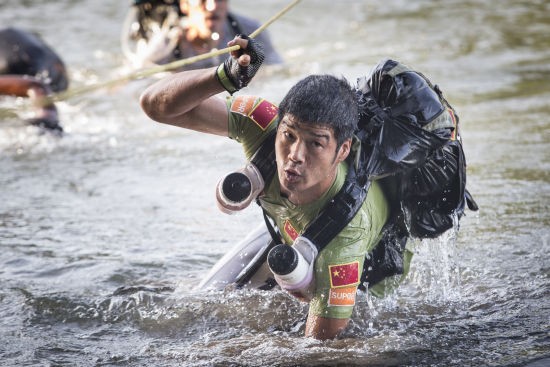
Chen Penbin wading through water during a Brazilian ultramarathon.
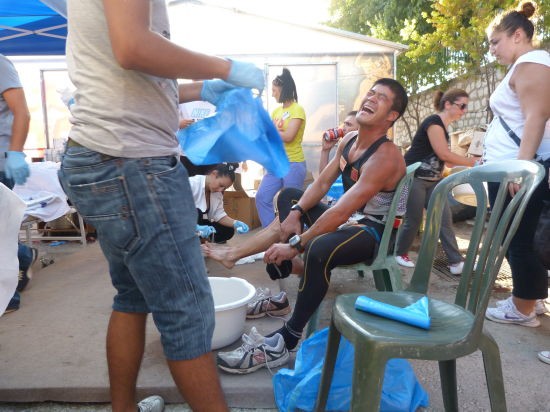
After finishing, Chen Penbin removes his shoes and socks—his soles are covered in blisters, some so severe they’ve stuck to his socks, causing visible pain.
Account by Chen Penbin
September 15, Australia: 100km ultramarathon. 7th place.
September 28, Greece: 246km ultramarathon. 51st place.
September 29, Greece’s race is one of the world’s most renowned classic events—it’s celebrating its 30th anniversary this year in honor of the marathon. Held from 1983 to 2012. Divided into 75 stages, each with a cutoff time. If you’re a slower runner, you must maintain an even pace to finish. It’s very challenging. The biggest issue: numerous mountain climbs, ascending to altitudes as high as 1,100 meters. Nights on the mountain are extremely cold, around minus five degrees Celsius. I arrived on the 24th, reached Athens on the 25th, and spent a day exploring. A young couple was there taking wedding photos—I hung out with them for the day. On the 26th, I went straight to registration and saw two people who looked Chinese. I asked if they spoke Chinese. They were Singaporean. There were so many participants, hotels were completely full, and “Polar Brother” (a Malaysian) hadn’t arrived yet, so the three of us shared a room. He was a huge help to the race. One person competed, one handled logistics, and we rented a car. Later, the logistics person ended up supporting me. The second half of the race allowed support crews.
I arrived at the start point at 4 AM—the Acropolis starting line. The race officially began at 5 AM. There were lots of photo opportunities. There were 351 runners plus support staff—it was packed. We took photos and greeted each other. I had wanted to bring a camera for the race, but the battery was dead. I didn’t follow the lead pack after the start and instead ran at my own pace—around 12 km/h, roughly 20th to 30th place. Gradually, I caught up and kept running. In the race, the 80km checkpoint had a 9-hour cutoff. Before my leg injury flared up, I was doing okay. At the 30km mark, the injury acted up. The organizers didn’t have the potato-and-salt remedy, but I had brought pills with a high salt concentration. The pain lasted about an hour before easing—I knew then I could finish. The weather got hotter, and I was running on exposed roads with no shade except for a white cap. Temperatures were over 40°C—it was simply too hot to run comfortably.
Out of 351 participants, only 72 finished. Only one-fifth completed the course. The highest number of finishers in previous years was 155, which highly depends on race-day weather. This year’s champion finished in 26 hours. Normally, it’s around 22–23 hours. The cutoff is 36 hours. By the 7-hour mark, I still hadn’t reached the 70km point. I’m used to such cutoff formats—generally, as long as you finish within the overall time limit, you’re good. I heard of people who’d entered over ten times without ever succeeding. That added a lot of pressure. During the race, I was constantly racing against the clock at each checkpoint. I’d stop briefly for drinks, worried about being late for the next one. It felt incredibly hot while running. At the 80km mark, I finished in 8 hours and 40 minutes. When I arrived, they said the cutoff was 9+ hours—I immediately relaxed, ate rice, and got a massage. But I still ended up using up my own rest time (without realizing it). After the break, I picked up speed again, gradually catching up. At every checkpoint, I kept asking: how much time do I have left? By evening, I started picking up the pace.
After the race, Polar Brother said this event was the toughest. Very few people finish. It tests your willpower. Running at night, I sped up, but my downhill shoes caused a major issue. About 200–300 meters from the aid station, the pinky nail on my foot tore off. I was wearing Solomon shoes—they’re very light, under 700 grams. A doctor bandaged and stabilized my foot. I borrowed a size 44 shoe (I usually wear 42). I was able to run again. I kept checking the time. The injured area didn’t hurt. I climbed over mountains over 1,100 meters high. At night, the winds were fierce, and the slopes were steep—I relied on my headlamp. It took over an hour to reach the summit, then I descended immediately. I kept checking the time. The Singaporean gave me a sports drink—an American brand—which helped. I ran until dawn, then into another scorching section where I could barely move.
After the final mountain, it was all downhill. Gradually, I reached flat terrain. Near the finish, I felt blisters forming on my feet—we weren’t far from the end, maybe 10+ km. I passed 8 or 9 runners. In the final 100m sprint, I gave it everything I had. The last 3km took about 30 minutes. I pushed past my limits. The final 900m felt incredibly long. I kept running, and as I rounded the corner about 100m from the finish, I caught up to someone just 20m away. I touched the Emperor’s Foot (finish monument). No Chinese had ever done this race before. There was no prize money—just a glass of water, an olive branch, and a certificate. The water wasn’t regular bottled water. The doctor made me soak my feet to prevent infection—they were extremely painful. My feet were covered in blisters. The doctor used a syringe to drain them and applied some medicine. The blister draining was agony. On September 30, I left Greece for Brazil.
Running Methods:
For long-distance races, shoes are crucial. Choose a size larger than your usual. Socks must be thick—ideally two pairs. Thick socks should be elastic and have excellent wrapping to minimize blister risk. Blister rates are much lower this way. Not every top brand fits everyone’s feet—only the right fit is perfect. Must be running shoes, not regular sneakers. Adidas has several models that become more suitable for runners’ feet over time. Solomon makes the best trail shoes—their downhill cushioning is far superior to Adidas.
Underwear. Long distances cause serious chafing. Seamless boxer briefs create minimal friction.
Headlamp. It must have a continuous 50-hour runtime. Always check the specs before buying.
Trekking poles—lighter is better.
Brazilian race: 254.43km. I finished in 39 hours. Runner-up.
On September 30, I flew directly from Athens to Brazil. I skipped the Athens award ceremony. Layover in Paris, then to São Paulo. Santarém. At the final layover, I met someone carrying a race bag—I followed him. He took me to a hotel, where I stayed that night. On October 4, at 6 PM, we gathered at the dock to take a boat to the race start. We rested there for two days. The organizers explained the rules and handed out bibs. The race officially started on the 7th. Day 1: 22.77km, Day 2: 23.38km, Day 3: 37.87km, Day 4: 37.09km, Days 5–6 combined: 108.22km, Day 7: 24.5km.
Right from the start, I was soaked. I finished all 7 energy bars. The champion used two more than me. Many runners started fast. There were river crossings, swamps, and climbs. A 2.6km stretch was extremely tough—the terrain was steep and grueling, serving as a harsh opener. Days 1 and 2: each checkpoint had a mandatory 15-minute rest. I finished 9th and 10th on Day 1—somewhat disappointed by the unexpectedly high difficulty and exhaustion. The swamps made running nearly impossible, and the climbs were brutally steep. Day 2, my overall standing remained 9th. I took my shoes off to cross the river, which slowed me down considerably. I was the second to reach the other side. I unpacked my bag, took out my shoes, repacked, and secured everything. On Day 3, I jogged slowly, sticking with the main group. Many runners took wrong turns—adding 40+ minutes. I slowly caught up and finished 9th.
Over 6 stages. During Stage 4, a stream run, my performance improved. I was utterly exhausted. In the 108.22km stage, I initially thought the route would be good and ranked around 10th—until we hit the beach and trail markers disappeared. We followed the river. Two of us ran together. The champion pulled ahead. We trekked through the jungle, crossed a mountain, descended back to the water, then to the beach—where he lost the markers again. By daylight, he followed me. After the beach, we went into the water and climbed again. For about 10km, the terrain improved slightly. Ants bit me. I had to watch both the yellow ribbons (markers) and the ground—there were roots and fallen trees everywhere. My entire body was covered in ants—dozens of them. Their bites were painful; they were large. I tried swatting them, took wrong turns, then retraced my steps. When I saw markers again, I moved on. I dealt with ants as I walked—once the pain subsided, I continued. At one point, the staff hadn’t placed markers in an overgrown area with no clear path. I wandered into thick brush and got pricked by thorns. After circling twice, I found the route on the fourth try—a gap no more than 6 meters wide. The yellow markers blended with the leaves. On Day 6, I exchanged leads with the champion and we reached the finish line together. By the final day, I knew the runner-up spot was secure.