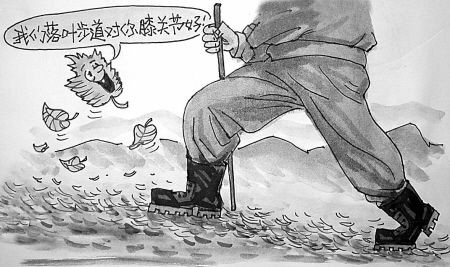
Hiking trail cartoon. Illustrated by Ding An.
In recent years, as urban residents’ demand for hiking and fitness has grown stronger, more and more people are venturing out of cities and into the mountains to engage in outdoor activities such as hiking, trekking, trail running, and stream tracing. Since Ninghai County in Ningbo built the country’s first national hiking trail system at the end of 2009, counties (cities) and districts have shown great enthusiasm for constructing hiking trails and walking trails. Yinzhou, Yuyao, and Fenghua have all built hiking and fitness trails, while Jiangbei, Beilun, Zhenhai, and Cixi have also developed their own distinctive hiking and walking trails based on local characteristics. It is understood that all 20 of Ningbo’s top tourism towns are building their own walking trails.
Although trail construction is booming, some officials from the city’s outdoor sports association have expressed concern: the enthusiasm for building hiking and walking trails is a good thing, but without scientific guidance and relying solely on enthusiasm—fully hardening these trails with materials like stone and cement—could lead to well-intentioned but counterproductive outcomes.
A person in charge of the Beilun District Tourism Bureau reported that after several months of participating in hiking activities, he unexpectedly developed knee joint effusion and unbearable pain. Similarly, a cadre from the publicity department of Fenghua City, who enjoyed hiking for fitness in his spare time, had to stop hiking after several months due to knee pain. According to analysis by relevant individuals, a significant reason for this is the severe impact on the knee joints caused by frequently walking on hardened surfaces like stone steps and cement stairs. A retired official from the Ningbo Forestry Bureau, who had been hiking for years, had the meniscus in both of his knee joints completely worn away. “This kind of meniscus damage is irreversible because, under current medical conditions, meniscus injuries cannot be rehabilitated through surgery or other means.”
According to Nie Jian, general manager of a Beijing-based company responsible for designing and constructing Ninghai County’s first national hiking trail system, hiking trails are different from tourist trails but can serve as an alternative. The difference is that hiking trails are minimally hardened, aiming to maintain their natural state, and can include leaf-covered trails, gravel trails, bamboo forest trails, and rock trails. “This helps minimize damage to people’s ankles and knee joints.” More importantly, Ninghai County’s hiking and fitness trail system has incorporated advanced international experience in fitness trail construction from countries such as the United States, Canada, Singapore, Australia, Japan, and South Korea. It has established a comprehensive system including personalized route selection, signage and positioning, outdoor safety rescue, and socialized services. This achieves ecological trail construction, diverse route options, unified trail signage, and full-service support. Many of these technologies were adopted in China for the first time.
Officials from the city’s outdoor sports association are calling for trail construction to be driven not just by enthusiasm, but by science and rationality. When funding the construction of hiking and walking trails, all regions and departments must conduct thorough preliminary research and preferably consult with relevant sports authorities to learn from the design concepts and scientific construction methods of trail building. “Try to avoid hardening the trail surfaces, and prioritize the protection of people’s health as much as possible from the design and construction stages.”