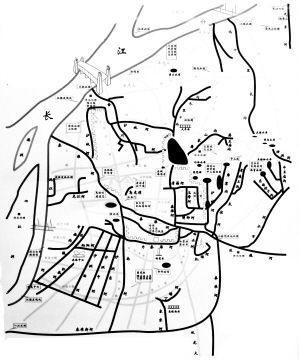
Partial Map of Nanjing Water Culture Tourism
“Flowing endlessly, the Yangtze vast; Upright forever, the Zhongshan peaks tall…” This is a Qing Dynasty literati Zheng Banqiao’s poetic description of Nanjing’s landscape of mountains, waters, city, and forests. It is well known that Nanjing has many rivers and lakes, but do you know just how many? Yesterday, a public welfare organization in Nanjing released the first hand-drawn “Jinling Water Culture Hiking Tourism Map.”
Volunteers Covered 124 Water Bodies Across Nanjing
Best Water Quality at Qinhuai River Source, Poor at Zhonghe Bridge
Mr. Ye Xiaoyu, who works in technical design, founded the Nanjing Love Journey Service Center out of his love for Nanjing’s water culture and concern for its environmental protection. From July 2011 to September 2012, Love Journey partnered with the Amity Foundation to launch the “Green Water Action.” Mr. Ye stated that the campaign aimed to promote environmental awareness, organizing citizens to participate once a month, with volunteers ranging from 80-year-old elders to kindergarten children.
At the salon, a reporter interviewed volunteer Ms. Chen, who works in finance and often participates in the “Green Water Action” in her spare time due to her concern for Nanjing’s water environment. Ms. Chen told the reporter that over the 14-month campaign, volunteers hiked and investigated 124 water bodies in Nanjing, including 72 in the main urban area, 11 in Jiangning District, 11 in Lishui County, 9 in Gaochun County, 7 in Pukou District, and 14 in Luhe District. “During our investigations, we not only picked up trash around water sources but also reported water pollution issues to relevant departments when discovered. In addition, we took water samples and handed them to water quality consultants at the tap water company’s testing department for analysis.”
In the water quality report provided by the “Green Water Action,” the reporter found that among the highly concerned Qinhuai River sections, the Baohua Mountain section at the river’s source was the area with the best water quality observed during the investigation. The water quality at Yangqiao North, Roturora Town, Xiaolong Bay, and the new and old forks of the Qinhuai River was generally good, meeting Class I or II water environment quality standards. In contrast, the water quality at Yinlong Garden and Zhonghe Bridge was poorer, meeting only Class III or IV standards.
Because the water source was fenced off with barbed wire
Wild animals darted onto the road
Volunteer Mr. Liu, a professor at Nanjing University of Finance and Economics and a participant in the “Green Water Action,” is over seventy with silver hair. Despite his age, he remains very enthusiastic about public welfare activities for protecting Nanjing’s water environment. “I’m not a native Nanjinger; I came here for work many years ago. I hope to walk around more and learn more about Nanjing’s water culture through this activity. The Green Water Action has taught me a lot,” he said.
Reflecting on the most memorable hike during the “Green Water Action,” Mr. Liu recalled visiting a reservoir at the northern foot of Zijin Mountain on April 14 of this year: “We visited the ‘Friendship Reservoir,’ ‘Shanghuangma Reservoir,’ and ‘Xiahuangma Reservoir,’ only to find all three surrounded by barbed wire—we couldn’t get in.” Reservoirs are built for public use and benefit, so why were they enclosed?
Professor Liu told the reporter that due to excessive development by real estate companies, the “Friendship Reservoir” had become a “villa area” within a protected zone. The other two reservoirs were entirely wrapped in barbed wire.
As a result, during dry spells, wild animals living on Zijin Mountain struggle to find water. The layers of barbed wire block not only public access but also the lifeblood of these wild creatures. Professor Liu expressed deep concern that many wild animals, unable to find water, stray onto roads, leading to tragic accidents where they are hit and even killed by vehicles.
Professor Liu’s observations resonated with Mr. Wang, another volunteer who participated in the reservoir survey. Mr. Wang noted that some streams near drainage outlets were filled with polluted milky-white scum, and the air carried the smell of chemical detergents. The ecological condition of these three reservoirs is not optimistic, and he hopes both the government and citizens will take action to cherish and protect the cultural and natural resources of Nanjing, this beautiful green capital.
Cultural Heritage Protection Experts Believe
The Beauty of the Qinhuai River Lies in the Word “Pō” (Moored)
The “Jinling Water Culture Hiking Tourism Map” released by the “Green Water Action” details the hundred rivers and lakes within Nanjing city and is well worth exploring by following the murmuring waters of Jinling.
Chen Hongyu, a renowned scholar in cultural heritage protection at Nanjing University of the Arts, believes that as Nanjing’s mother river and China’s foremost historical and cultural river, the Qinhuai River boasts a profound water culture. Enhancing the Qinhuai River’s visual appeal greatly helps preserve and promote its water culture.
“The culture of the Qinhuai River should not be confined to museums or community display windows,” Chen Hongyu suggested introducing a “river bus,” starting from the SanCha River at the Qinhuai River’s estuary, connecting sites such as Zhonghua Gate and Yueya Lake along the way. Using electric boats to carry passengers, this approach would not only alleviate road traffic congestion to some extent but also allow more people to experience the Qinhuai’s water culture more appropriately and intimately through boating.
During the discussion, Chen Hongyu emphasized that the beauty of the Qinhuai River lies in the word “泊” (moored). Simply walking along and looking around is not enough. The “cruise culture” of the Qinhuai has a history of nearly a thousand years, and our generation has the duty to preserve and promote this culture.