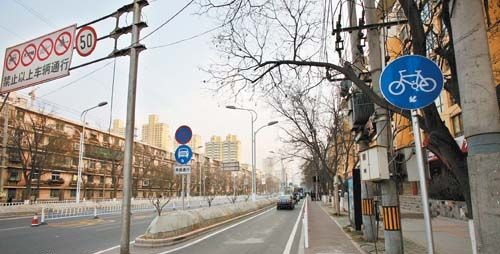
The bicycle lane on Dunhuang Road has been repurposed as a new lane, squeezing bicycles onto the sidewalk.
Discussion: Bicycles need proper roads before being deployed
On January 5, news about deploying 10,000 public rental bicycles in the main urban area and constructing dedicated bicycle lanes immediately triggered widespread online and offline discussion. On Sina Weibo, user "Your Eyes My Sea" said: This kind of transportation is indeed needed. User "Lan Shan Ye Ying" said: Deploying public rental bicycles is a good thing, but unfortunately, Lanzhou doesn’t have bicycle lanes. User "Lanzhou Fei Lao" believes: This is a good thing for easing traffic congestion and helping commuters, but the quality of citizens is also key. There are concerns that vandalism or even theft could occur within days of deployment. I think reducing bus fares is also an effective way to ease traffic — the tap-and-go fare for buses in Lanzhou is even higher than in some big cities. The current situation is that taxis are hard to hail, buses are crowded, and bicycles have no road to ride on.
"What used to be narrowing lanes have now become sections where there are no bicycle lanes at all. Bicycles need proper roads before being deployed. Also, parking bicycles is a huge challenge—some residential communities and family compounds don’t even have spaces for them." A netizen commented on our newspaper’s Weibo platform.
On-site report: Bicycle lanes in the city are disappearing, and there’s nowhere to park bicycles
On January 5, reporters walked the streets of Lanzhou and found few citizens riding bicycles. Looking around the streets, whether on sidewalks or motor vehicle lanes, cars were speeding or crawling everywhere. One passerby sighed that Lanzhou has entered the automobile era. At around 10 a.m., reporters walking from Xizhan to Anning discovered that the original bicycle lanes had been taken over by motor vehicles, and bicycle lanes had been moved to sidewalks. Due to the incomplete development of the new bicycle lanes, some cyclists had to weave through traffic.
It is understood that last year, the Lanzhou Traffic Police Brigade increased the number of motor vehicle lanes on major urban roads such as Baiyin Road and Panxuan Road from two to three, reducing the bicycle lane to just one. Similarly, on roads like Wudu Road and Gannan Road, although there are dividing lines between motorized and non-motorized vehicles, bicycle lanes are still "occupied" by motor vehicles. In addition, reporters found that many bicycle lanes have been designated as "borrowed lanes" for motor vehicle turns, leading to frequent scenarios where cyclists and motor vehicles compete for space, creating serious safety hazards.
Additionally, reporters found during visits that bicycle parking is also an issue—many residential communities and family compounds have converted their original bicycle sheds into car parking spaces. "Private car parking spaces charge high fees, bicycles are hard to secure, and the income collected is minimal," explained a property management representative from one community.
Suggestion: Prioritize planning for bicycle lanes in future road construction
Reporters noted that Lanzhou’s transportation project plan also mentions the construction of dedicated bicycle lanes. However, some citizens worry that many areas in Lanzhou no longer have space to build such lanes. "Unless we reduce three lanes to two or narrow the sidewalks—this approach of robbing Peter to pay Paul isn’t viable. But if we don’t do that, where can we find space to expand bicycle lanes?" said Mr. Wang, a resident. He believes that both pedestrians and vehicles should each have their own designated paths, which would make the city more livable and reflect urban harmony. But when the city was originally planned, these future development details weren’t fully considered, leading to ongoing road issues today.
During interviews, many citizens expressed that cycling is not only in line with health and environmental needs but can also alleviate traffic pressure—it’s a major trend toward low-carbon, eco-friendly commuting. One citizen mentioned that cities like Zhuzhou in Hunan have done this quite successfully. But in Lanzhou, many road sections no longer have bicycle lanes, which is an unfortunate reality. They hope relevant departments will take bicycle lanes into full consideration in future road planning. Some also suggested removing the green belts in the middle of roads and relocating them to create dedicated bicycle lanes.
Related News
Lanzhou’s first dedicated bicycle lane opens along the BRT route
To address traffic congestion in Lanzhou’s urban areas, the city’s transportation department plans to integrate bicycles into the public transit system to solve the “last mile” commuting problem. In fact, with the opening of the Anning BRT, Lanzhou’s first dedicated bicycle lane has also been launched.
On January 6, reporters found along the BRT route that facilities for the dedicated bicycle lane on both sides of the Anning Liujia Bao to Xizhan BRT corridor were gradually becoming complete, and many “cyclists” had begun using the route. Though only about one meter wide, the surface is paved with specially colored light red gravel, separated from the motor vehicle lane by barriers. At intervals, not only are there bicycle lane signs on the roadside, but bicycle symbols are also painted on the road surface with white paint. Bicycle parking spaces on some sections are also being installed and tested. However, it is still common to see motor vehicles parked or driving in the bicycle lane.
According to staff from the BRT Asian Development Bank Project Office, as per planning requirements, the dedicated bicycle lanes on both sides of the Anning Liujia Bao to Xizhan section—as supporting infrastructure for the BRT—have been completed and put into use. Currently, construction workers are further improving facilities on some sections.
"Although the facilities aren’t perfect and there are still many issues, having a dedicated bicycle lane is a huge step forward and truly reflects human-centered design," said Wang Guoming, who rode along the bicycle lane on the morning of January 6, speaking passionately about bicycle safety.
Regarding the launch and use of the first bicycle lane, Professor Lin Ke from Lanzhou University’s School of Management stated that citizens’ commuting methods must be diversified. As a representative of “green commuting,” bicycles should serve as an extension of rail transit and buses within the public transit system. Urban planning should strengthen the construction and management of dedicated bicycle lanes, retrofit existing transit facilities, and increase bicycle-accessible routes. To completely resolve the issue of bicycle lanes being encroached upon, illegal parking and stacking of goods in non-motorized lanes should be strictly dealt with. Only by safeguarding the right-of-way for bicycles can they truly make a comeback.