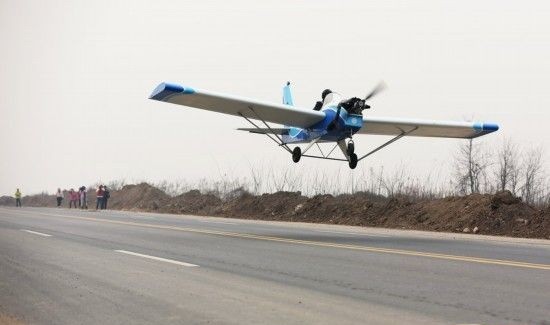
Chen Mo realizes his "flying dream"

Test flight successful
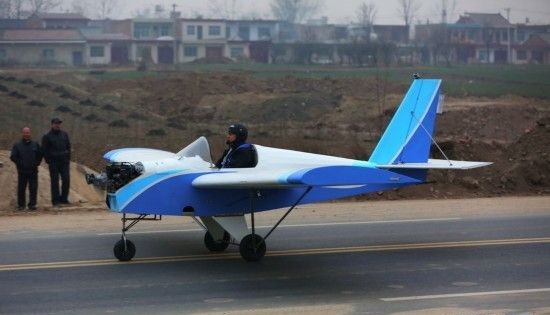
Taxiing and taking off
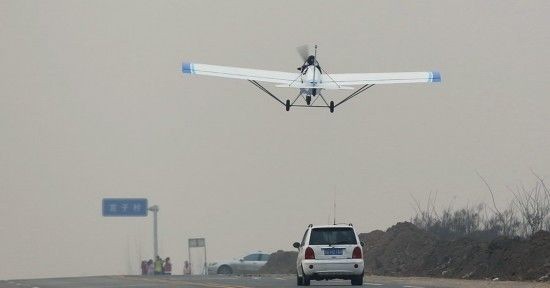
This is a wooden small aircraft named JDT Mini-Max
Born in 1989, Chen Mo is a student majoring in Aircraft Manufacturing Engineering at Northwestern Polytechnical University. He began building a wooden small aircraft named JDT Mini-Max in August 2011 and recently completed a successful test flight on an unopened road outside Xi’an West. The aircraft cost around 100,000 yuan to build, so Chen Mo had to work part-time during the summer break to earn money.
Born in 1989, Chen Mo is from Baishui, Weinan. In 2010, he was admitted to the Aircraft Manufacturing Engineering program under the Department of Mechanical and Electrical Engineering at the Mingde College of Northwestern Polytechnical University and is now a junior. Since childhood, he has loved hands-on work and has a great talent for mechanical manufacturing. He once taught himself the "Electrician’s Handbook." His childhood dream of flying motivated him to start building a wooden small aircraft named JDT Mini-Max in August 2011. He is the first college student to build this type of small aircraft, and only one other person in China has successfully built and flown this model. To build this approximately 100,000-yuan aircraft, Chen Mo had to work part-time during the summer to raise funds.
After more than a year of effort, Chen Mo’s self-built aircraft was finally completed. Starting on the 23rd, villagers near an unopened road outside the South Third Ring Road in Xi’an could see the small blue-and-white aircraft preparing for its test flight. More than ten aviation enthusiasts from across the country came one after another to help Chen Mo with pre-flight debugging.
Several people carefully pushed the aircraft from the roadside warehouse onto the road and let some air out of the tires. “This increases resistance and acts as a shock absorber.” After adjustments, Chen Mo put on a helmet and sat in the cockpit. Once the engine started, the airflow from the propeller made it nearly impossible to stand nearby. With a loud roar, the aircraft gradually began to taxi, accelerating steadily.
“Practicing taxiing is one thing, but we also need to tune the engine,” Chen Mo said. Everything needed to be checked before the test flight. For example, after starting the engine previously, the vibrations were so strong that screws on the aircraft body were found to be loose. “That’s normal, but measures need to be taken.” He then used self-locking nuts and thread-locking adhesive to secure them.
During engine tuning, another issue was discovered: the rotation speed was not ideal. “It should reach 6,200–6,500 rpm, but it’s only at 5,800 rpm.” Chen Mo analyzed that the propeller diameter might be too large. So he took it back to the lab and sawed off the excess length.
Yang Weimin is the first person in China to have successfully test-flown the same model of aircraft. He specially flew from Shenzhen to Xi’an to witness Chen Mo’s test flight. He said that this aircraft design is very mature, and he is confident about the success of the test flight. “As long as it doesn’t rain, it’s fine. No wind would be best. Wind makes higher technical demands. The weather has been good recently, so it’s a good time for the test flight.”
■ Did You Know?
The JDT Mini-Max is a real aircraft capable of flying at altitudes of over 3,600 meters. It was designed by Wayne Ison, a renowned American ultralight aircraft designer, and has proven to be a mature design. There are over 3,500 self-built aircraft of the same model flying worldwide, with a solid safety record.
According to the Civil Aviation Administration of China (Order No. 188 of the Civil Aviation Administration), under the chapter “Ultralight Aircraft,” as long as the empty weight is less than 116 kg, the speed is below 100 km/h, and it carries only one person, no airworthiness certificate needs to be applied for from the air traffic control authorities. After assembly, the JDT Mini-Max has an empty weight of about 113.4 kg, can take off at speeds of 40–50 km/h, and accommodates only one passenger, thus meeting the legal requirements for takeoff.