“Walking is too slow, driving is too fast—cycling is just right. It lets you enjoy beautiful scenery, builds your willpower, has a moderate pace, and isn’t too expensive. I think there’s no better way to travel than by bike.” On Youth Day, May 4, 2012, more than half a year after donating hematopoietic stem cells, 27-year-old Huang Haixing officially began his 26-day, 2,100-km Yunnan-Tibet cycling journey. “On the road to turning 30, I wanted to fulfill my dream and leave a mark on my youth.” The hardships and rewards this ordinary young man experienced during his Yunnan-Tibet ride will stay with him for life.
Travel Insight: “Chatting with people I met along the way and hearing their stories broadened my horizons, enriched my experiences, and made my world more colorful. These things fascinated me even more than the scenery.”
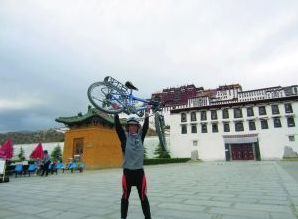
Huang Haixing proudly lifts his bicycle in front of the Potala Palace
The Story Begins
Don’t Waste Youth Without Some Madness “When you’re young, you should do something crazy and meaningful—something that’ll bring tears to your eyes when you’re old.”
Huang Haixing joined China Marrow Donor Program as a volunteer in his junior year. In May 2011, he received a call saying a patient had been matched. Initially worried about the impact on his health, he ultimately decided to donate stem cells after realizing it could save a life. After about a month of recovery, his health returned to normal, and it remains strong today. “The marrow bank staff told me the patient is doing well and I might even get to meet her this year.” For Huang Haixing, something as significant as donating stem cells seemed like “no big deal.”
Strictly speaking, Huang Haixing isn’t a seasoned cycling expert. “I started cycling in December 2010 when I bought myself a Merida mountain bike as a birthday gift, mainly influenced by a cycling friend who rode around Hainan Island and visited Yangshuo. That style of travel inspired me. I felt life should be more colorful, and young people should do something crazy and meaningful—otherwise, youth would be wasted, which would be such a pity.”
Since owning the mountain bike, Huang Haixing has cycled through Zhuhai, Shenzhen, Jiangmen, as well as border areas like Dongxing, Pingxiang (China’s southern gateway), and the Detian Waterfall in Daxin. After completing the China-Vietnam border highway by bike, he dreamed of cycling to Lhasa: “Cycling to Lhasa is definitely a memorable and worthwhile achievement. I chose the Yunnan-Tibet route mainly because I wanted to cycle around Erhai Lake in Dali, visit Lijiang, Shangri-La, see Meili Snow Mountain—all places I’ve longed to go. Also, I really dislike the Sichuan-Tibet route, which feels like a crowded market.”
So, a cycling team of three post-80s nearing 30 and three post-90s set off last Youth Day. They took a bus to Dali and started cycling from there, looping around Erhai Lake, passing through Lijiang, taking National Highway 214 to Shangri-La, then Yanjing, and after Mangkang, they rode National Highway 318 to Lhasa. After Mangkang, they passed through Rumei, Bangda, Ranwu Lake, Bomi, Nyingchi, and finally reached Lhasa. The entire journey covered 2,100 km in 26 days, and nearly everyone lost about 10 pounds by the end.
On the Cycling Road
Danger on Baima Snow Mountain: Extreme Weather Tests Willpower “Riding hungry at night, we barely made it to Lijiang by 9:30 PM, and our teammates were almost exhausted.”
On the first official day of cycling, Huang Haixing and his teammates faced a huge challenge. The 148-km stretch from Dali to Lijiang proved tougher than expected due to poor planning for the initial physical adjustment. No one realized it at first. “The teammates hadn’t fully adapted yet, and there were too many uphill sections. By 5:30 PM, after reaching Heqing County, we skipped a meal to push on to Lijiang, leading to a near-collapse during the final 40 km from Heqing to Lijiang. We rode hungry through the night and arrived in Lijiang by 9:30 PM, with teammates almost completely drained.”
While climbing the 4,300-meter-high Baima Snow Mountain, a continuous 48-km uphill section coupled with extreme weather—sleet, cold, hunger, falling rocks, and low visibility—tested everyone’s endurance. “I wanted to quit countless times and questioned the meaning of the trip, but I pushed through. That day left the deepest impression on me.”
On the night before climbing the first 5,000-meter peak, Dongda Mountain, the team slept in a room for 29 people. Other cyclists’ loud drunken behavior kept everyone awake. The next day, climbing the bumpy, 26-km uphill of over 5,000-meter Dongda Mountain, Huang Haixing experienced mild altitude sickness: “I felt extremely sleepy, had a slight headache, kept resting by the roadside, and even napped on the grass for half an hour until the symptoms eased before continuing uphill. After reaching the summit, I didn’t dare linger and quickly descended.”
People Met Along the Way
Shouting “Mom, I Love You!”
On Mother’s Day, May 13, 2012, as the group prepared to leave Nixi Township for Shusong Village, Yaojia—a usually carefree teammate—suddenly pulled out a slightly worn flag from his saddlebag with the words “Mom, I Love You!” printed on it. He said that even though he was on the road, he wanted to send his mother back home a blessing. He had made the flag before the trip, and though it was a bit tattered, the thought behind it was touching.
68-Year-Old Cyclist from Shanghai Riding to Lhasa
After descending the Nujiang Seven-Twenty Hairpins, the group rested at a roadside shop where Huang Haixing met several older cyclists from Shanghai, the oldest being 68 years old. Despite his age, he had chosen to cycle to Lhasa. Even more impressively, he had started from Shanghai, covering over 3,000 km in a month and a half. Though slow, they kept going. “At that moment, I suddenly thought—nothing is ever too late. Why shouldn’t I strive to achieve my dreams?”
The Happy Smiles of a Father and Son with Dwarfism
The 71-km uphill stretch from Baxoi County to Ranwu Lake was against the wind. “At one turn, I suddenly saw a father with dwarfism, struggling to push a child-sized bicycle with his toddler son, who hadn’t learned to walk yet. The two strolled leisurely under the sun, glancing at each other occasionally with happy smiles. Seeing this melted my heart. Amid such harsh natural conditions, this father and son radiated joy. Sometimes, aren’t we the ones asking for too much and appreciating too little?”
Travel Insights
Riding the Yunnan-Tibet Route: Joy Is the Main Theme
“Cycling gave me another life—broadened my horizons, improved my mindset, and helped me face life’s ups and downs with greater equanimity.”
The movie *Kora* also depicts Yunnan-Tibet cycling stories: A 24-year-old Taiwanese young man, in the cooling October air, sets out from Lijiang alone to fulfill his brother’s dying wish. He cycles solo across the Tibetan Plateau, averaging over 3,500 meters in elevation and covering nearly 2,000 km to Tibet. Along the way, he faces challenges like traversing no-man’s-land, nearly falling off cliffs while night cycling, dog attacks in Baxoi, and two days of vomiting and diarrhea from food poisoning. This is not just a travel film but also one about freedom and growth.
After completing his own challenge, Huang Haixing watched *Kora* and felt it accurately portrayed all the extreme hardships of cycling the Yunnan-Tibet route. But personally, he found that cycling the Yunnan-Tibet route is often joyful. “The joy of admiring the scenery, conquering one uphill after another, sharing stories with others—pain and joy coexist. That’s the biggest takeaway from cycling the Yunnan-Tibet route, and joy is the main theme.”
“Cycling not only enriched my life but also, in a way, gave me another life. Visiting different places, seeing unique scenery, understanding diverse stories—it gave me a new perspective on the world, built my resilience, broadened my horizons, improved my mindset, and helped me face life’s ups and downs with calmness. Travel truly gave me a reborn feeling.”
Private Cycling Tips
1. Physical Training: Start preparing half a year before the official departure. Run every day, gradually increasing your distance from two kilometers to five kilometers. Your body will gradually become stronger. Also, do a long ride of about 100 kilometers each week to build up endurance—train your butt to become an “iron seat” that can withstand the more than 2,000 kilometers of bumps on the Yunnan-Tibet Highway.
2. Cycling Gear: Choose a mountain bike with strong adaptability, preferably a high-quality brand, so it can perform stably on the complex road conditions of the Yunnan-Tibet Highway. I’ve seen cyclists on no-name mountain bikes on the road whose wheel spokes broke, leaving them unable to ride any further. Additionally, it’s best to bring repair tools, tire patches, rain gear, a helmet, gloves (preferably waterproof), warm and cold-resistant clothing, spare brake pads, a flashlight, and other essentials. Avoid carrying too much extra gear to keep the weight manageable.
3. Cycling Skills: Learn as much bike repair as possible before you set off—you’ll often have to rely on yourself out there. In case of extreme weather such as heavy rain or snow, it’s best to rest. Rain can trigger natural disasters like falling rocks, landslides, and mudslides, and wet roads are especially dangerous when going downhill. Be extra cautious. If you get injured or can’t ride anymore, you can flag down passing vehicles for help or call 110 for assistance. Always pay attention to road signs while cycling, keep track of your location, and make it easier for others to find you if needed.
4. Best Cycling Season: The best months to go to Tibet are May, when the azaleas are in bloom, the weather is good, and there’s less rain; September is also great, after the rainy season and before winter, with pleasant temperatures. The months of June, July, and August have better vegetation, but because it’s the rainy season, the risk of landslides, mudslides, and falling rocks is much higher. Moreover, daily rain can dampen your mood for enjoying the scenery.