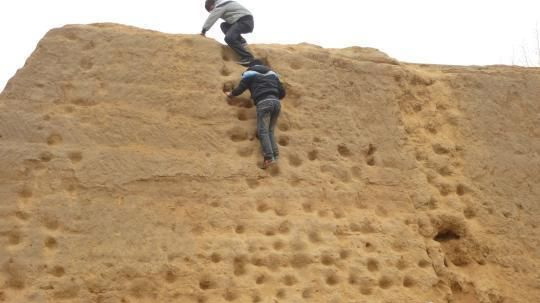
Zhengzhou’s Shang Dynasty Replica City Wall Becomes a Climbing Spot
Recently, news that the protective soil layer of the Shang Dynasty city wall ruins in Zhengzhou had become a training ground for rock climbing enthusiasts caught widespread public attention. Many netizens commented that “cultural heritage protection efforts are insufficient.” In response, Ma Yupeng, head of the Shangcheng Ruins Protection Management Office, said that the protective soil layer is not a cultural relic but part of a “protection and display project” built to replicate the Shang Dynasty city wall. “Even so, citizens should help maintain it and treat the project as if it were a cultural relic,” Ma urged.
Reporters visited the Shang Dynasty city wall ruins near the Confucius Temple in Zhengzhou, where they observed that the stepped surfaces of the protection and display project were riddled with pothole-sized indentations roughly the size of footprints. Some citizens had already climbed onto the soil layer and were descending through the holes. Due to the steep slope of the steps, the climbing was very dangerous, yet many children were still climbing up and down. No warning signs were visible near the soil layer.
A parent who was there with their child for a stroll said that since the replica wall was built last year, it has become a playground for locals. “At first, there were just a few small holes, but as more people dug and climbed around, it ended up like this.”
Liu, a student from Zhengzhou Electric Power College near the Shangcheng Ruins, told reporters that the area is surrounded by schools and residential neighborhoods, attracting many visitors. People often come to climb, and some even hold “rock climbing” competitions. “I’ve even seen people sliding straight down the slope,” Liu said. “There are inspectors who come by, but there are too many people playing here to really keep things under control.”
In response, reporters interviewed Ma Yupeng, director of the Shangcheng Ruins Protection Management Office. Ma said that staff conduct uninterrupted patrols every day. “But there are simply too many visitors, making management difficult. For some people, we can only offer education. Sometimes, as soon as we leave, others climb right back up.”
“There used to be hedges installed, but they were destroyed not long after,” Ma explained. He noted that for a long time, the ancient city wall had served as a place for locals to cool off and rest. Due to long-standing habits, protecting and managing the site has proven very challenging. “The protection and display project isn’t meant to keep citizens from visiting—it’s just not finished yet. Once completed, a wooden boardwalk will be built to facilitate public tours,” Ma said. “For now, we’ll implement some protective measures first and then work to complete the project as planned. But we still hope the public will cooperate and help protect the display project.”
Many netizens have criticized the situation. User “Xiaoguanfu” said, “Cultural relic protection is urgent.” Another, “Bapin Xiancheng,” commented, “There are plenty of places to go rock climbing—why do it on a cultural relic?”
In response, Ma Yupeng clarified that the “protection and display project” is not a cultural relic. It is part of the preservation efforts for the Shang Dynasty city wall and one of the protective measures for the Shangcheng Ruins. Although it is not a relic itself, he still hopes the public will “approach protecting this display project with the same attitude as they would a cultural relic.”
It is understood that the Zhengzhou Shang Dynasty ruins date back over 3,600 years and represent the largest and best-preserved early Shang Dynasty capital site discovered in China to date. Due to years of weathering, parts of the ancient city wall’s surface have largely disappeared. The protection and display project serves both to protect the Shang Dynasty city wall and to provide a “restorative display” of it, and is also part of the “Zhengzhou Shang Dynasty Capital Ruins Protection Plan.”
“The protection effort still relies on the cooperation of the public. We hope everyone will consciously protect the ancient city wall, the protection and display project, and the Shangcheng Ruins,” Ma Yupeng concluded.