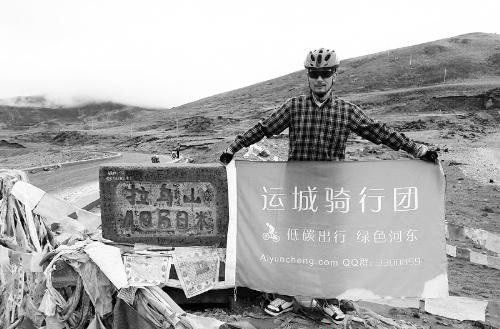
Riding a bicycle across Tibet, Li Junliang overcame countless challenges.
This is the clichéd plot of some cycling stories: a underdog young man pedals through Tibet, conquers numerous hurdles along the way, and undergoes repeated spiritual transformations in life. The key point is, after returning, this young man didn’t just tuck the experience away in his memory like many other cyclists, but instead transformed the life lessons he learned into the drive to strive forward, thus creating another entrepreneurial story.
He started a company, founded the “Yuncheng Post-80s and 90s Youth Association”; he frequently appeared on Yuncheng Literature and Art Radio to share insights and review films; he also organized two Internet Users' Sports Games; he posts positive energy content on Weibo every day...
He is “Frog Martin” Li Junliang, who inspires a group of young people to face life positively and has become a role model for many youths in Yuncheng.
An Unusual Cycling Journey
“For me, happiness is not about owning a car or a house, but about having a reason every morning at 6 a.m., when others are still dreaming, that excites me enough to jump out of bed and start working hard for the day!” Li Junliang, from Zhangjin Village, Taocun Town, Yanhu District, Yuncheng. The 29-year-old returned to Yuncheng after working in the Jiangsu-Zhejiang area and faced a life crossroads: “Use the savings from these years to buy a car and a house, then find a stable job and live the so-called happy life that others envy? Or use the wealth and experience accumulated over the years to start a business? The latter is riskier, and I couldn’t decide right away.” He wanted to do something to regain his self-confidence.
Two years ago, Li Junliang read about a fellow cyclist’s journey online and had the idea of cycling the Sichuan-Tibet route, though he never acted on it. Now, the thought resurfaced strongly. He quickly drew up a detailed travel plan and rode back and forth to Phoenix Valley, 20 kilometers from home, in the days before departure to build up his stamina.
On June 1, 2012, at Yuncheng’s Nanfeng Square, fellow cyclists came to see him off. One veteran rider’s words have stayed with him ever since: “One doesn’t get many chances in life to cycle to Tibet. Whether you succeed or not, your life will be changed by it, and the experience will make you more determined and persistent in the future.” That piece of wisdom was exactly what Li Junliang was seeking. Admittedly, he had a bit of vanity before setting off—“If I succeed, I’ll earn a certain status in Yuncheng’s cycling circle, commanding respect and admiration.” But those fleeting thoughts of vanity were soon drowned out by physical discomfort.
From Yuncheng to Chengdu, crossing the Qinling Mountains and traversing the Shu Roads, he cycled about 200 kilometers each day. The longest uphill stretch was 28 kilometers, and some sections had no guardrails. When meeting oncoming vehicles, Li Junliang, hugging the edge of the road, was just a hair’s breadth away from the cliffs below, sometimes breaking out in a cold sweat from the scare.
During the climb over the Qinling Mountains, heavy rain poured for several days nonstop. Li Junliang pedaled on in the rain, drenched to the bone. “There were few people in the mountains, and the only tool I had to fight the rain was my raincoat. The biggest torment of wearing wet clothes while cycling is the constant friction against the inner thighs, causing many small blisters, each rub adding to the pain.”
With many uphill and mountainous sections, maintaining speed required hard pedaling and sudden sprints, which caused excruciating knee pain—each push of the pedal brought a cold sweat. It wasn’t until the fourth day that the pain gradually subsided.
Li Junliang offered an alternative interpretation of this period: “It’s like going through failure. The first failure hurts a lot, but after multiple failures, the body and mind gradually become numb to the pain. When you become indifferent to success or failure and give your all, things actually become much easier.”
A Long Journey of Life
With a loud “bang,” Li Junliang turned his head to see a half-meter-wide boulder land on the asphalt road, leaving a deep crater by the roadside. Had he been half a second slower, he would have become the boulder’s victim.
Being alive—the meaning of life, first and foremost, is to “stay alive.” At that moment, scenes of what he had considered setbacks over the past 20-plus years flashed through Li Junliang’s mind like a film. “Only then did I realize how insignificant they all were. Compared to staying alive, everything else is as light as a feather.” “The outcome of a trip to Tibet comes in only two forms: it makes the determined even more resolute, or the lost even more directionless. What determines the final outcome is not the strongest part of your heart, but the weakest.”
On the first day in Tibet, the road from Batang to Markham was treacherous and complex. By then, he had parted ways with the Yuncheng cyclists and was traveling with others—Xiao Zhang from Yunnan, Lao Zhou from Nanjing, and Lao Chu from Shandong. That day, flash floods hit, and red floodwaters carrying rocks and branches roared down the road. After soldiers used bulldozers to clear rocks and mud for an hour, the debris was gone, but the flood continued unabated. Upon hearing the go-ahead to proceed, Li Junliang and others pushed their bikes and waded through the floodwaters. “The bone-chilling cold was beyond words. We moved just 100 meters in half an hour, the force of the water pounding against our legs leaving no room for anything else. Only after getting out of the flood did I realize one of my shoes had been washed away...”
A month of cycling gave Li Junliang three life insights, which he summed up in three keywords: be yourself, collaborate, and dream. These have also been the three principles he’s applied constantly in his life and work since returning from Tibet.
Be yourself. During the ride, he met three elderly men, all over 60 years old on average, fully equipped and brimming with vitality. They all mentioned: “When we were young, we were always chasing this and that, for our parents, for our children. Only when we got older did we realize we had been living for others all along. The things we truly wanted to do in our hearts were left undone for various reasons. Now that we’re retired and life at home is stable, we’ve come out to seek the freedom we missed in our youth. To truly be ourselves for once.” As they spoke, tears glistened in the old men’s eyes.
Collaborate. “Due to the complex road conditions, there were often issues like flat tires or broken chains. Fellow cyclists generously shared their spare parts. Lao Zhou from Nanjing, the most experienced rider among us, was adept at bike assembly and fixed anyone’s problems. He also checked our bikes daily. At one point, the road was washed out, and the three of us shielded one bike, got it across, then came back to help another friend.” The help among cyclists improved efficiency and ensured safety. This insight benefited Li Junliang immensely in running his business.
Dream. No matter what you lose—possessions, relationships—it doesn’t matter, as long as you still have dreams. Sky burial is a unique Tibetan custom. Li Junliang watched as a body on a cliff was torn apart and consumed by vultures... The intensity and sorrow of the scene struck him deeply. In less than half an hour, the body was gone, leaving only white bones. “Life is so brief and tiny—what do temporary gains or losses really matter? If I don’t strive to change something, I’ll be left with nothing but regret and resentment when my time is up. I might not have love or wealth, but I can’t live without dreams.” He’s a thoughtful person, and it’s this introspection that’s shaped his driven mindset today.
A “Motivated” Young Man’s Day
“Good morning, world.” Every day after waking up, Li Junliang greets the day loudly. Before sunrise, he drives his van out. Along the way, when he sees people waiting for the bus, he stops and asks, “I’m headed to town—anyone want a free ride?” People are familiar with the van plastered with his company’s logo, and a few hop on, getting off at their destinations. “Everyone is changing the world. If you do a little more for others, the world becomes a little better because of you!” He smiles the whole time. Before 7 a.m., he arrives at his window and door installation company, arranges the day’s customer installation tasks, then lists the regular clients he’ll visit, loading boxes of apples into the van. It’s a promotion he offers loyal customers—a carefully selected box of apples, plus a free wooden door maintenance and waxing service. “At year-end, besides customer follow-ups, I also communicate with distributors in counties and towns. We’ve been cooperating for over half a year, so we need to discuss plans and sales strategies for the next year and set feasible marketing plans.” He seems to have boundless energy at all times.
After visiting more than ten clients, he flips open his notebook. It’s his fourth time being a guest on Yuncheng Traffic Literature and Art Radio, talking movies with everyone, this time about “1942.” “That Pulitzer Prize-winning American journalist is the male lead in ‘The Pianist,’ and the old priest who gave Zhang Hanyu a haircut is the famous lead from ‘The Shawshank Redemption.’ How many viewers caught that?” His interactive style perks up the audience.
In the evening, back home, after dinner, he turns on his computer and plays Michelle Obama’s 2012 commencement speech at Oregon State University, listening intently. Since returning from Tibet, he’s also included lecture courses from top instructors at Yale, Harvard, Oxford, Cambridge, Stanford, Columbia, Khan Academy, MIT, and Wharton in his learning plan. “Why spend money and time at university when you can learn the same things online? Thank the internet for giving those who love learning but hate school a chance to improve.” His theory has sparked debate among many friends, but has also won over quite a few.
His mind is active—he handed out 100 sets of cycling jerseys printed with his company name to fellow riders, promoting them with humorous flair: “These garments possess scientifically unexplainable properties; wearers may gain invisibility at times. Warning to women: beware men wearing these. Warning to men: don’t use these to harm others or society.”
The company was built after his return from Tibet, using up all his savings and borrowing an additional 100,000 yuan. He knows failure could come at any time. “If Howard Schultz had given up after being rejected 242 times, there’d be no Starbucks; if J.K. Rowling had quit after years of publisher rejections, there’d be no ‘Harry Potter’... So no matter how tough it gets, just grit your teeth and hold on.”
Every Challenge for the Inspirational Guy
Li Junliang feels many difficulties aren’t as scary as he initially imagined. For example, he worried about severe altitude sickness on the plateau, even fearing he might suffocate—but in reality, at the first high-altitude pass over 4,000 meters on the Sichuan-Tibet route, Zheduo Mountain, he felt no discomfort at all and even enjoyed the surreal sight of snow-covered peaks above and lush green grass below.
Last year, he launched the "Yuncheng 80s and 90s Youth Role Model Power" campaign, established a youth entrepreneurship association, and recruited online through his Weibo handle "Frog Martin." He also organized two five-kilometer cross-country races under his company’s brand name. Hundreds of participants wore his company’s apparel and paraded through the streets, leaving many Yuncheng residents astonished: "How much must this have cost?" Friends who saw him buzzing about nonstop every day like a spinning top would exclaim, "Have you been injected with some kind of energy boost?"
More netizens who admired "Frog Martin" Li Junliang quietly supported him—treating him to Golden Eyebrow tea worth over ten thousand yuan per 500g, giving him free apples, and promoting his vest apparel without asking for anything in return. One admirer enthused, "A god-like young man with god-like ideas." "The Potala Palace has always appeared in my mind as a grand and towering structure." But when he saw it, it was just a building atop an earthen hill in the city center. "We often let our imaginations run wild about things we haven’t seen or experienced. When they’re right in front of you, you realize it’s really not that extraordinary. What I’ve done, you can do too."
Not long ago, the Aircraft Carrier Style craze inspired these Yuncheng youths. Chen Ding, the young chief editor of the Lingtong Information Magazine, was the first to release staff Style photos, and he quickly followed suit by putting his company’s Style photos online. Some netizens who followed him also posted Style photos of their own shops and companies.
"Seeing him work hard every day is very inspiring—it makes me feel full of energy too." Many boys and girls in Yuncheng, motivated by his spirit, began embarking on their own entrepreneurial journeys. Meanwhile, "Frog Martin" was entering the peak season for his business. Although other similar products were seeing sluggish sales, orders kept pouring in, bringing in tens of thousands of yuan in daily revenue. He thrived in this state of readiness, always ready to take on every upcoming challenge.
"Sometimes lying in bed with my eyes closed, I can almost hear the wind howling down from the snow-capped mountains along the Sichuan-Tibet Highway. Sometimes in my dreams, I can still see that endless plateau landscape..." Cycling the Sichuan-Tibet Highway was the most meaningful and valuable attempt I’ve ever made. It added depth to my life and took away some of its restlessness. On the morning of January 31, 2013, at 6 a.m., Li Junliang got up on time, started his car, and headed into a new day.