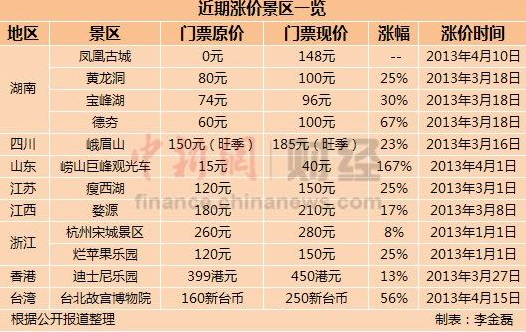
Domestic scenic spots have seen a new round of “price hikes”
Recently, with the arrival of the peak tourist season, domestic scenic spots have launched a new wave of “price hikes.” Many well-known attractions such as Fenghuang Ancient Town, Wuyuan Scenic Area in Jiangxi, Mount Emei in Sichuan, and Slender West Lake in Yangzhou have raised their ticket prices, with the highest increase reaching 167%. In response, netizens lament that scenic spots are becoming increasingly “unaffordable,” while experts say that scenic areas should not rely too heavily on ticket-based revenue.
Scenic spot tickets see a new wave of “price hikes”
With the approach of Tomb-Sweeping Day and May Day, spring tourism is gradually heating up, and so are scenic spot ticket prices. A statistical survey by the finance channel of China News Service found that recently, a number of scenic areas including Fenghuang Ancient Town, Wuyuan Scenic Area in Jiangxi, and Mount Emei in Sichuan have raised their ticket prices.
Among them, the all-inclusive ticket price for Wuyuan Scenic Area in Jiangxi has been increased from the original 180 yuan to 210 yuan, a rise of 17%. The peak-season ticket price for Mount Emei in Sichuan has been adjusted from 150 yuan to 185 yuan, an increase of 23%. The ticket price for Longdong Scenic Area in Zhangjiajie, Hunan, has been adjusted from 80 yuan to 100 yuan, a rise of 25%; Baofeng Lake Scenic Area’s price has gone from 74 yuan to 96 yuan, an increase of 30%; and Dehang Scenic Area has been raised from 60 yuan to 100 yuan, a hike of 67%.
In addition, Slender West Lake in Yangzhou began implementing a peak-season ticket price of 150 yuan per person starting March 1, an increase of 30 yuan or 25% from before. Starting April 1, the sightseeing bus at the Juling Scenic Area of Mount Lao in Shandong switched from small vehicles to large buses, raising the price from 15 yuan per person to 40 yuan, a jump of 167%.
Netizens lament that scenic spots are becoming increasingly “unaffordable”
In addition to mainland China, scenic spots in places like Hong Kong and Taipei have also joined the price hike trend. Among them, the adult one-day ticket price for Hong Kong Disneyland was increased from 399 Hong Kong dollars (approximately 319 RMB) to 450 Hong Kong dollars (approximately 360 RMB) starting March 27, an increase of about 13%. The regular ticket price for the National Palace Museum in Taipei has risen from 160 New Taiwan dollars to 250 New Taiwan dollars, a 56% increase.
Apart from direct price increases, several scenic areas have adopted an “all-in-one ticket” system, bundling tickets together, which has been criticized as a disguised price hike. Among them, Fenghuang Ancient Town in Hunan began implementing a 148-yuan all-in-one ticket system starting April 10. Hangzhou Songcheng Scenic Area has also adopted an all-in-one ticket pricing system, with the combined park entry and performance ticket priced at 280 yuan per person, a 20-yuan increase; the ticket for the Rotten Apple Amusement Park has been adjusted to 150 yuan per person, a 30-yuan rise.
Faced with either direct or indirect ticket price hikes, netizens have lamented that scenic spot tickets are getting more and more expensive—it's truly becoming “unaffordable.” A report previously released by the China Tourism Academy showed that 89.2% of netizens believe that scenic spot tickets are “too expensive, and the cost of tickets has seriously affected their enthusiasm for travel.”
“Ticket economy” should transform into an industry economy
It is worth noting that in September last year, the National Development and Reform Commission (NDRC) announced two batches of scenic spots that had lowered their ticket prices. According to statistics, a total of 174 tourist and sightseeing spots across various provinces, autonomous regions, and municipalities reduced their prices, with an average decrease of about 30%. However, most of the price cuts were applied to “less popular” scenic areas, with only 14 5A-level scenic spots—including Mount Wudang, the Three Gorges Dam, Yellow Crane Tower, Jade Dragon Snow Mountain, and the Xishuangbanna Tropical Botanical Garden—implementing reductions.
In fact, domestic scenic spot ticket prices have long surpassed those of some international destinations. According to a report by China Securities Journal on April 1, the basic ticket price for the core area of Wulingyuan in Zhangjiajie is 245 yuan, while the ticket for permanent exhibitions at the Louvre in France is only 10 euros, and the entrance fee for hiking in Yellowstone National Park in the United States is just 12 U.S. dollars.
In response, Wang Yanyong, professor at the Tourism Management Department of the School of Economics and Management at Beijing Jiaotong University, and director of the Tourism Development and Planning Research Center, said in an exclusive interview with the finance channel of China News Service that although China’s tourism industry has long advocated moving away from a “ticket economy” and building a tourism industry chain, too much emphasis is still placed on direct economic income from tourism. Future transformation and upgrading should make full use of the six key elements—food, accommodation, transportation, entertainment, shopping, and travel—to shift from a ticket-based economy to an industry-based economy.