During the 2014-15 Volvo Ocean Race, in addition to the competing teams circumnavigating the globe, the race village also embarked on a worldwide journey—setting up in 11 stopovers across five continents to introduce the event to local communities. As a result, the race unquestionably became the sporting event requiring the most containerized logistics transportation on a global scale. Completing the logistics for the Volvo Ocean Race is truly an epic achievement. Knut Frostad, CEO of the Volvo Ocean Race, commented: “Logistics management is absolutely vital to the Volvo Ocean Race. Visiting multiple countries across five continents over nine months is a huge challenge.”
A global work network enables efficient overall coordination
GAC is one of the logistics sponsors of the Volvo Ocean Race. The partnership between the two began in September 2012, with GAC providing the event with a range of logistics services including sea freight, air freight, and all related logistics needs. Based on the nature of the event, GAC developed a mobile office (a 40-foot container) that moved with the work team from one stopover port to the next. At the same time, GAC has over 300 offices in 43 countries around the world. Its extensive global work network, coupled with established teams and rich experience in each city, enabled GAC to excel at both overall coordination and detailed execution.
The harsh racing environment of the Volvo Ocean Race means sailboats can break down anywhere on the planet, necessitating fast and effective logistics to deliver necessary parts promptly to designated locations so that boats can be repaired and back in the race as quickly as possible. To this end, GAC’s control tower in Southampton operates 24/7. This mechanism proved invaluable during the incident involving Dongfeng Race Team. During the fifth leg, the mast of the Dongfeng team broke. With little time to spare before the sixth leg, GAC maintained close contact with airlines and trucking companies, enabling the mast to be flown from Dubai to Amsterdam and then to Brazil as quickly as possible. Upon arrival in Brazil, customs, police, and other local authorities were prepared to ensure seamless and smooth follow-up transportation. Thanks to GAC’s assistance, the Dongfeng team was able to complete repairs in time and went on to win the sixth leg.
In addition to transporting emergency spare parts, GAC’s most important task is helping the Volvo Ocean Race transport race village equipment. Due to the unique demands of the race, and to prevent the race village from not being set up by the time the boats arrive—given how fast they sail—organizers prepared two identical sets of race village equipment, using a leapfrog transport method to save time. Maersk Line was also involved in transporting the race village equipment.
Leapfrog shipping along two routes ensures equipment arrives safely
Maersk Line’s collaboration with the Volvo Ocean Race dates back to the 2011-12 edition, when—though not yet an official partner—it twice assisted the damaged Team Sanya by transporting their boat, allowing them to reach the stopover port for repairs and continue the race. In the 2014-15 Volvo Ocean Race, Maersk Line became the official logistics partner of the Volvo Ocean Race.
Maersk Line is responsible for shipping the equipment needed to set up the race villages via containers. This means that by the time the race arrives at a stopover port, the equipment for the next port is already in transit. To give a simple example: although the fleet’s stopover order is Cape Town, Abu Dhabi, Sanya, and Auckland, when the fleet sails from Abu Dhabi to Sanya, the equipment for Abu Dhabi is not sent to Sanya but directly to Auckland. The equipment needed to set up the Sanya race village actually left Cape Town much earlier.
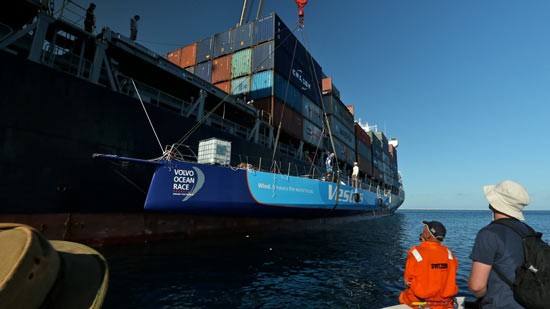
In addition to transporting the race village, Maersk Line was also actively involved in the rescue operation after Vestas Wind hit a reef, helping to transport the boat from the grounding site to a shipyard for repairs.
Shared environmental values build a strong partnership
How did GAC and Maersk Line come to collaborate with the Volvo Ocean Race? One key reason is their shared values—namely, a commitment to sustainability and environmental protection. GAC believes in delivering world-class work using fewer resources while maintaining high-quality, efficient service; Maersk Line’s philosophy focuses on reducing costs, improving efficiency, prioritizing environmental care, and pursuing sustainable development; and the Volvo Ocean Race has long been dedicated to promoting environmental protection. It can be said that it is this shared focus on the environment and sustainability that brought the three parties together.
These environmental principles are reflected in both the setup and transportation of the race villages. The race villages of the Volvo Ocean Race are all modular and largely constructed with recycled materials. This approach not only minimizes environmental impact but also maximizes resource utilization through the repeated use of equipment.
The transportation of the race villages is not just about moving logistics—it’s a relay of environmental protection ideals across the globe. As a top-tier global event, the Volvo Ocean Race strives to protect the environment while constantly pushing boundaries. Leveraging its influence, it promotes a philosophy of harmony between humans and nature, contributing to a better future for humanity.