Wang Shi: What Mountaineering Has Taught Me.
(*Himalayan Vertical*, originating from a film by Wang Shi
Wang Shi expresses gratitude to mountain guides and shares summit stories with the world
Wang Shi highly recommends *Himalayan Vertical* to the world, reminiscing about his youth)
At 9 a.m. on a Monday morning, in the VIP cinema hall of the legendary theater in Beijing’s trendy shopping district of Lan Kwai Fong, Mr. Wang Shi sits calmly in the darkness, preparing to climb Mount Everest once again — he is bringing the 4K ultra-high-definition extreme film we spent four years making, called *Himalayan Vertical*, to Seattle to attend the premiere of another Hollywood film with the same theme, *Everest*. That movie is based on the 1996 mountaineering disaster on the southern side of Everest, and one of its protagonists is his friend. The two films: one Eastern, one Western; one focusing on the southern side of Everest, the other on the northern side; one a commercial film, the other a documentary. But what clearly moved Wang Shi is not this drama: at 30, he headed to the special economic zone; at 40, he made waves in the real estate industry; at 50, he took up the banner of reshaping industry order; at 60, he studied at Harvard... “Entrepreneur Wang Shi” is probably long accustomed to being dramatically focused on from the summit, but for the “young Wang Shi” of many years ago, the mountaintop might hold the brightest light of the future...
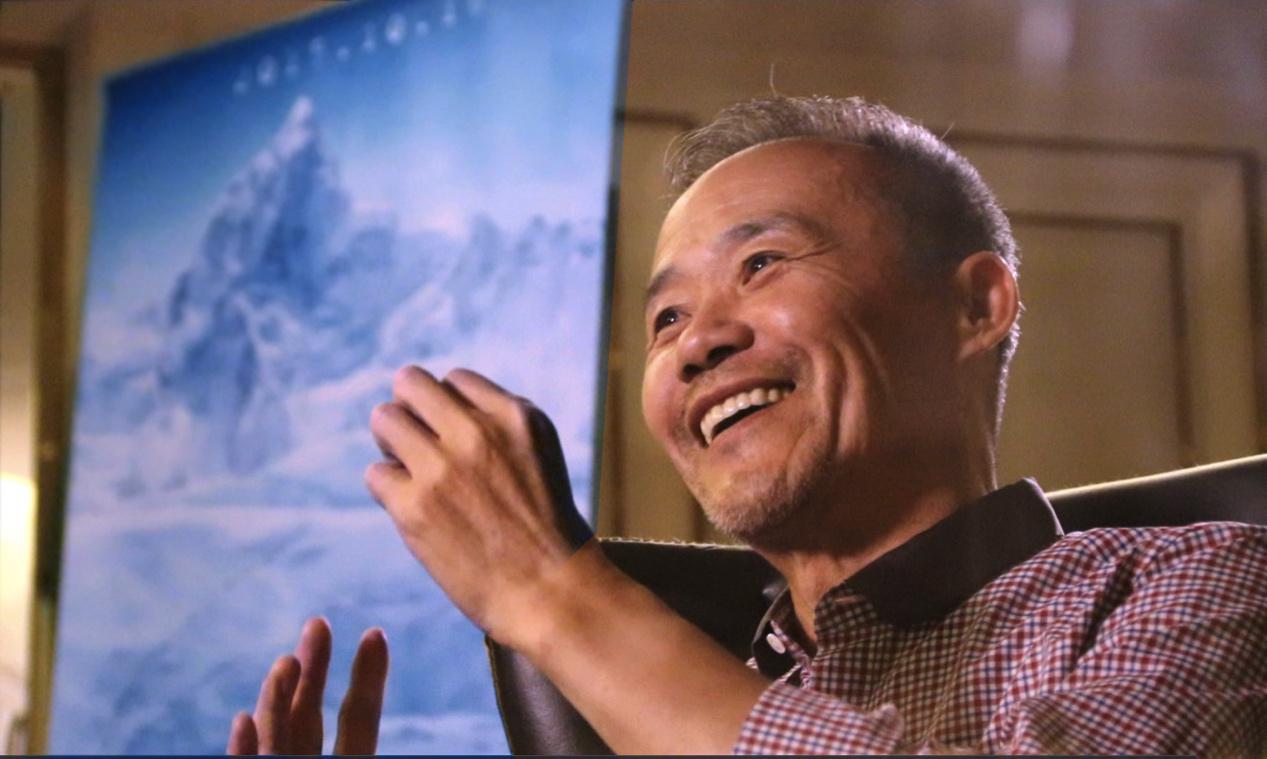 “In our generation, there were two heroes in our youth: one was the Chinese table tennis team, and the other was the Chinese mountaineering team.”
At this moment, what holds his complete attention is another group of youths on the big screen, who are steadily advancing toward the summit...
“The scenery here is beautiful, absolutely worth coming up to see, but I think more about how to get down.”
Many years ago, during his first summit of Everest, Wang Shi once remarked like this. And this four-year extreme film tells the story of those who take climbers up the mountain and safely bring them down — the young high-altitude guides from the Tibet Mountaineering School at the foot of Everest. As the French Golden Ice Axe spirit states — among the human values carried by climbing, life is the highest value. To defend this value, Tibetan mountaineer Nyima Tsering and the Swiss professional outdoor sports brand Osprey jointly founded the world’s only school dedicated to training professional high-altitude guides.
In interviews, Wang Shi has mentioned Sir Edmund Hillary several times — the New Zealand mountaineer who said “because it’s there.” As the first person in the world to summit Everest, what captivates the public most is not only his feat of reaching the top but also his story with Sherpa guide Tenzing Norgay. Back then, Hillary and Norgay told the media that they had summited together, but it wasn’t until 1999, 11 years after Norgay’s death, that Hillary broke his silence and first revealed who reached the top first in his book *View from the Summit*: “We were very close, Tenzing loosened the rope a bit, and I continued to break trail upward. Then, I climbed onto a flat snowfield, and from there, all I could see was the sky.”
When it comes to commercial mountaineering and the relationship with guides, Wang Shi is equally candid about his attitude — “Guides and climbers are closely linked. Without their help, people like me would probably find it hard to reach the summit. They give us the most professional and essential assistance, but completing high-altitude climbs isn’t as simple as just having money, as ordinary people might imagine...”
“I prepared for four years to climb Everest, and it influenced my whole life.”
Climbers and guides at the summit of Everest
Young high-altitude guide Sodov
“*Himalayan Vertical* excites me! As a rare film depicting extreme mountaineering, it not only has incredibly beautiful and stunning scenery but also explores the relationships between people and between humans and nature, appealing to a broad audience.”
Tibet Mountaineering School, where trainee guides practice rock climbing
“These kids carry others’ dreams to the summit while also realizing their own. Especially in this ‘privileged parent’ era, this film is very enlightening for both children and parents.”
Until the end of the interview, we never got the chance — or figured out how — to tell him that this was actually a film originating from him — in 2010, the producer of *Himalayan Vertical*, Lao Lei, went to the foot of Everest as a photographer to interview Wang Shi, who had just returned from a summit. Along the way, they met a young student from the mountaineering school, who asked Lao Lei to deliver a scripture book to Lama Agusangji at the Upper Rongbuk Monastery. Built in 1899, the Upper Rongbuk Monastery is located on the northern side of Everest, about 20 kilometers from the summit, and is the highest monastery on Earth. It is said that Padmasambhava once practiced here. Agusangji is the monastery’s sole monk, who regards Everest as the incarnation of a dakini and believes humans should not disturb her. The young mountaineering guide who brought the scripture from below is his son.
Agusangji, who alone worships and guards the sanctity of Everest at the Upper Rongbuk Monastery
Over four years of filming, we experienced a high-altitude rescue involving hundreds of people on the northern side of Everest, the largest mountaineering disaster in human history on the southern side, the Nepal earthquake... But in the end, this film was edited to be extremely calm: because we really couldn’t define this mountain or these people, just as we couldn’t define that father and son. Should they climb? Or continue to guard? We have no answer. We can’t even learn their serenity. All we know is that the mountain has given us an unprecedentedly broad understanding of this world, just as Wang Shi and his Vanke — after descending, what lingered in his mind wasn’t the view from the heights but the snow leopard, the apex predator of Everest’s ecosystem —
During an interview in 2008, Wang Shi, who had just returned from the summit, was suffering from snow blindness. He said: “Mountaineering is an extension and concentration of life. It forces you to review your past life and understand what you’ve overlooked. At the moment of snow blindness, besides darkness, you face death. I kept thinking: if I can make it back alive, I’ll be grateful to my family!”
Actually, we don’t even know his real name. “Agu” means “uncle” in Tibetan. All mountaineers from around the world who come to the Upper Rongbuk Monastery to pray call him this — Uncle Sangji, nameless.