Toread Participates in Drafting Outdoor Sports Clothing Standards
On April 25, 2016, the GB/T 32614-2016 national standard for "Outdoor Sports Clothing - Windbreakers," approved and issued by the Standardization Administration of China and drafted under the leadership of Toread Holding Group Co., Ltd., was officially released and will come into effect on November 1, 2016. This national standard was overseen by the Sports Clothing Sub-committee of the National Technical Committee for Standardization of Sporting Goods and involved multiple leading companies and testing institutions in the industry, including the National Knitted Product Quality Supervision and Inspection Center, in its drafting and formulation.

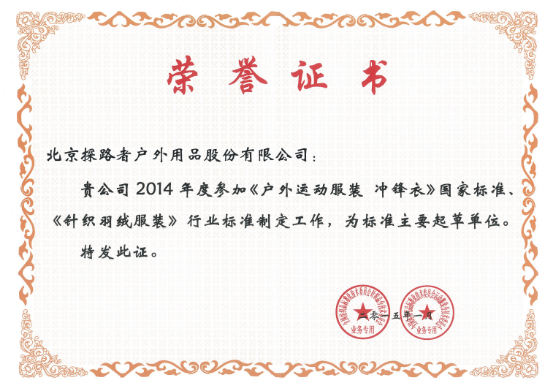
The drafting of the new standard relied on the strong R&D, testing, and data analysis capabilities of Toread’s Polar Bionic Laboratory within its R&D center. Over 2,000 sets of experimental data were analyzed to extract practical functional performance metrics for windbreakers. Under the organization of the standards committee, technical discussions and research were conducted with industry experts, third-party testing institutions, and various standards committees. After multiple rounds of small-scale feedback collection, more than five formal expert review meetings, and the consolidation of opinions from over a hundred experts, the process—spanning more than three years—from standard drafting, review, submission, to final release was completed. This provides a solid basis for the production and quality inspection of windbreaker products.
From the perspective of ensuring product quality, the new standard sets out quality requirements for windbreaker products in three areas: first, safety indicators—including formaldehyde content, pH value, odor, and carcinogenic aromatic amine dyes—which must meet the requirements of the "National Basic Safety Technical Code for Textile Products"; second, basic performance requirements—including dimensional change rate after washing, color fastness, seam intercolor fastness, light fastness, pilling and abrasion resistance, tear strength, and seat seam strength of pants; third, functional requirements—including surface water repellency, hydrostatic pressure, and moisture permeability.
Specifically, to ensure that the functional requirements of windbreakers meet the needs of various outdoor sports, the new standard divides these functional requirements into professional grade (Level I) and non-professional grade (Level II). Level I products have stricter functional requirements suitable for professional outdoor activities, while Level II products have slightly lower functional metrics, suitable for everyday outdoor leisure activities.
(1) In terms of surface water repellency (commonly referred to as water shedding, meaning water droplets on the fabric roll off like dew on a lotus leaf, leaving no trace), the standard specifies a spray rating of 4 before washing, with a waterproof performance evaluation of “excellent water shedding capability.”
(2) For hydrostatic pressure (referring to the fabric’s ability to withstand prolonged high water pressure without inner leakage or dampness), the standard sets corresponding metrics for both the fabric itself and fabric seams.
(3) Regarding moisture permeability (the need for sweat vapor generated by the body to be promptly released), considering the need for timely sweat vapor dispersion during outdoor activities, the standard specifies moisture permeability levels to achieve better thermal and moisture comfort. It sets moisture permeability at 5,000 for Level I products and 3,000 for Level II products. Additionally, post-wash moisture permeability testing requirements have been added to better ensure the product's functional performance.
Moreover, to protect children’s health, the standard includes safety requirements applicable to children, such as safety standards for drawstrings on children’s tops, safety requirements for cords and drawstrings in children’s clothing, and residual metal needles.
As a key drafting entity of the standard, Toread actively fulfills its responsibilities as a leading domestic outdoor brand by strictly controlling product quality and establishing an effective quality standard system. It has rigorously developed and implemented over 50 internal control standards and has participated in drafting 12 national and industry standards.
While providing consumers with more comfortable and safe product experiences, Toread also hopes to offer technical support and a basis for regulating the outdoor clothing market, ensuring the quality of outdoor apparel, safeguarding the health and safety of outdoor enthusiasts, and promoting healthy, orderly, and sustainable industry development.