I. Market
1. 2015 Domestic Outdoor Products Market Overview
For most practitioners and companies in the outdoor industry, 2015 was a rather challenging year.
As an emerging sunrise industry, the outdoor products sector has experienced over two decades of rapid growth since its inception in the mid-1990s. According to COA statistics, from 2001 to 2010, the domestic outdoor products industry achieved a compound annual growth rate exceeding 60%. In 2011, the market retail size surpassed 10 billion yuan for the first time, exceeded 15 billion yuan in 2013, and reached 18 billion yuan in 2015.
Like all emerging industries, after a period of rapid development, an “adjustment phase” is an inevitable part of industrial evolution. In 2013, the core domestic outdoor products market grew by 16.7% compared to the previous year, marking the first time the growth rate fell below 20%. In 2014, it grew by 10.9% compared to 2013, and in 2015, the growth rate dropped to just 5.3% compared to 2014. After years of rapid expansion, the domestic outdoor products industry entered an adjustment phase starting in 2014.
In interviews with over 50 companies, nearly half of the executives mentioned the highly complex market environment and competitive pressures their businesses are currently facing. In summary, “against the backdrop of profound changes in the overall national economic climate, there are both internal issues accumulated over more than twenty years of rapid growth that need to be addressed, and external forces viewing the outdoor industry as a sunrise sector, continuously entering and intensifying market competition.” One executive vividly remarked, “The speed of new brands entering the market far exceeds the pace of market size growth.”
“Adversity reveals true character.” While we felt the pressure the adjustment phase has brought to businesses during the interviews, what was more reassuring was witnessing the tremendous progress made by Chinese domestic brands over the past two decades. As a typically imported industry, the outdoor sector has shifted from being dominated by foreign brands in its early stages to now having domestic brands occupy more than half of the market share. A number of leading domestic brands view this adjustment period as an opportunity. They are taking full advantage of the time window provided by the market readjustment to deeply reassess “brand positioning and development strategies,” strengthen internal capabilities, and enhance self-development capacity—preparing to embrace the next growth cycle of the outdoor industry with greater maturity.
2. Overall Outdoor Products Market
With the development of the outdoor industry, an increasing number of brands from outside the sector have begun to enter the outdoor products industry. This trend has, on one hand, enriched the industry’s content, but on the other, has somewhat blurred its boundaries.
Based on the degree of alignment with outdoor activities, we divide the outdoor products market into four segments:
1) The core outdoor market, composed of professional outdoor brands—those deeply rooted in the outdoor industry, with the majority of their revenue derived from outdoor-related business.
2) The sports outdoor market, consisting of sports brands that offer outdoor products. These brands primarily focus on traditional sports products, but have incorporated outdoor products as part of their product lines, though not yet as their dominant offerings. Examples include Adidas, Nike, Li-Ning, and Anta.
3) The casual outdoor market, made up of fashion and leisure brands that offer outdoor products. Their main product lines are fashion and leisure items, but they also include outdoor products as part of their offerings, though not as their primary focus. Examples include LOTTO, JEEP, and CAMEL ACTIVE.
4) The low-end outdoor market, consisting of brands from the low-consumption sector that offer outdoor products. For instance, Quechua under Decathlon, as well as numerous outdoor brands sold in supermarkets such as Metro and Walmart.
Dividing the outdoor products market into these four segments helps us study market changes and gain a comprehensive view of the outdoor market—especially valuable for market investors, as “only with clear boundary definitions can statistical data be of reference value.”
In 2015, the total domestic outdoor market size reached 45.4 billion yuan, reflecting a 12.5% increase over the previous year (Figure 1.1).
1. Composition and Evolution Trends of Outdoor Distribution Channels
Outdoor product sales organizations include various levels of agents, distributors, and others. This report focuses on outdoor retail terminals, mainly comprising department store channels, specialty outdoor stores (street-side shops), and online sales channels.
1996–2015 Illustration of the Evolution of Domestic Core Outdoor Products Market Sales Channels (Figure 3.1)
Trends in the Number of Core Outdoor Brands from 2010 to 2015 (Figure 2.1)
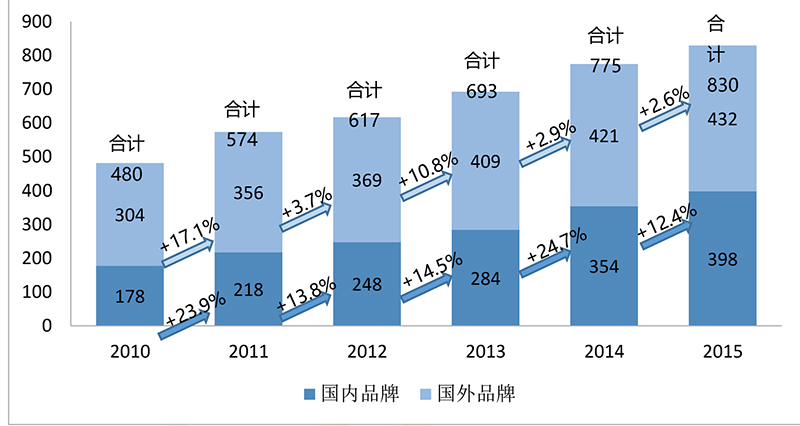
We organized industry experts to identify 830 core outdoor brands from over 1,200 outdoor brands or those claiming to be “outdoor brands.” In 2015, the number of brands in the domestic core outdoor market continued to rise, increasing by 7% compared to 775 in 2014. Among them, the number of domestic brands was 398, accounting for 47.95% of the total, with a growth rate of 12.4%; the number of foreign brands was 432, making up 52.05% of the total, with a growth rate of 2.6%. The growth rate of domestic brands outpaced that of foreign brands, and 80% of the newly added domestic brands were so-called “online brands” primarily focused on e-commerce sales.
As shown in Figure 2.1, the number of brands in the Chinese outdoor market continues to fluctuate, but the growth rate has slowed. Comparing this with the development history of outdoor markets in Europe and America, a common trait emerges: during the early growth phase of the market, a large number of new brands emerge, while in the mature phase, the number of brands significantly decreases.
The historical data of Korean outdoor brands is even more typical. From the 1980s to the 1990s, the Korean outdoor industry experienced rapid growth, with a surge of domestic Korean brands—peaking at nearly 800. However, very few actually succeeded in the long run.
Looking at trends in the domestic outdoor market, the growth rate of offline brands has clearly slowed down; online brands will likely continue to grow for some time. However, due to their shallow roots in outdoor culture, some online brands may quickly disappear. Currently, nearly 10% of brands in the domestic outdoor market are effectively non-operational.
The proportion, importance, sustainability, and feasibility of sales through foreign brand agents are steadily declining. We believe this trend will continue. As the domestic outdoor market develops, the concentration of brands in the market will inevitably increase, although the pace of this process remains unpredictable.
Finally, we must not overlook the capitalization of the outdoor industry and the surging involvement of capital. This includes two aspects: First, the capitalization of the industry itself is accelerating. Aside from companies like Toread and Sanfo that have already gone public, several others are on the path to IPOs, while numerous brands and channel companies have introduced financial or strategic investors, thereby raising the overall capitalization level of the industry. On the other hand, investment institutions represented by private equity funds are not only increasing their investments in industry brands and channels but also showing a trend of directly acquiring and operating brands, channels, clubs, and events. Given their financing and investment capabilities, they could have a significant impact on the overall ecosystem of the industry.Ringing.
In summary, 2015 was full of challenges and changes; while looking toward the future, we not only see gradually recovering growth potential and speed, but also witness numerous possibilities for change and the uncertainties brought about by these new developments. Navigating such immense uncertainty to seize opportunities, gain a first-mover advantage, and avoid pitfalls is both a challenge for existing industry players and prospective investors, as well as an opportunity to achieve late-mover advantages and rapidly increase corporate value through innovation.
Research Methodology
This report was completed by a dedicated research team organized by the China Outdoor Brands Alliance. In this report, while maintaining a focus on the core outdoor market, we also conducted in-depth research on the non-core outdoor market. We hope that by studying segmented markets and conducting comparative analysis, readers can more clearly grasp the full picture of the outdoor market. Especially for market investors, “clearly defined boundaries make statistical data more valuable as a reference.” We sincerely thank the member companies of the Outdoor Brands Alliance for their strong support to the research team in terms of funding, products, and especially market data.
Data Sources
The sales data for the core outdoor market mainly come from interviews with the heads or sales directors of the top 50 enterprises in the industry, as well as major regional distributors and retailers; since there are many publicly listed companies in the sports brands sector, the data for the sports outdoor market are primarily based on publicly available data from these listed companies; the data for the casual outdoor market and the low-end outdoor market are mainly based on textile industry market data from large domestic retail businesses and the sales data of over 20 well-known casual brands.
Online sales data are primarily based on publicly available data from Tmall and JD.com.
The data sources for physical retail outlets: among the 334 prefecture-level and above cities nationwide, we selected 107 cities and deployed over 300 market researchers to conduct retail outlet statistics for street-side stores and mall-based stores, establishing a database. This database serves as the basis for estimating national data. The researchers are all from outdoor clubs or outdoor retail enterprises and have established stable cooperative relationships with the research team to ensure the dynamic updating of the retail outlet database.
Brand Scope:A team of industry experts individually screened over 1,200 recognized or self-proclaimed “outdoor brands” to determine the scope of core outdoor brands for 2015.
The screening principles applied by the research team to various types of market data: We place greater emphasis on industry market data accumulated by well-known brands over the years.
All statistical data in this report exclude skiing, mountain biking, fishing, and hunting segments.