It was last seen six years ago—rare winter migrant "Lowe's Duck" spotted at Guandu in a dazzling makeover
Reported by Lin Yuying / Comprehensive report
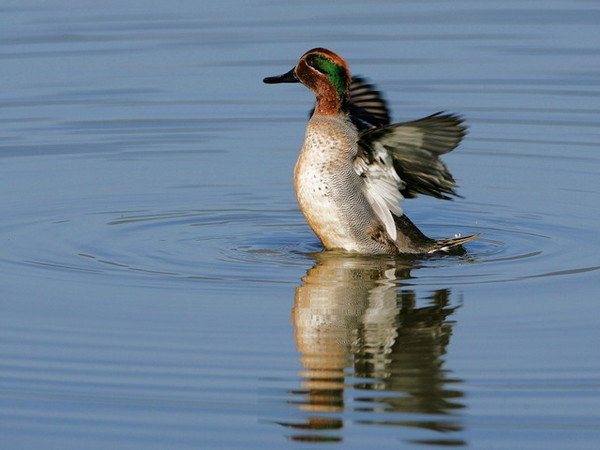
On the morning of the 21st of last month, an outcry arose at Taipei’s "Guandu Nature Park": "Come take a look—what kind of duck is this?" After being identified by Director Yeh Tsai-fu of the Ministry of Environment as a male Lowe's Duck—a rare winter migrant—birdwatchers on the scene exclaimed, "What a find!" In Taiwan’s various wetlands, the Lowe's Duck is an extremely uncommon migratory bird, often attracting large groups of enthusiasts who gather to catch a glimpse of its shimmering decorative plumage. The previous recorded sighting at Guandu Nature Park was way back in February 2007 (the 96th year of the Republic of China)!

▲ A Eurasian Teal (left) and a Red-necked Grebe (right) have molted their feathers and are preparing to embark on their next journey. (Photo: Hsiao Mu-chi / Guandu Nature Park)
Guandu Nature Park is recognized by BirdLife International as an important habitat for migratory birds and serves as a resting and refueling station for birds traveling between south and north, hosting over 200 bird species. When migratory birds arrive in autumn, they’re dressed “plainly,” but by Lunar New Year, they’ve donned stunning new plumage. As spring equinox approaches, the park’s ponds and mudflats teem with returning geese, ducks, snipes, and herons, all making final preparations to head home.
Among the wintering migratory birds at Guandu, the most numerous are the duck flocks numbering over 5,000, primarily Eurasian Teals, along with regular annual visitors such as the Garganey, Northern Shoveler, Eurasian Wigeon, Green-winged Teal, Red-necked Grebe, and Northern Pintail. Occasionally, rarer species like Lowe's Duck, Gadwall, Baikal Teal, and Greater White-fronted Goose also appear. These ducks either glide gracefully across the ponds or forage along the mudflats, their adorable and comical antics always captivating onlookers.
Especially the males, who undergo dramatic makeovers with their vibrant breeding plumage, gather on the water to perform elaborate courtship dances—stretching their necks, shaking their heads, flicking their tails, and flapping their wings to flaunt their dazzling colors—all in hopes of winning over a mate. By March, they’ll return together to their northern breeding grounds to start new family lines.

▲ A Eurasian Teal (left) and a Red-necked Grebe (right) have molted their feathers and are preparing to embark on their next journey. (Photo: Hsiao Mu-chi / Guandu Nature Park)
Some visitors ask, "Isn’t birdwatching difficult? Don’t you need high-end binoculars? And don’t all birds just look the same?" But birdwatching isn’t that hard. Guandu Nature Park not only provides high-powered binoculars for free but also has resident guides who can answer questions. If you want to learn more about birds and hear fascinating stories about them, why not pay a visit in person?
This avian holiday paradise also hosts a lively chorus of "nighttime sprites" every April and May. During this time, Guandu Nature Park organizes "Frog-Watching Camps," inviting the public to get to know this vocal ensemble. Activities include Frog Bingo, fascinating insights into their unique anatomy, outdoor surveys teaching participants to identify frogs by sound, and survival challenges.
%Don’t miss out on this unique experience. (Source: Guandu Nature Park)

Share
This article is published by HowToTrip. Sharing and reposting are welcome — please credit the source.
Article URL: https://www.howtotrip.net/views-28922
Related Articles
- Shaoxing's "Grandpa Gourd" hangs the gourds back up: "If there are too many people, we'll interact less — just take a quick look from afar"
- Chinese authorities announce "reciprocal adjustment" to Japan visa fees — single-entry visa jumps from 2,250 to 16,750 yen!
- The "health stones" carried by a traveler were found to have radiation levels exceeding safety limits by a thousand times, potentially endangering fellow passengers on the same flight. Customs issues warning!
- Shenzhen Airport Issues Late-Night Notice: Unidentified Aerial Object Detected, Causing Widespread Flight Delays!
- “They only said it cost money after I opened the box and washed it!” 200g of grapes sold for 60 yuan on a high-speed train—12306 responds!
- Can't buy an airline ticket? Denied exit? Blocked from boarding? A large number of Chinese tourists have mysteriously become "discredited individuals"
- Adverse weather and economic fluctuations impact Colombia's coffee market
- Beach bathing area responds to 2 yuan/30 seconds fee for freshwater foot rinsing: Clearly priced!
- Taking off with an improperly closed cabin door? Wing malfunction? Multiple flights made emergency returns mid-journey!
- Experience the gifts of nature! A countdown of the world’s ten most stunning coastlines