National Geographic / The Ancient Wells of Memory
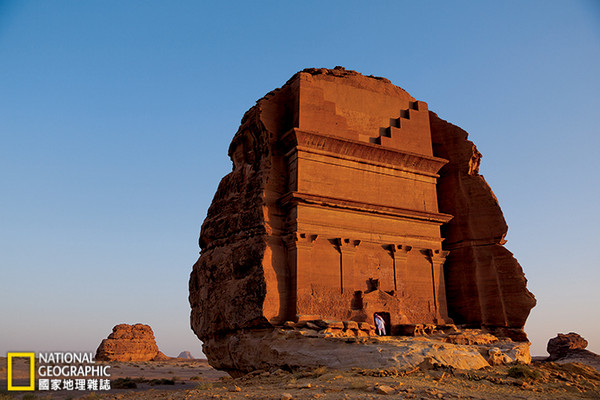
The Nabataeans, whose history predates Islam, carved magnificent tombs into the rock at Mada’in Saleh. Photography by John Stanmeyer, National Geographic China, July 2014
By Paul Salopek
Photography by John Stanmeyer
The old Hijaz region has thousands of wells. We walked up to them. Some yielded sweet water. Most were brackish. It didn’t matter. These wells, scattered like scars across the long-abandoned Arabian caravan routes, are relics of human survival. Each well is a microcosm of the local land and culture. So, too, are the people who once drank from them. The Hashemite family, which once ruled the Red Sea coast of Saudi Arabia and established a kingdom in the Hijaz, is long gone, but the wells remain—some bustling, others deserted. Some wells seem to carry an aura of sorrow or joy. Every bucketful is a tiny universe. These wells shaped how we felt about each place we passed through.
Wadi Wasit is a forgotten well.
We reached it on a scorching August day. We had walked over 1,200 kilometers from Jeddah toward Jordan, and this was the halfway point. We rested in the shade of two thorny trees. There, we met the Running Man.
This plump, bearded Bedouin camel herder was kind, curious, talkative, and jittery. He mistook us for treasure hunters. He was there to sell antiquities.
“Look at this!” he said. He showed us a tin ring, an iron sword scabbard, and a badly worn coin.
How old are these things?
The Running Man didn’t know. “Qadim jin,” he said, meaning very old. He shrugged.

The well at the Al-Baida Oasis once provided water for camel caravans and pilgrims for centuries. Now it’s just a dry, gaping hole. Folklore says Moses once watered his sheep here. Photography by John Stanmeyer, National Geographic China, July 2014
The Hijaz is a crossroads of Arabia, Africa, and Asia, and has long been connected to Europe through trade—one of the most legendary corners of the ancient world. Wanderers have passed through here for ages. Stone Age humans hunted and fished their way north through savannas that no longer exist, eventually leaving Africa. The earliest civilizations—Assyrians, Egyptians, and Nabataeans—roamed these lands, trading slaves for incense and gold. Islam was born here. Pilgrims from Morocco or Constantinople may have drunk from the wells of Wadi Wasit. Lawrence of Arabia might have gulped its water. No one knows. Qadim jin.
“Take it!” the Running Man said. “No charge!” But we declined, leaving his treasures behind.
As we loaded our gear onto two camels and prepared to leave, we saw him again. He was running—circling the well at a sprint. He had shed his white robe and was running in his underwear under the relentless sun, circling the desert well. He ran with wild abandon. The Running Man wasn’t crazy. He wasn’t on drugs. He wasn’t joking. I think he was lost. If we forget history, we all lose our way. We forget where we’re going. The Hijaz has a rich past. But I’ve never been anywhere more bereft of memory.
[Read the full article inNational Geographic China, July 2014. Copyright reserved. Please credit the source.]
Share
This article is published by HowToTrip. Sharing and reposting are welcome — please credit the source.
Article URL: https://www.howtotrip.net/views-22429
Related Articles
- Shaoxing's "Grandpa Gourd" hangs the gourds back up: "If there are too many people, we'll interact less — just take a quick look from afar"
- Chinese authorities announce "reciprocal adjustment" to Japan visa fees — single-entry visa jumps from 2,250 to 16,750 yen!
- The "health stones" carried by a traveler were found to have radiation levels exceeding safety limits by a thousand times, potentially endangering fellow passengers on the same flight. Customs issues warning!
- Shenzhen Airport Issues Late-Night Notice: Unidentified Aerial Object Detected, Causing Widespread Flight Delays!
- “They only said it cost money after I opened the box and washed it!” 200g of grapes sold for 60 yuan on a high-speed train—12306 responds!
- Can't buy an airline ticket? Denied exit? Blocked from boarding? A large number of Chinese tourists have mysteriously become "discredited individuals"
- Adverse weather and economic fluctuations impact Colombia's coffee market
- Beach bathing area responds to 2 yuan/30 seconds fee for freshwater foot rinsing: Clearly priced!
- Taking off with an improperly closed cabin door? Wing malfunction? Multiple flights made emergency returns mid-journey!
- Experience the gifts of nature! A countdown of the world’s ten most stunning coastlines