Could the bamboo leaves in Guan Yu’s painting actually be a poem? The stone-carved words in the painting seem like a mystery to solve, just like in Detective Conan
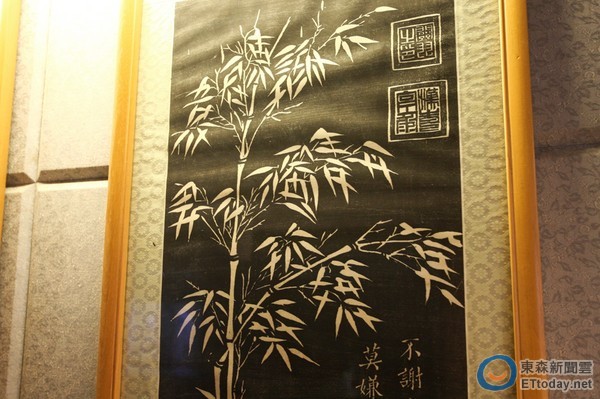
▲Can you spot the verses hidden among the bamboo leaves?
Reported by Chen Ruizhong / Guilin
At first glance, the few bamboo stalks before your eyes appear to be nothing more than an ink-rubbing painting accompanied by poetic verses. But the more you look, the more something seems off: why are some bamboo leaves sparse while others dense, and why do they grow at such peculiar angles? It turns out this bamboo painting actually conceals a five-character quatrain hidden within it.
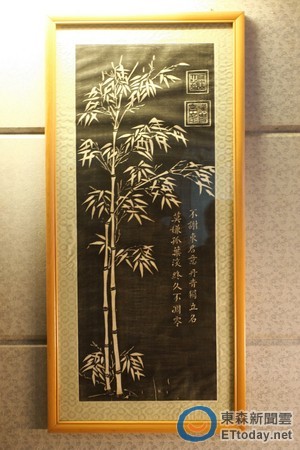
This ink painting with a poem concealed in the bamboo is said to have been created by the famous Three Kingdoms general Guan Yu when he was trapped in Cao Cao’s camp. The painting features two bamboo stalks: the one on the left has branches slanting to the right, known as the “rain bamboo”; the one on the right appears to be swayed by the wind, hence called the “wind bamboo.” As a result, later generations often refer to this painting as the “Wind and Rain Bamboo,” which can be seen in places like the Xi’an Forest of Stone Steles and Luoyang’s Guanlin.
The branches and leaves of the two bamboo stalks are intricately interwoven in the painting, and if you look closely, you will be able to see the following words written:“I do not thank the Lord of the East for his favor, for my ink-painted image stands alone with fame. Do not disdain my lone, pale leaves — in the end, I shall never wither.”These words are said to have been left by Guan Yu after learning of Liu Bei’s whereabouts while he was in Cao Cao’s camp. Determined to leave Cao Cao and search for his sworn brother, he created this hidden-poem painting as a farewell to Cao Cao, expressing his resolve and setting forth on his journey. Later, admiring Guan Yu’s deeds and martial prowess, Cao Cao ordered the painting to be engraved onto a stone stele to pass it on through the ages, naming it the “Guan Di Poetic Bamboo Stele.”
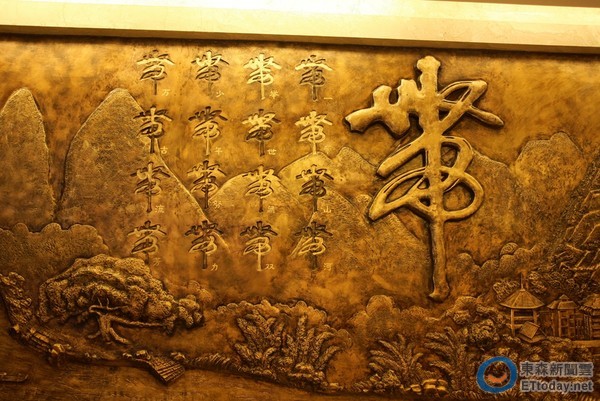
▲The single character “带” (belt/dai) that can be broken down into an entire poem.
For travelers, trying to discern the shapes of individual characters hidden within this bamboo painting is as fun as Sherlock Holmes or Detective Conan solving a mystery. And if you find that not challenging enough, on Yangshuo’s Bilian Peak there is carved a massive 3-meter-tall character “带” (dai), created by Qing Dynasty calligrapher Wang Yuanren. Though it’s just one character, different strokes within it can be pieced together to formthe poetic line: “A belt of mountains and rivers, unparalleled in the world. Young people strive, their glory lasts forever.”As a result, some hotels display this “带” character in their lobbies, allowing guests from afar to break down and guess the hidden meanings. Have readers figured out the mystery behind it yet?
Guilin Stone Carving Forest (Guihai Stele Forest)
Address: No. 1 Longyin Road, Guilin City
Opening Hours: 09:00~17:00
Ticket: 65 RMB (included in the Seven Star Park ticket)
%肌豆氐凼?癖?芳/strong>
Share
This article is published by HowToTrip. Sharing and reposting are welcome — please credit the source.
Article URL: https://www.howtotrip.net/views-11089
Related Articles
- Shaoxing's "Grandpa Gourd" hangs the gourds back up: "If there are too many people, we'll interact less — just take a quick look from afar"
- Chinese authorities announce "reciprocal adjustment" to Japan visa fees — single-entry visa jumps from 2,250 to 16,750 yen!
- 旅客携带的“保健石”核辐射超标千倍,同机人员或遭殃!海关提醒!
- 深圳机场深夜通报!出现不明升空物,航班大面积延误!
- “拆盒洗了才说要钱!”高铁200克葡萄卖60元,12306回应!
- 买不了机票?出境被拒?登机被拦?一大波中国游客莫名成了“失信人”
- 不利天气和经济波动影响哥伦比亚咖啡市场
- 海边浴场回应冲脚淡水收费2元/30秒:明码标价!
- 舱门没关好就起飞?机翼出现问题?多个航班途中紧急折返!
- 感受大自然的馈赠!盘点世界十大唯美海岸线