Prague: Artistic Moments in Cafés
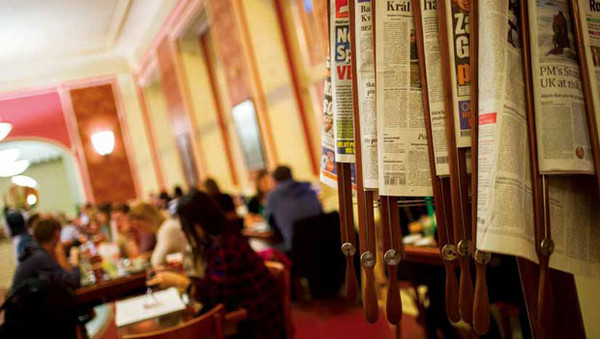
▲ Compared to cafés in other European capitals, those in Prague have a more “grand” character. (Photo provided by Business Weekly / Photography by Li Mingyi)
By Xu Yuhua
Compared to cafés in other European capitals, those in Prague have a more “grand” character, stemming from the imperial grandeur of the past and the refined atmosphere of a cultural capital. When traveling, stopping by a Prague café for a cup—whether coffee or beer—is one of the best ways to experience life.
Café Louvre: Exclusive to Prague’s Elite
If Kafka’s name can be equated with Prague, then Café Louvre is also closely linked to this city and its writer.
Located on Národní Street, Café Louvre is the most famous café in Prague, and it doesn’t shy away from its illustrious background, proudly calling itself the café exclusive to Prague’s elite. Established in 1902, its French name comes from the Musée du Louvre in Paris. Since then, Café Louvre has been a gathering place for the city’s intellectuals. Around 1905, a law student named Kafka became a regular here.
Just like in modern cafés, writers would stop by to write feverishly back then. Even because Café Louvre was one of the first places in the city to have a telephone, artists and intellectuals treated it like an office. Between 1911 and 1912, Albert Einstein, who worked at Charles University in Prague, also became a well-known patron.
It wasn’t just celebrities who added legend to Café Louvre; to some extent, the space also influenced the development of feminist consciousness in Czech society. In the 19th century, as in other parts of Europe, Czech ladies would invite female friends for afternoon tea at home, but this habit began to change in the early 20th century. Upper-class women, like gentlemen, started visiting cafés and enjoying their own company. Their place of choice? Café Louvre.
Café Imperial: Atmosphere and Gastronomy
In a city like Prague, rich in Art Nouveau and Art Deco works, many buildings bear witness to this important artistic movement from the late 19th and early 20th centuries. Among them, the Hotel Imperial, completed in 1914 and recently celebrating its centennial, is a leading figure. It was the most luxurious Art Deco hotel of the last century and is now listed as a Czech national monument.
Café Imperial is part of the legendary Hotel Imperial. Its opulence makes it not just a supporting player but a popular social venue. As you step into the café, the lofty, hall-like space might make you think you’ve entered a museum, and the aristocratic ambiance floating in the air is dazzling and enchanting.
Café Savoy: Classic Recommendations from Insiders
Many Prague travel guides mention Café Savoy, but don’t hastily label it as touristy. In fact, when we asked Prague’s Mandarin Oriental and Four Seasons hotels—two five-star establishments that set local tastes—which places they’d recommend for an authentic experience, the answer was unanimous: “Café Savoy.”
The dazzling Neo-Renaissance-style space, with its two-story-high ceiling adorned in gold and decorative bas-relief panels, and the sparkling large chandeliers hanging above; looking down from the second-floor seating feels like a scene from The Great Gatsby.
The full Savoy breakfast is the most classic. Served on a silver tray are boiled eggs, cheese, ham, bread, cakes, butter, and jam, accompanied by coffee or tea. Insiders will tell you that the ham here is a uniquely Czech homemade variety—you absolutely must try it and not waste the experience.
Grand Café Orient: A Must-Visit for Cubist Pilgrims
Cubism is one of the avant-garde art movements of the early 20th century, originating in France and led by painters Pablo Picasso and Georges Braque, later spreading across Europe. Its forms extended to sculpture, architecture, and design. When the Cubist wave reached Czech, it transformed into a series of Cubist buildings, with over ten still well-preserved today. Among them, the most outstanding representative is the House of the Black Madonna in Prague’s Old Town.
For art lovers, visiting Grand Café Orient is a pilgrimage, while for café enthusiasts, it’s a great spot to observe Prague’s café scene. On sunny days, the balcony seats are the most sought-after, offering a view of the bustling Old Town streets. At night, the spotlight shifts to the old pianist whose music drifting through the air, paired with a coffee or beer, is pure enjoyment.
This early 20th-century avant-garde space still looks modern a hundred years later, though now it carries a heavier, enduring glow with an old soul.
【More Reports】
※ For the full story, see Business Weekly.
※ This article is authorized by Business Weekly. Reproduction without permission is prohibited.
Share
This article is published by HowToTrip. Sharing and reposting are welcome — please credit the source.
Article URL: https://www.howtotrip.net/views-10810
Related Articles
- Shaoxing's "Grandpa Gourd" hangs the gourds back up: "If there are too many people, we'll interact less — just take a quick look from afar"
- Chinese authorities announce "reciprocal adjustment" to Japan visa fees — single-entry visa jumps from 2,250 to 16,750 yen!
- The "health stones" carried by a traveler were found to have radiation levels exceeding safety limits by a thousand times, potentially endangering fellow passengers on the same flight. Customs issues warning!
- Shenzhen Airport Issues Late-Night Notice: Unidentified Aerial Object Detected, Causing Widespread Flight Delays!
- “They only said it cost money after I opened the box and washed it!” 200g of grapes sold for 60 yuan on a high-speed train—12306 responds!
- Can't buy an airline ticket? Denied exit? Blocked from boarding? A large number of Chinese tourists have mysteriously become "discredited individuals"
- Adverse weather and economic fluctuations impact Colombia's coffee market
- Beach bathing area responds to 2 yuan/30 seconds fee for freshwater foot rinsing: Clearly priced!
- Taking off with an improperly closed cabin door? Wing malfunction? Multiple flights made emergency returns mid-journey!
- Experience the gifts of nature! A countdown of the world’s ten most stunning coastlines