Wanchun Garden
Wanchun Garden

At the entrance of Wanchun Garden stands a white marble statue of Xu Xiake, the Ming Dynasty geographer. His figure, clad in a long robe with a sash, a straw hat hanging from his back, and a walking stick in hand as he gazes into the distance, exudes determination, fearlessness, and perseverance in conquering challenges. This captures his bold spirit at the age of thirty, when he courageously climbed the peaks of Dashan and Tianyou, and trekked through the scenic spots of Wuyi Mountain. The statue was erected by the Wuyishan Scenic Area Management Committee to commemorate the 380th anniversary of his exploration of Wuyi Mountain. To the left of the statue is the starting point where Xu Xiake began his mountain ascent, now marked by a stone archway built on the 400th anniversary of his birth.
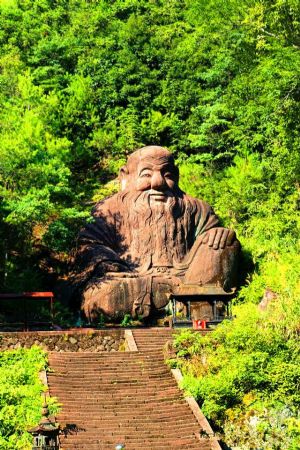
Wanchun Garden is a riverside park nestled against mountains and water. Strolling along the stone paths, visitors can look up to admire the majestic form of Dashan Peak, the reserved grace of Chan Rock, the delicate beauty of Yannv Peak, and the imposing presence of Lion Peak. Looking down, they can appreciate the reflections of clear waters and green bamboo, the vibrant colors of lawns and flowers. With its real mountains and waters, Wanchun Garden remains spring-like all year round, bursting with vitality and endless scenery—truly living up to its name “Ten Thousand Springs.”
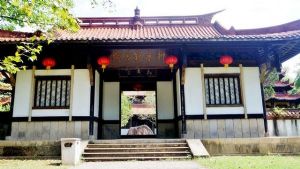
Upon entering the scenic gate of Wanchun Garden, a wall made of Wuyi red gravel rock encloses the lush garden within, adding an air of mystery. Yet, the vibrant life within the garden seems to burst forth despite the wall, with a rich fragrance of flowers filling the air. Famous and unnamed plants, even the smallest grasses growing in crevices and bamboo shoots emerging from the ground, respond to the call of spring, sprouting everywhere and bursting with vitality.
Walking along the paths paved with blue bricks and Wuyi red gravel rock, visitors can breathe in the fragrance of plants and be enveloped by the thick ambiance of spring, merging into the ocean of blooming life. The paths follow the natural contours of the land, winding and curving fluidly along the terrain. They organically connect various flower stands, potted plants, miniature landscapes of famous mountains, as well as flowers, grasses, bamboos, shrubs, trees, ground covers, pavilions, buildings, and villas.
The designs of the various plant stands include both ground-level and elevated types, some framed by gravel, others mimicking trees or bamboo to achieve a remarkably realistic effect, all with unique shapes. The potted plants feature twisted trunks and branches, showcasing diverse postures and expressions. Tall trees and short ones complement each other, deciduous and evergreen trees alternate, and various flowering trees bloom at different times. The layout of buildings, villas, and pavilions follows the principle of “prefer lower to higher, prefer earthy to foreign, prefer light to gaudy, prefer hidden to exposed, and prefer scattered to clustered.” Taking into account the terrain, the structures are arranged at varying heights to harmonize with the natural environment (even the entrance power distribution room and management offices were built slightly recessed to preserve the overall aesthetic). The exteriors of the buildings are rustic and natural (some are decorated to resemble tree bark), while the interiors are equipped with modern functionalities and amenities. The surrounding landscape is designed with complementary flowers and trees to enhance the overall ambiance. Retaining walls are built with natural gravel stones following the natural curves of the mountain, using dry-stacked construction techniques.
This is an organic unity of natural beauty and cultural landscapes. If you visit in spring, various types of azaleas, Bauhinia, and unnamed flowers and plants bloom in full splendor, each vying for attention—the reds like fire, the pinks like rosy clouds, and the whites like snow. Here, man-made beauty and natural beauty are ingeniously combined, artfully woven into a “magnificent, multi-layered” three-dimensional natural tapestry. As visitors stroll through, each step reveals a new view, refreshing the senses and captivating the heart. The breathtaking scenery intoxicates and enchants, leaving a lasting impression that lingers long after the visit. “The grass and trees know spring will soon depart, competing in splendor with a riot of colors”—this is a sea of flowers, a colorful world, a paradise on earth. Wuyi Mountain is filled with beautiful sights all year round, like a painting in every season. Wanchun Garden is just one of the many wonders of Wuyi Mountain.






Share
This article is published by HowToTrip. Sharing and reposting are welcome — please credit the source.
Article URL: https://www.howtotrip.net/travel-19513
Related Articles
- Shaoxing's "Grandpa Gourd" hangs the gourds back up: "If there are too many people, we'll interact less — just take a quick look from afar"
- Chinese authorities announce "reciprocal adjustment" to Japan visa fees — single-entry visa jumps from 2,250 to 16,750 yen!
- The "health stones" carried by a traveler were found to have radiation levels exceeding safety limits by a thousand times, potentially endangering fellow passengers on the same flight. Customs issues warning!
- Shenzhen Airport Issues Late-Night Notice: Unidentified Aerial Object Detected, Causing Widespread Flight Delays!
- “They only said it cost money after I opened the box and washed it!” 200g of grapes sold for 60 yuan on a high-speed train—12306 responds!
- Can't buy an airline ticket? Denied exit? Blocked from boarding? A large number of Chinese tourists have mysteriously become "discredited individuals"
- Adverse weather and economic fluctuations impact Colombia's coffee market
- Beach bathing area responds to 2 yuan/30 seconds fee for freshwater foot rinsing: Clearly priced!
- Taking off with an improperly closed cabin door? Wing malfunction? Multiple flights made emergency returns mid-journey!
- Experience the gifts of nature! A countdown of the world’s ten most stunning coastlines