Tourist Attractions
Linfen Guan Di Temple
The deity worshipped at Guan Di Temple is Guan Yu, a great general of the Shu Kingdom during the Three Kingdoms period. Located on the west side of South Street in Chengnei Village, Linfen, the temple was first built in the seventh year of the Qianlong reign during the Qing Dynasty and was renovated in 1988. It is a key cultural relic protection unit of Linfen City and also one of the best-preserved ancient buildings in Yicheng County today. Guan Yu, commonly known as “Guan Gong,” with the courtesy name Yunchang…
Nanshi Site
Nanshi Site The Nanshi Site (Second Batch of Provincial-Level Protected Sites) Era: Neolithic Age Address: 10 km northwest of Yicheng County, in Nanshi Village, Lizhai Town Area: 1300×1400 meters. Due to years of mountain floods, farmland leveling, and soil extraction by villagers, exposed ash layers can be found everywhere in the gullies and field-edge cliffs within the site area...
Zaoyuan — Nanchan Site
Zaoyuan — Nanchan SiteZaoyuan — Nanchan Site (Third Batch of Provincial-level Protected Sites)Era: Neolithic AgeAddress: Approximately 10 kilometers east of Yicheng CountyThe site is located along both banks of the Hui River and its tributaries—the Shipo River, Jiaodi River, Haizi Gully, and Shimen River—in Longhua Town (formerly Beichan Township), about 10 km east of Yicheng County. It lies in the piedmont zone transitioning from the Taiyue Mountains to the Fen River Valley. The area includes…
Heyun Site
Heyun SiteHeyun Site (Third Batch of Provincial Protected Sites)Era: Neolithic to Zhou DynastyLocation: Around Heyun Village, Nantang Township, approximately 12 kilometers southwest of Yicheng County. The site is situated on the northern terrace of the lower reaches of the Hui River, with relatively flat terrain. It almost connects to the Nanding Site to the east and the Xiayang Site to the west, stretching about 1,900 meters from east to west and about 900 meters in width, with a total ar…
Weigou – Beishoucheng Site
Weigou – Beishoucheng Site Era: Shang and Han Dynasties Location: Northwest of Yicheng County Includes a vast ancient site spanning between Nanshoucheng, Beishoucheng, Dongshoucheng, Weigou, Laojungou, Houweigou, Yingli, Caojiapo, and Fengjiapo, represented by the Weigou – Beishoucheng Jin Culture city site. The terrain of the site can be broadly divided into northern and southern parts…
Stele Commemorating Monk Yugong’s Virtuous Deeds
Stele Commemorating Monk Yugong’s Virtuous DeedsStele Commemorating Monk Yugong’s Virtuous Deeds (Second Batch of Provincial Protected Monuments) Era: Yuan Dynasty Location: Inside the old city, Chengguan Town, Yicheng County According to inscriptions on the side of the stele and the 1929 Yicheng County Annals, it was originally erected in Jinxian Temple at the southeast corner of Tongyingfang in the old city of Yicheng County. After the temple was destroyed, it was moved in the first year of the Wanli era of the Ming Dynasty to the Temple of the Goddess of Earth (Houtu Shengmu) located on a high terrace to the east of the old city...
Nancheng Ancient City Ruins
Nancheng Ancient City Ruins Era: Neolithic, Shang, Zhou Address: Gucheng Village, Nancheng Town, Yicheng County The southern part of the ruins extends across Gucheng Reservoir to the southern bank, the northern edge reaches the southern gully of Nanmiao Village, the eastern side stretches into the upper and lower Jianxia Gorges, and the western side borders Beichang Village. It spans 2,100 meters from north to south and 1,900 meters from east to west, covering a total area of approximately 4 square kilo…
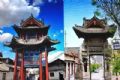
The Stone Four-Gate Archway and the Wooden Four-Gate Archway
The Four-Gate Archways (including the Stone Archway and the Wooden Archway) [Seventh Batch of National Key Cultural Relics Protection Units] Era: Ming Dynasty Location: Intersection of the southern old city of Yicheng County Date of establishment unknown. The stone archway features a four-pillar, three-story bluestone structure with a single-eave, cross-hipped roof. It was renovated multiple times during the 39th year of the Wanli era in the Ming Dynasty (1611), the Qing Dynasty's Qianlong era, and the Republican period. The structure is square-shaped, allowing passage on all four sides, with each face measuring 5.5 meters in both width and depth. The beams, brackets, rafters, and dougong (bracket sets) are all exquisitely crafted. The stone surfaces are adorned with refined carvings of figures, birds, beasts, flowers, and other patterns, arranged uniquely on the pillars and lintels. The main designs stand out with strong three-dimensional effects, featuring smooth, well-arranged carving lines that give the stone archway an exquisite and majestic presence, a marvel of craftsmanship.
南捍东岳庙
南捍东岳庙(第六批国保)时代:元至清地址:翼城县东10公里的隆化镇南捍村始建年代不详,正殿檐下斗?硖庥小爸猎???吣辍??滴醵???辍弊盅?O执娼ㄖ?椎睢⒄?钗???殴梗?嘟郧宕?ㄖ?C碜?背?希?兄帷?/a>