Get it all done in one go: A lazy person’s guide to travel and transport tickets at Kansai Airport
Text and photos byBuji
Japan really does a very thorough and thoughtful job when it comes to promoting tourism and being foreigner-friendly. Just the fact that you can buy so many travel tickets all in one place at Kansai Airport left a deep impression on Buji. Moreover, many important transportation websites and attraction websites not only have English versions, but also typically offer Chinese and Korean versions. Today, let’s talk about exactly which types of tickets you can purchase all at once at Kansai Airport.
There are two places inside Kansai Airport where you can buy many useful travel tickets and JR tickets for exploring the Kansai region:
1. The “JR Midori no Madoguchi (Green Window)” inside Kansai Airport Station, located between Terminal 1 and Terminal 2. This window specializes in selling various West Japan JR Passes to foreigners.
2. The “Kansai Travel Information Center” on the first floor of Terminal 1. This center offers various transport passes other than JR (such as private railways and subways), as well as other types of travel tickets. Below, we’ll explain them clearly and concisely in bullet-point format.
※※※ Before looking into which tickets you can buy, it’s recommended that you first confirm how many days you plan to travel, outline the areas you want to visit, and draft a rough itinerary. This way, you’ll be able to find the most suitable ticket for your trip without getting overwhelmed or confused by the information.
1. The “JR Midori no Madoguchi (Foreigners’ Window)” inside Kansai Airport Station
The previous article “Transport from Kansai Airport to Osaka and Kyoto: The Haruka Ticket is Super Value for Money!” mentioned the “types of JR West Japan Passes” and the “Arashiyama Train tickets” sold at the “Kansai Airport Station” Green Window (Foreigners’ Window).
However, the focus of that article was to tell you how to get from Kansai Airport to Kyoto and Osaka, with an emphasis on explaining the HARUKA ticket among the many JR Pass options. Here, we’ll explain the other types of JR West Japan Passes. As for how to find the “Green Window,” please refer to the previous article.
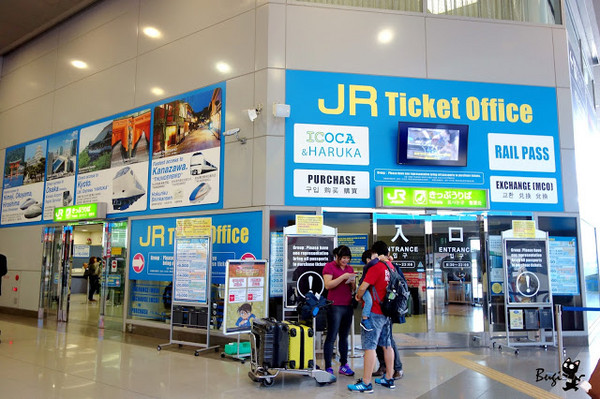
The Green Window looks like this—it’s a dedicated counter for foreigners. Inside, you can communicate in English, and they also understand Chinese quite well.
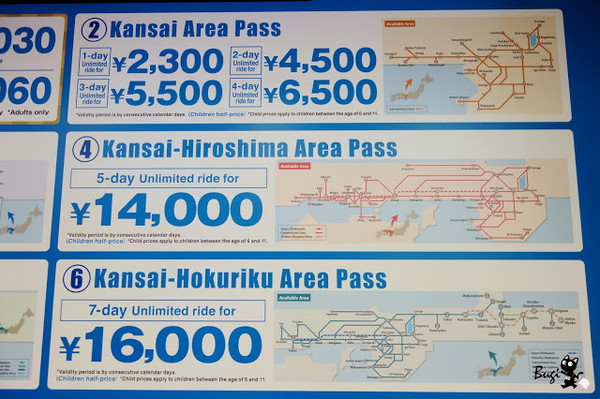
Among these JR West Japan railway passes sold exclusively to foreigners, there are six types that are relevant to travel in the Kansai area (shown in the image below). Buji will briefly explain them in the order shown on the official poster. Except for (1) the ICOCA & HARUKA, which is a relatively simple one-time ride ticket, the usable areas of the railway passes gradually expand from (2) to (6).
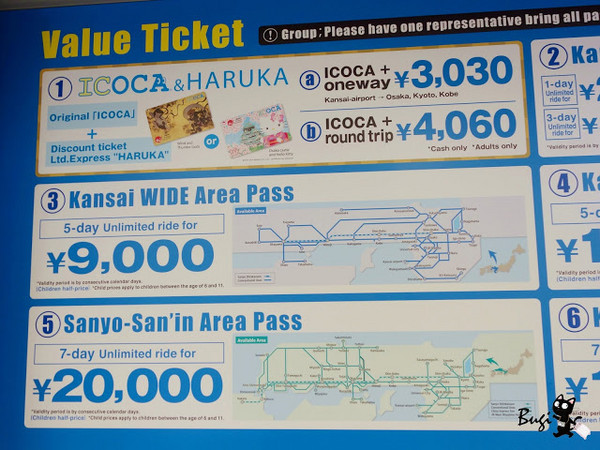
1) ICOCA & HARUKA Pass
This has been explained in detail in the previous articlehttp://www.bugi.tw/2015/11/haruka.html, so we won’t go over it again here. In short, Buji thinks this pass is an incredibly good deal for traveling between Kansai Airport and Osaka or Kyoto (especially Kyoto).
2) Kansai Area Railway Pass
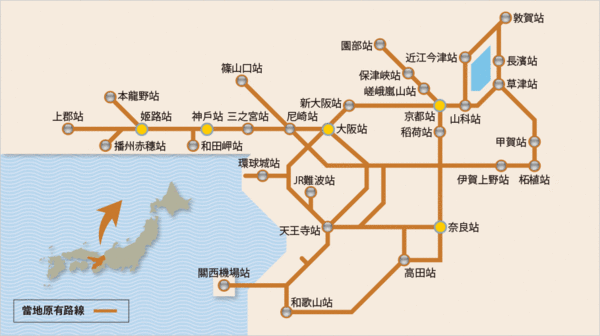
▲ Areas and JR routes covered by the Kansai Area Railway Pass (Image / West Japan JR Official Website)
This pass covers areas including Himeji, Kobe, Wakayama, Osaka, Nara, and more. It allows you to use the HARUKA limited express free seat from Kansai Airport, as well as JR West’s local lines such as the New Rapid Service (New Rapid), Rapid Service (Rapid), and Local Trains (Ordinary).
If your travel range is only within Osaka, Kyoto, and Kobe, then the JR Railway Pass version is sufficient—just refer to this one. You can skip the following (3) to (6) and scroll down to see what other tickets are available at the “Kansai Travel Information Center.”
The Kansai Area Railway Pass comes in four versions: 1-day, 2-day, 3-day, and 4-day passes.
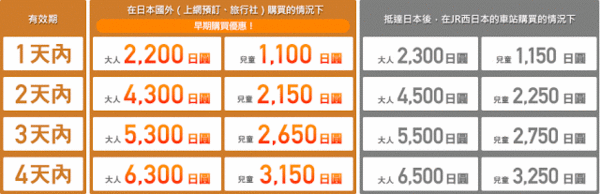
▲ Kansai Area Railway Pass ticket (Image / West Japan JR Official Website)
For details, please refer to:https://www.westjr.co.jp/global/tc/travel-information/pass/kansai/.
3) Kansai Wide Area Railway Pass
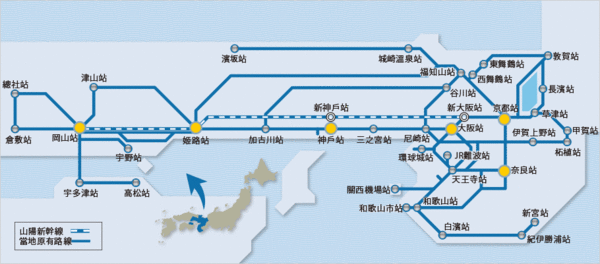
▲ Routes and areas covered by the Kansai Wide Area Railway Pass (Image / West Japan JR Official Website)
This JR Railway Pass covers areas including Okayama, Kobe, Osaka, Nara, Kyoto, and Wakayama. According to the official website, you can use:
"1. Non-reserved seats (ordinary car free seating) on the Shinkansen line between Shin-Osaka ⇔ Okayama;
2. Non-reserved seats (ordinary car free seating) on limited express trains (such as HARUKA, KUROSHIO, THUNDERBIRD, KOUNOTORI, SUPER HAKUTO (Kyoto ⇔ Kamigōri)); 3. JR West local trains including Special Rapid Service (新快速), Rapid Service (快速), and Local Trains (普通列车)."

▲Fares for the Kansai Wide Area Pass (Image / JR West Japan official website)
This pass is valid for 5 days, with an adult fare of 9,000 yen.
For more details, please refer to the official website:https://www.westjr.co.jp/global/tc/travel-information/pass/kansai_wide/.
4) Kansai–Hiroshima Area Pass
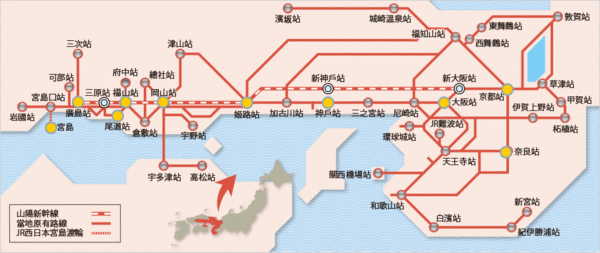
▲Coverage area of the Kansai–Hiroshima Area Pass (Image / JR West Japan official website)
This version of the pass includes the Hiroshima area in addition to the coverage of the "(3) Kansai Wide Area Pass", and is valid for five days.

▲Fare for the Kansai–Hiroshima Area Pass (Image / JR West Japan official website)
For more details, please see:https://www.westjr.co.jp/global/tc/travel-information/pass/kansai_hiroshima/.
5) Sanyo–San'in Area Pass
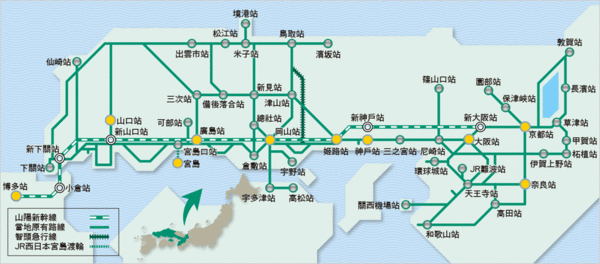
▲Coverage area of the Sanyo–San'in Area Pass (Image / JR West Japan official website)
In addition to Kyoto, Osaka, Kobe, Nara, Wakayama, Okayama, and Hiroshima, this pass also extends to Hakata in Kyushu, making it a seven-day pass with an even larger coverage area.

▲Fare for the Sanyo–San'in Area Pass (Image / JR West Japan official website)
For more details, please see:https://www.westjr.co.jp/global/tc/travel-information/pass/sanyo_sanin/.
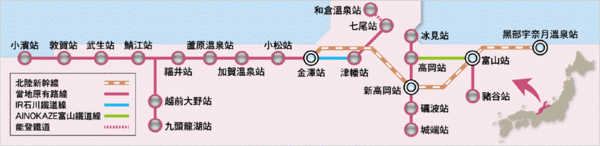
6) Kansai–Hokuriku Area Pass
▲Coverage area of the Kansai–Hokuriku Area Pass (Image / JR West Japan official website)
Basically, this is the coverage of the "(3) Kansai Wide Area Pass + Hokuriku region railways". The Hokuriku area refers to the popular Shirakawa-go and Mount Haku (also known as Hakusan), so if you plan to visit both the Kansai region and these northern destinations, this might be a good option.

▲Fare for the Kansai–Hokuriku Area Pass (Image / JR West Japan official website)
For details, please refer to:https://www.westjr.co.jp/global/tc/travel-information/pass/kansai_hokuriku/.
※※ In addition to the above 6 JR Passes related to the Kansai region, the following can also be purchased at the JR Midori no Madoguchi (Green Window) in Kansai Airport Station:
1) Hokuriku Area Pass:https://www.westjr.co.jp/global/tc/travel-information/pass/hokuriku/.
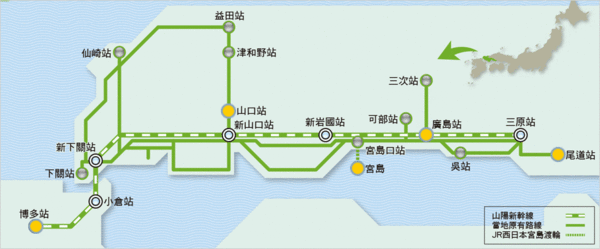
2) Hiroshima–Yamaguchi Area Pass:https://www.westjr.co.jp/global/tc/travel-information/pass/hiroshima_yamaguchi/. This pass mainly covers Hiroshima, Yamaguchi, Miyajima, and Hakata in Kyushu.
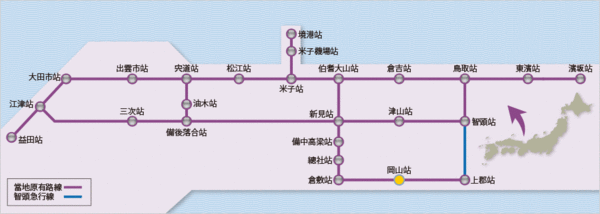
3) San'in–Okayama Area Pass:https://www.westjr.co.jp/global/tc/travel-information/pass/sanin_okayama/.
2. "Kansai Tourist Information Center"
This tourist information center is located on the first-floor lobby of "Kansai Airport Terminal 1," making it easy for travelers who have just arrived in Japan to find by taking an elevator or escalator down to the first floor.
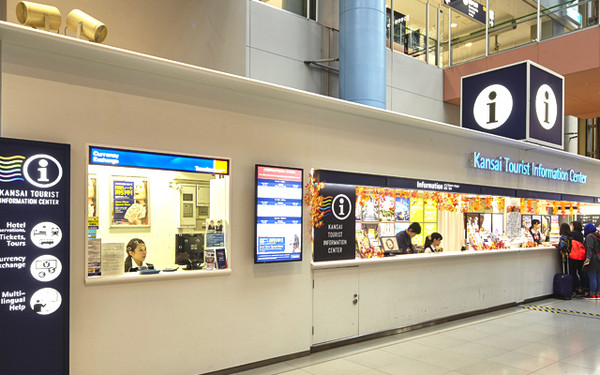
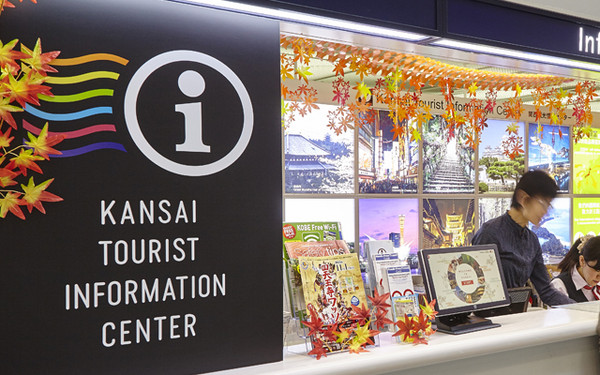
▲Tourist information center inside Kansai Airport (Photo / Kansai Airport Tourist Information Center official website)
In addition to services such as currency exchange (Japanese yen), hotel booking assistance, guided tour reservations, and the sale of prepaid SIM cards for internet access, this service center also sells a variety of tickets, which are explained below.
1) Osaka Amazing Pass 1-day and 2-day tickets
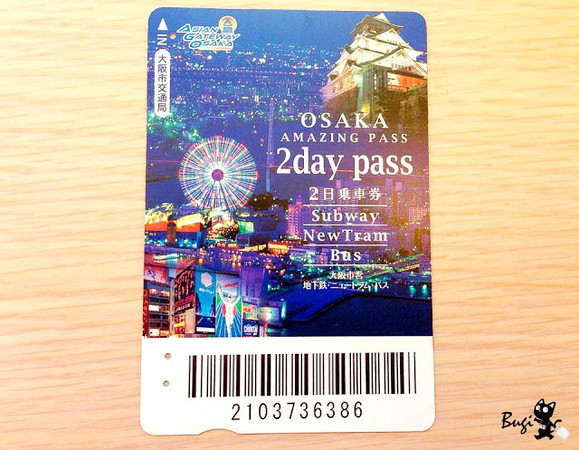
Many people visiting Osaka purchase this type of ticket. The 1-day pass costs 2,300 yen, and the 2-day pass costs 3,000 yen. The one purchased here was the 2-day pass. When buying, the ticket seller provides a discount guidebook that details the various discounts available.
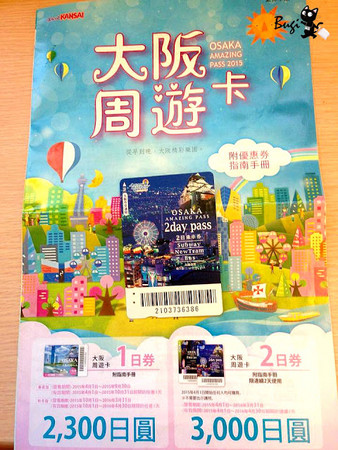
The pass allows free entry to "28 famous Osaka attractions and facilities," such as the Umeda Sky Building Observatory (regular price 800 yen), Dotonbori River Cruise (regular price 900 yen), Osaka Castle (regular price 600 yen), Tempozan Ferris Wheel (regular price 800 yen), and the sail-shaped sightseeing boat Santa Maria (regular price 1,600 yen).
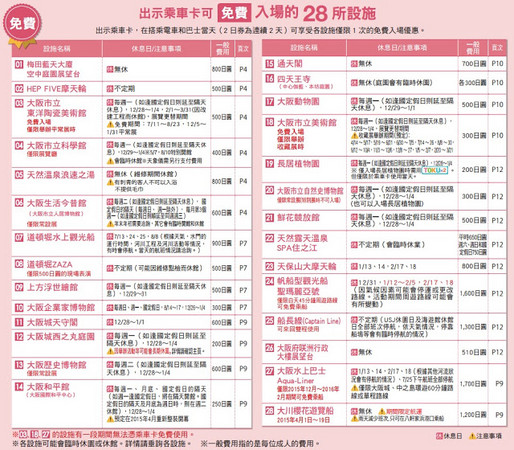
▲28 free attractions and facilities,http://www.osaka-info.jp/osp/cht/facility/free.php(Photo / Osaka Amazing Pass official website).
In addition, the 1-day pass allows unlimited rides on Osaka’s "subways, new tram lines, and private railways" (JR lines not included) during the validity period; the 2-day pass allows unlimited rides on "subways and new tram lines" for two days (private railways and JR lines not included).
※Transportation routes covered by the 1-day passhttp://www.osaka-info.jp/osp/cht/kukan/kukan_1day.html.
※Transportation routes covered by the 2-day passhttp://www.osaka-info.jp/osp/cht/kukan/kukan_2day.html.
Essentially, if you use this 1-day or 2-day pass in Osaka to ride the subway and visit at least three of these 28 attractions, it’s almost always worth it. You can visit the link above to see which of the 28 attractions interest you, add up their regular prices, include transportation costs (a single subway ride is around 300–400 yen), and if it seems like a good deal, go ahead and buy it!
※Full version of the Osaka Amazing Pass discount guidebook:http://www.osaka-info.jp/osp/cht/pdf/guide.pdf.
2) Kyoto & Osaka Sightseeing 1-day and 2-day passes (Kyoto-area train discount tickets, sales period: March 2016)
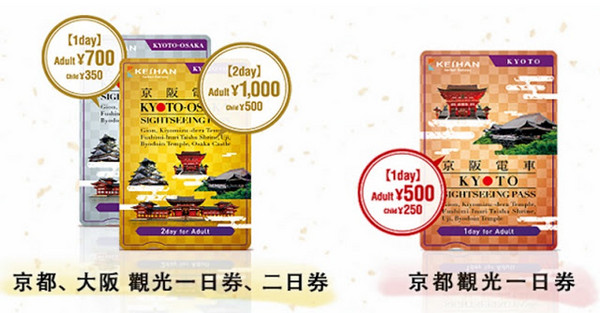
※Related information:http://www.keihan.co.jp/travel/tw/discountticket.html.
3) Kansai Thru Pass (KTP) 2-day and 3-day tickets
KTP is also a transportation discount ticket, but it covers more than just Osaka and Kyoto — it can also be used in Kobe, Himeji, Nara, Wakayama, Mt. Koya, and other areas. Within the validity period, there's no need to use it consecutively (Sundays excluded). Upon arriving at Kansai Airport, you can also take the Nankai Electric Railway from the airport to Osaka using the Kansai Thru Pass (the premium rapi:t express train requires an additional fee).
The Kansai Thru Pass comes in a 2-day version (4,000 yen) and a 3-day version (5,200 yen). During the valid period, it doesn’t have to be used consecutively. For example, the 3-day pass could be used on Monday, Wednesday, and Friday.
※Kansai Thru Pass official website:http://www.surutto.com/tickets/kansai_thru_hantaiji.html.
※Transportation routes and areas covered by the Kansai Thru Pass:http://www.surutto.com/images/ticket/kansai_thru_pass/english/en_map.pdf.
The official site has even produced a promotional explainer video for the Kansai Thru Pass — those who want to learn more can check it out!
4) Kintetsu Rail Pass 5-day ticket
This 5-day pass costs 3,800 yen per adult and allows unlimited rides across the entire Kintetsu Railway network, covering Osaka, Nara, Kyoto, Ise-Shima, and Nagoya.
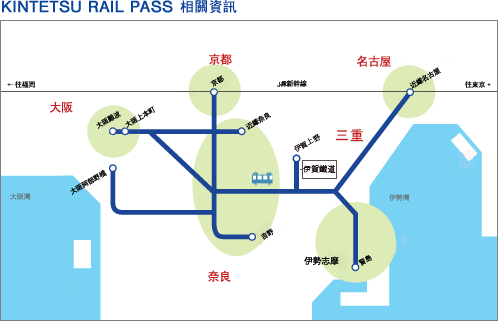
▲Coverage area of the Kintetsu Rail Pass (Image / Kintetsu Railway official website).
▲Travel times and fares for Kintetsu Railway trains from Osaka and Nagoya to various destinations (Image / Kintetsu Railway official website).
5) Universal Studios Japan Admission Ticket
The adult ticket is 7,200 yen including tax. However, only the standard admission ticket is sold here; express passes are not available. For express passes, you need to purchase them online in advance, through a travel agency, or queue up to buy them on-site.
-----------------------------------------------------------------------------------------
The above are the tickets available at the tourist information center on the 1st floor of Terminal 1, as researched by Buji. There may be other tickets not mentioned here, or if there are any errors, please feel free to let us know.
Once again, if you’re unsure which tickets to buy, it’s recommended to first outline the places you want to visit and your general itinerary, then decide which type of ticket suits your needs. For example: if you plan to visit three or more of the 28 attractions covered by the Osaka Amazing Pass, then the “Osaka Amazing Pass” would be quite cost-effective; if you’re traveling to Osaka, Kyoto, and Nagoya, the “Kintetsu Rail Pass 5-day Pass” could also be a good option; if you’ll be moving around Kyoto, Osaka, and Kobe within five days, you might consider the “Kansai Thru Pass,” which focuses on subways, private railways, and buses, or the “Kansai Area Pass” or “ICOCA & HARUKA Ticket” for JR-based travel (other JR West Japan rail passes can generally be skipped).
Want to see moreof Buji’s independent travel experiences
Welcome to joinBuji’s Fan PageandBuji’s Blog
Share
This article is published by HowToTrip. Sharing and reposting are welcome — please credit the source.
Article URL: https://www.howtotrip.net/views-9321
Related Articles
- Shaoxing's "Grandpa Gourd" hangs the gourds back up: "If there are too many people, we'll interact less — just take a quick look from afar"
- Chinese authorities announce "reciprocal adjustment" to Japan visa fees — single-entry visa jumps from 2,250 to 16,750 yen!
- The "health stones" carried by a traveler were found to have radiation levels exceeding safety limits by a thousand times, potentially endangering fellow passengers on the same flight. Customs issues warning!
- Shenzhen Airport Issues Late-Night Notice: Unidentified Aerial Object Detected, Causing Widespread Flight Delays!
- “They only said it cost money after I opened the box and washed it!” 200g of grapes sold for 60 yuan on a high-speed train—12306 responds!
- Can't buy an airline ticket? Denied exit? Blocked from boarding? A large number of Chinese tourists have mysteriously become "discredited individuals"
- Adverse weather and economic fluctuations impact Colombia's coffee market
- Beach bathing area responds to 2 yuan/30 seconds fee for freshwater foot rinsing: Clearly priced!
- Taking off with an improperly closed cabin door? Wing malfunction? Multiple flights made emergency returns mid-journey!
- Experience the gifts of nature! A countdown of the world’s ten most stunning coastlines