There are more udon shops than traffic lights in Japan's Kagawa Prefecture, where strong arms knead out chewy noodles!
By Eiiko Nagahama, Comics by Ueki Tsuru / "The Japanese 47-Prefecture Gourmet Map," published by Kokudosha Publishing
Translator: Wei-Pin Huang
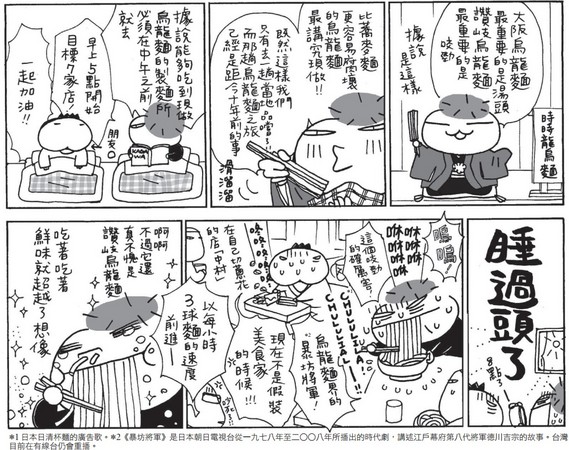
Kagawa is Japan’s narrowest and most compact prefecture. When it comes to local cuisine, you can’t help but think of udon and udon and udon.It’s said that there are more udon shops than traffic lights, and now the number of udon shops across the prefecture, big and small, adds up to over 800.
Even standard café menus usually include udon, so it’s really impressive. People eat udon for breakfast, udon for lunch, and even udon when they’re drunk — I couldn’t help but think that over eighty percent of the bodies of Kagawa residents must bemade of udon.
Why is this place the kingdom of udon? Because it’s home to high-quality wheat, salt, and soy sauce, but most importantly, it produces a lot of dried sardines, the key ingredient for dashi broth. With all these ingredients readily available, it’s like having Momotarō with his monkey, dog, and pheasant companions.
Most udon shops in Kagawa operate on a self-service basis: you cook the noodles yourself, pour the broth, and add your own toppings. I imagine that when Kagawa folks see a “self-service” sign at a gas station, they might just be tempted to start cooking udon. In the past, I studied udon-making at the Sanuki Udon School, and the process is actually quite simple. It’s just mixing flour with salted water several times, kneading, resting, cutting, and boiling.
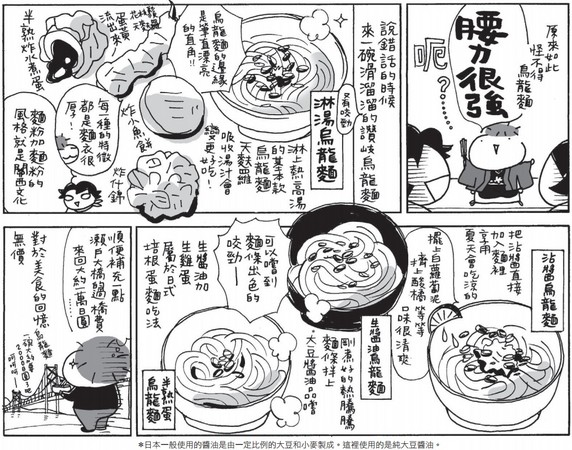
It’s really “just that,” but there’s a technique to the process, and it affects the flavor of each shop’s udon. For example, kneading isn’t just about brute strength. The instructor would say:“Use your hips!”So I pushed with all my might, like in sumo pillar-pushing training, and the dough suddenly gleamed — it was incredible. Strong udon requires powerful hip strength.
In addition, Kagawa residents also love sweet flavors. Basically, the seasonings in their dishes tend to be on the sweet side. For ozoni (New Year’s rice cake soup), they use white miso broth and even add red bean mochi. As you eat, the red bean paste melts into the soup, and you can’t tell if you’re eating ozoni or a red bean soup with mochi — but that’s part of the fun.
The spiritual food of Kagawa residents:
Hard Bread ● Said to be the hardest senbei (rice cracker) in history.
Glutinous Rice Candy Balls ● Colorful hollow spherical cookies, usually given as wedding favors to guests.
Deliciousness non-stop from morning to night
Download the “ETtoday News Cloud APP” for quick updates on the latest food info →
iOS:https://goo.gl/rmIDdx
Android:https://goo.gl/XPe8Uj
Share
This article is published by HowToTrip. Sharing and reposting are welcome — please credit the source.
Article URL: https://www.howtotrip.net/views-9320
Related Articles
- Shaoxing's "Grandpa Gourd" hangs the gourds back up: "If there are too many people, we'll interact less — just take a quick look from afar"
- Chinese authorities announce "reciprocal adjustment" to Japan visa fees — single-entry visa jumps from 2,250 to 16,750 yen!
- The "health stones" carried by a traveler were found to have radiation levels exceeding safety limits by a thousand times, potentially endangering fellow passengers on the same flight. Customs issues warning!
- Shenzhen Airport Issues Late-Night Notice: Unidentified Aerial Object Detected, Causing Widespread Flight Delays!
- “They only said it cost money after I opened the box and washed it!” 200g of grapes sold for 60 yuan on a high-speed train—12306 responds!
- Can't buy an airline ticket? Denied exit? Blocked from boarding? A large number of Chinese tourists have mysteriously become "discredited individuals"
- Adverse weather and economic fluctuations impact Colombia's coffee market
- Beach bathing area responds to 2 yuan/30 seconds fee for freshwater foot rinsing: Clearly priced!
- Taking off with an improperly closed cabin door? Wing malfunction? Multiple flights made emergency returns mid-journey!
- Experience the gifts of nature! A countdown of the world’s ten most stunning coastlines