Pictures speak louder than words! The Divine Palette in the West: 6 Must-Visit Fairyland Destinations in Northern Xinjiang
Text provided by Qidou Travel Network; photos provided by Xin’an Travel
The colorful verses sung by poets can be found at Five-Color Beach,
The heavenly melodies played by musicians echo through Kanas Moon Bay,
The vibrant masterpieces painted by artists grace the Erersi Grand Canyon,
The vast open lands beloved by sports enthusiasts lie in Buluke Grassland,
The imaginative world of gamers comes alive in the Nine-Bend Eighteen-Curve area,
The filming location of the Oscar-winning movie Crouching Tiger, Hidden Dragon is Devil’s City,
The magical landscapes of the Western Regions seem like the backdrop of Journey to the West—these enchanting sights in northern Xinjiang are like God’s own palette, painting the earth in the most diverse colors~
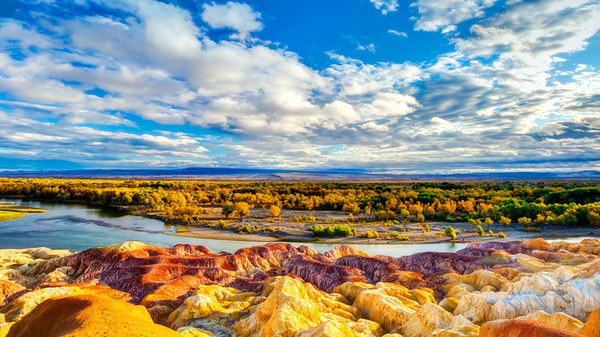
Five-Color Beach
Known as the “No. 1 Beach under Heaven,” Five-Color Beach is traversed by the Irtysh River—the only river in China that flows into the Arctic Ocean—which also contributes to the legendary beauty of Five-Color Beach.
Five-Color Beach presents a stark contrast on both sides of the river: the southern bank features oases, deserts, and a blue sky meeting in harmony; the northern bank showcases cliff-like Yardang landforms, with undulating hills and ever-changing hues. The jagged outlines of the riverbank rock layers, illuminated by the setting sun, display a spectrum dominated by red, interspersed with green, yellow, white, black, and transitional shades—truly living up to its name as “Five-Color Beach.”
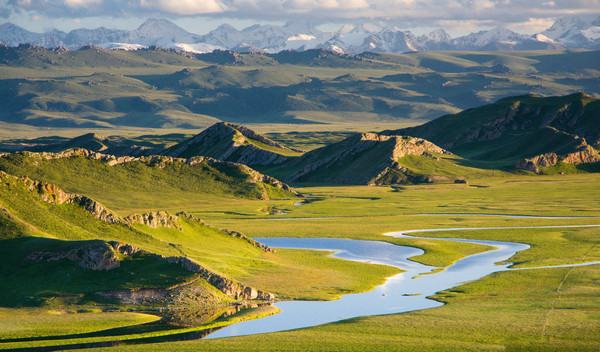
Bayinbuluke Grassland
The expansive Bayinbuluke Grassland lies within an intermountain basin in the central Tianshan Mountains, surrounded by snow-capped peaks at an altitude of about 2,500 meters. It is the second-largest grassland in China, with flat terrain and lush water and grass, making it the richest summer pasture on the southern slopes of the Tianshan.
“Bayinbuluke” means “rich springs” in Mongolian. When summer arrives, the grassland bursts with layered greens, boundless pastures, widespread lakes and marshes, and herds of cattle and sheep—a scene of thriving vitality. The nine ethnic groups living here—including Mongolian, Han, Tibetan, and Kazakh—have adapted to the local environment with their own unique lifestyles, contributing to a rich tapestry of ethnic culture.
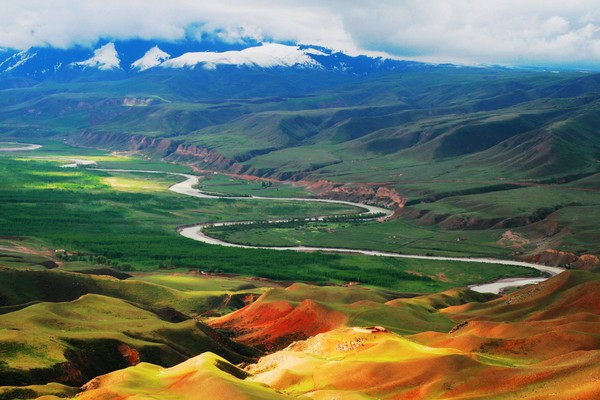
Nine-Bend Eighteen-Curve
Not far from Bayinbuluke Grassland, the Nine-Bend Eighteen-Curve stretches 576 kilometers with as many as 1,142 bends. Locals describe it as: “The winding waters flow eastward, twisting and turning until they finally reach their end.” The meandering river seems to tell age-old stories. Standing atop Baxilik Mountain by Swan Lake, you can almost hear the myths that have been passed down through the ages.
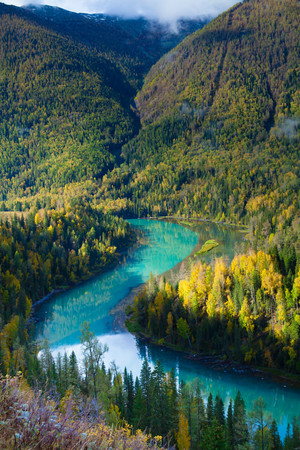
Kanas Moon Bay
“Kanas” means “beautiful, rich, and mysterious” in Mongolian. Kanas Lake is located in the northern part of Burqin County in Xinjiang, with a surface elevation of over 1,300 meters—making it a true alpine lake. Moon Bay is the most famous attraction of Kanas Lake. Here, the lake traces a graceful arc, as if a bright moon has fallen into this densely forested canyon, captivating countless visitors.
In the eyes of locals, nothing can rival the beauty of the moon quite like Moon Bay. From spring to autumn, from morning to evening, under varying weather conditions and light, the shimmering waters continuously transform into a mystically charming spectacle, offering endless stunning scenes for photography enthusiasts.
Erersi Grand Canyon
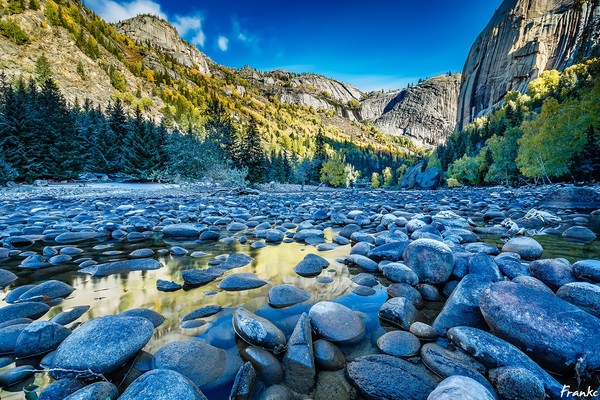
The Erersi Grand Canyon in the Keketuohai National Park is a mysterious art gallery along the Erersi River. The ceaselessly flowing Erersi River winds through mountains, grasslands, and dense forests, painting exquisite masterpieces. As travelers walk through the canyon, towering and uniquely shaped granite peaks line both banks, each with its own distinct form and seemingly carrying centuries of history of the Kazakh herders, telling tales of the passage of time.
Devil’s City
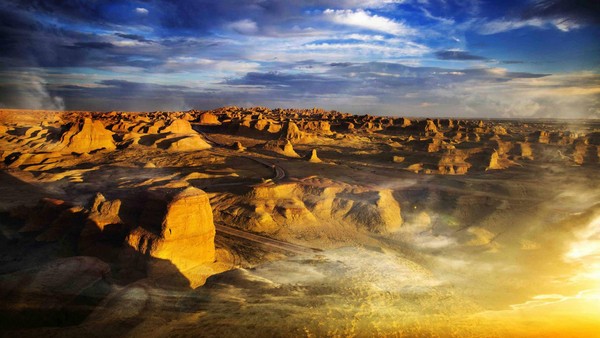
“Yardang” is a geographical term, meaning “steep earthen mounds” in Uyghur, referring to a unique landform found in arid regions. The ground in the Devil’s City area is cracked, with small shrubs like camel thorn scattered across the land. The table-like mountains here, composed of reddish and gray-green rock layers, have been eroded by water and shaped by windblown sand over millions of years, resembling ancient city walls, fortresses, and palaces, along with many vividly realistic animal and plant-shaped rock formations.
Every summer and autumn, Devil’s City is often swept by winds of force seven or eight. The wind howls through the valley, carrying sand and stones that produce eerie sounds like ghostly wails—hence the name “Devil’s City.” Known as a natural museum, the unique geological features of Devil’s City have made it a popular filming location, including for the critically acclaimed Oscar-winning film Crouching Tiger, Hidden Dragon.
After admiring the breathtaking scenery of northern Xinjiang, are you ready to explore it yourself? Before you go, remember to do your homework and brush up on some fun facts:
“Bayinbuluke” in Mongolian means ~ rich springs
“Kanas” in Mongolian means ~ beautiful, rich, and mysterious
“Yardang” in Uyghur means ~ steep earthen mounds
More related information
Recommended itinerary: 【China Airlines Direct Flight Urumqi - North Xinjiang Premium 10+1 Day Tour】Hemu Village, Nalati, Kanas Lake Jianyuan Mountain Villa, Koktokay, Bayinbuluke, No Shopping, No Hidden Fees, Free WIFI in Vehicle. Early Bird Discount: Book & Pay Deposit before March 15 to enjoy a Second Person Discount of NT$3,000.
Guaranteed accommodation at Jianyuan Mountain Villa by Kanas Lake, just 230 meters from the breathtaking Kanas Lake. Stay right in the scenic spot and immerse yourself in the beauty of a fairyland on earth.
Shin An Travel 4499-669 (add 02 for mobile)
Websitewww.peacetour.com.tw
Share
This article is published by HowToTrip. Sharing and reposting are welcome — please credit the source.
Article URL: https://www.howtotrip.net/views-8166
Related Articles
- Shaoxing's "Grandpa Gourd" hangs the gourds back up: "If there are too many people, we'll interact less — just take a quick look from afar"
- Chinese authorities announce "reciprocal adjustment" to Japan visa fees — single-entry visa jumps from 2,250 to 16,750 yen!
- The "health stones" carried by a traveler were found to have radiation levels exceeding safety limits by a thousand times, potentially endangering fellow passengers on the same flight. Customs issues warning!
- Shenzhen Airport Issues Late-Night Notice: Unidentified Aerial Object Detected, Causing Widespread Flight Delays!
- “They only said it cost money after I opened the box and washed it!” 200g of grapes sold for 60 yuan on a high-speed train—12306 responds!
- Can't buy an airline ticket? Denied exit? Blocked from boarding? A large number of Chinese tourists have mysteriously become "discredited individuals"
- Adverse weather and economic fluctuations impact Colombia's coffee market
- Beach bathing area responds to 2 yuan/30 seconds fee for freshwater foot rinsing: Clearly priced!
- Taking off with an improperly closed cabin door? Wing malfunction? Multiple flights made emergency returns mid-journey!
- Experience the gifts of nature! A countdown of the world’s ten most stunning coastlines