A Private Space for New Yorkers: A Casual Café Run by a French Owner
Text and photos by Huang Zhijun, excerpted from *New York Studies*, published by Times Publishing
It’s said that New York apartments are too cramped and dim, so New Yorkers all have a go-to café that serves as their personal living room—a place they visit now and then to unwind, much like the “Central Perk” in the TV series *Friends*. Indeed, I have such a spot in New York, and the owner is a French woman.
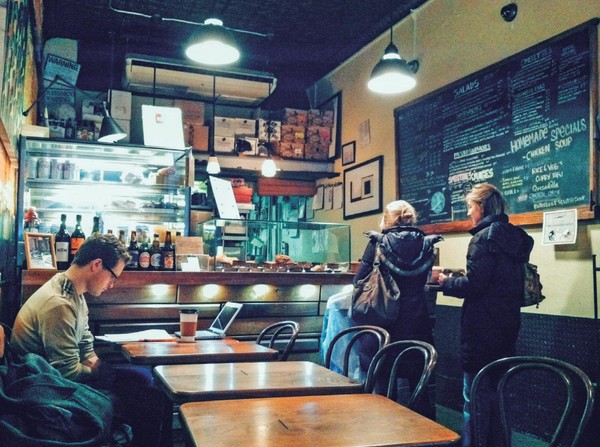
I didn’t fall in love with this café at first sight. Its style was a bit unkempt, as ordinary as a neighborhood grocery store downstairs, and I was somewhat disappointed to have made a special trip, as if I had dressed up for a formal dinner only to find it was just a casual family meal. On the other hand, a part-time young man behind the counter left a deep impression on me—he was one of the few servers in New York who would flash a genuine smile and genuinely care about customers’ needs.
So I gave the café a second chance and, on the part-timer’s recommendation, ordered a bacon and egg sandwich. I still remember how the yolk oozed out of the whole wheat toast, covering the lettuce and tomatoes, reminding me of the breakfast shops at Taipei street corners. From then on, I visited irregularly, hoping for more pleasant surprises—even though the part-time young man eventually disappeared.
This café isn’t a “coffee shop” where coffee takes a backseat to food, but rather the opposite—a “café.” In New York, you go to the former for good coffee and the latter for a filling meal. Though called a “café,” this place serves coffee that rivals that of a coffee shop, and with both food and drinks available, it gradually became my go-to spot for caffeine and lunch.
When I lived in Jersey City, I often took a book, hopped on the subway for one stop across the river, and spent my time at this café—reading, sipping coffee, and having lunch—usually a ham and egg scramble mixed with scallions and Swiss cheese, or a flaky yet soft chocolate croissant—until I left half an hour before class. After moving to Manhattan, it took just two minutes to walk here, so I’d often bring a newspaper or laptop and spend the afternoon there.

There are actually several cafés within walking distance of my apartment, but none offer as diverse or exciting a menu as this one. On hot days when I have no appetite, I’d order a vinaigrette salad; on cold days when I need something warming, I’d have a bowl of chicken soup with a few slices of baguette; if I’m just craving a snack, one of their homemade cookies or muffins baked at the bakery in the meatpacking district is perfect; if I’m watching my diet, a freshly blended veggie juice with any three ingredients is always delicious.
Even the classic Western sandwich gets creative twists here, with seasonal variations to suit different tastes. After hanging around for a while, I found out the café is run by a French woman. No one told me she was the owner, but the way she carried herself made it clear she wasn’t just another part-timer.
The woman is from Paris, around 45 years old, with dry, dark brown long hair and an olive-toned complexion that makes her look like she was born along the Mediterranean coast—strikingly conspicuous in the mostly blonde, fair-skinned West Village. Her lips are always painted a bold red, and her English is thick with a heavy French accent, pronouncing “croissant” in the original French way, “kwa-song.” She dresses fashionably yet appropriately—wearing a black leather jacket in autumn, floral dresses in spring—and often rides a vintage-style bike to the café, sometimes carrying a bouquet of flowers, as if the air around her is filled with the sound of an accordion playing chansons.
Yet the French woman isn’t the warm, welcoming type. Most of the time, she wears a stern expression, as if indifferent to whether you eat or not. Even though I know she’s the owner and she recognizes my rare Asian male face in the café, our conversations never go beyond ordering. Occasionally, when she’s in a good mood, she might force a small smile at me, a regular who visits at least three or four times a week.
Her management style is also quite hands-off. Especially since modern workplaces emphasize the efficiency of “division of labor,” this café still operates on a pre-industrial linear production model: the two staff members behind the counter don’t split roles like at Starbucks—one taking orders and the other making coffee—but instead each handles a customer from start to finish. As a result, any extra customers are left waiting while part-timers are busy slicing bagels or frothing milk, ignored.
Perhaps the workload of doing everything like an octopus is too exhausting, because staff turnover here is extremely high. Often, within a few months, it’s a whole new set of faces. As a regular, I went from asking names and greeting everyone to just treating them as acquaintances.
For a while, two part-timers lasted six months, always cheerfully calling me “Kim,” and even scolded me for not knowing their names. But just weeks after learning they were named “Fen” and “David,” one quit, hat in hand, and the other was fired by the French woman. With frequent staff shortages, during peak breakfast and lunch hours, I’d sometimes see the French woman, her husband, and son pitching in to help.
Even with such management, which often leads to disgruntled customers walking out or lines forming out the door, the French woman remains unfazed, calmly handling transactions or introducing the day’s doughnut flavors. The part-timers, earning only fixed hourly wages, are actually happier when it’s slow—they take their time, and no one rushes.
Faced with the French woman’s blunt and carefree attitude, New Yorkers, who live by the mantra of capitalism, can only shake their heads and sigh. But just as New Yorkers still yearn for Paris, this café retains its unique charm, bustling with business all year round.
The portions here are hearty enough to feed a laborer—sometimes so much that I skip dinner—but the quality is on par with the refined French bistros in the West Village. The décor is simple, even a bit run-down, but the walls are painted a bright orange-red, adorned with a few art pieces that may be for display or sale. The tables and chairs aren’t fixed, so customers often push them together in a cozy mess. Someone’s biting into a tomato-topped biscuit while reading, another sipping a peanut-butter fruit smoothie with a newspaper—intimate and harmonious. With fewer than twenty seats, no restroom, but free Wi-Fi and multiple outlets, I used to sit for hours without anyone rushing me away.
The café is located on the edge of the West Village, surrounded by one of Manhattan’s rare purely residential areas. Its unassuming exterior means you could easily walk past it, so most customers are local neighbors, with few tourists or office workers stopping by. This allowed me to observe a few familiar faces.
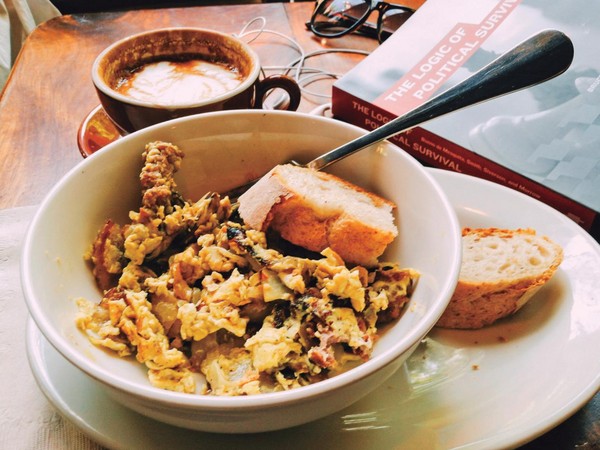
One elderly woman, likely nearing her nineties, was a regular like me. They say eating is a blessing, and though her hair was snow-white, her appetite was no less than that of a growing young adult. She always ordered an egg roll with salad, then slathered a thick layer of butter on the accompanying whole wheat toast, sometimes adding a few drops of honey for extra flavor. Despite her hearty appetite and plump figure, she always kept an orange plastic pill bottle on the table, as if subtly reminding others that if she ever collapsed, feeding her the pills inside would be the right move.
The white-haired grandmother was never seen with family or friends, yet she lived a comfortable, content life. She often tried to chat with other customers—even if most New Yorkers responded indifferently—and after meals, she’d take out a compact mirror, carefully apply lipstick to her lips, and leave with a smile, leaning on her cane.
Another elderly woman, also with white hair but dyed a rebellious lake green and tied into two playful braids, was probably an old-school hippie who’d been around the West Village since the ’60s or ’70s. The green-haired granny always brought a novel, a coffee, and a cookie, often reading so intently that she’d giggle to herself. Whenever I saw her or the white-haired granny, I reminded myself to live just as carefree and graceful in old age.
Of course, this café isn’t just for retirees. One slightly stocky middle-aged man always stared intently at his laptop screen, monitoring stock market trends. I, who liked to read the *Financial Times* over coffee, must have caught his attention, because one day he finally approached me.
Turns out, the man ran his own hedge fund and used this café as a place to catch up on financial news while eating. Perhaps sensing a kindred spirit, the well-connected fund manager later introduced me to a company that analyzed distressed bonds. From then on, whenever we met at the café, we’d chat about which markets were unstable or which bonds were worth investing in—even though financial trading wasn’t my field, and I could only respond with vague murmurs.
This Algerian man was also a regular at the café. He’d often chat with the French woman in fluent French, but I hadn’t seen him for a while since that winter we met. *The Economist* once noted that the average lifespan of a hedge fund is only five years. I don’t know whether this fund manager made a fortune and left for greener pastures or suffered heavy losses and scrambled to sell off assets, but I’m grateful for his guidance.
New York truly lives up to its title as the “city of opportunity.” At this café, I even encountered that fund manager who once offered to connect me with Wall Street.
Another man, seemingly in his thirties, had wild blond hair like a flaming crown atop his head, with a bright fluorescent headband around his forehead. His entire outfit was unrestrained, clearly in the fashion scene, and he seemed worlds apart from me. Maybe noticing that I always read the *Financial Times* here, the blonde guy once introduced himself—he had studied applied math at the London School of Economics, worked in finance for a few years, then decided to chase his dream and switch to fashion design, now running a studio in the meatpacking district.
Just as I was marveling at how New York has every kind of person—how a financial analyst could become a flamboyant fashion designer—the blonde guy, upon learning I was from Taiwan, suddenly mentioned he spoke “Mandarin” and launched into a heavily accented introduction of his business spanning the Pacific, shuttling between New York and Shanghai, even boldly declaring that Chinese and English were the only important languages, and the rest weren’t worth learning.
Before I could process the blonde guy’s multifaceted background, he left his email, saying he could introduce me to financial firms looking for Chinese speakers. But when I actually reached out, I heard nothing. Later, when I ran into him at the café, he acted as if nothing had happened and chatted casually—it seems he’s quite adept at socializing, no wonder he moves so freely between finance and fashion in New York.
Hollywood celebrities love staying in the West Village when in New York, and I once spotted an Oscar-winning actress at this café. One day, I noticed a woman in casual sportswear diagonally across the table who looked familiar. My journalist instincts told me it might be Hilary Swank. But with a mirror reflecting behind me, I couldn’t pull out my phone to check. It wasn’t until she stepped out to take a call, and other customers excitedly asked her companion, that I confirmed it.
My impression of Hillary Swank had always come from the Oscars, where I pictured her as a tall and sturdy woman. But in person, she turned out to be surprisingly petite and slender. Being so close that I could’ve reached out and touched her, I couldn’t help but observe her every move. A few times, our eyes even met — yet I was surprised to find that this big star was somewhat… not very approachable or friendly.
The moment she walked into this café, she naturally asked the staff to change the indie rock that was playing. I was taken aback, wondering who would dare to be so bold — not even French women usually tell employees what music to play. But no matter. Sometimes I’ve felt the urge to ask the part-timer not to keep playing Billboard chart-toppers either, since inappropriate music can easily ruin the vibe of a café.
What surprised me even more was that despite being a two-time Academy Award-winning Best Actress, the star seemed anxious about whether people would recognize her as famous. Yet New Yorkers are used to spotting celebrities on the street and mostly just take it in stride. She ended up resorting to all sorts of dramatic gestures to announce to the world that a Hollywood celebrity was present. But when an middle-aged woman finally asked for a photo, she put on airs before reluctantly agreeing — which really turned my stomach.
From silver-haired grandmas and green-haired grannies, to fund managers, fashion designers, and even Oscar-winning actresses, the most memorable person I encountered in this café was actually an ordinary-looking young man.
One time, I was carrying a textbook, planning to spend the afternoon buried in it at the café. As I placed the book on an empty table, the young man at the next table and his girlfriend exchanged incredulous glances. Thinking I’d taken their space, I quickly apologized — only to have his girlfriend say, “No, it’s just that my boyfriend works as an online instructor for the publisher of your textbook. And look at the cover photo — the guy on the right is him!”
As I compared the photo, the man blushed bright red and waved at me. We both couldn’t believe how crazy the coincidence was. I hurriedly opened the textbook and asked him to sign it. Other customers gathered around, curious about what was going on. The man, seemingly shy by nature, instead closed the book and signed his initials on the roundish forehead of the guy in the photo — making a joke of himself.
While ordering, I caught him excitedly taking a selfie with my textbook. I told him the book was great and had taught me a lot. Before leaving, he left me a ballpoint pen from that publisher, joking that using it would help me ace my exams. Later, I looked him up online and found out he was actually a Harvard graduate — a real high achiever. New York really is full of talent.
I truly cherish having such a French-run café near my apartment. Not only is the food delicious and affordable, but I’ve also met all kinds of New Yorkers here. Even though I sometimes get impatient waiting over ten minutes for a sandwich, if efficiency is what I’m after, I guess I’ll just go to Starbucks.
Share
This article is published by HowToTrip. Sharing and reposting are welcome — please credit the source.
Article URL: https://www.howtotrip.net/views-8046
Related Articles
- Shaoxing's "Grandpa Gourd" hangs the gourds back up: "If there are too many people, we'll interact less — just take a quick look from afar"
- Chinese authorities announce "reciprocal adjustment" to Japan visa fees — single-entry visa jumps from 2,250 to 16,750 yen!
- 旅客携带的“保健石”核辐射超标千倍,同机人员或遭殃!海关提醒!
- 深圳机场深夜通报!出现不明升空物,航班大面积延误!
- “拆盒洗了才说要钱!”高铁200克葡萄卖60元,12306回应!
- 买不了机票?出境被拒?登机被拦?一大波中国游客莫名成了“失信人”
- 不利天气和经济波动影响哥伦比亚咖啡市场
- 海边浴场回应冲脚淡水收费2元/30秒:明码标价!
- 舱门没关好就起飞?机翼出现问题?多个航班途中紧急折返!
- 感受大自然的馈赠!盘点世界十大唯美海岸线