Jogging: The Must-Have Fashionable Sport for New Yorkers — A View of Life Along the Hudson River
Text and photos by Huang Zhijun, excerpted from *New York Studies*, published by Times Publishing
The image of New Yorkers as sports enthusiasts has spread globally through films and TV series. Indeed, Manhattan is filled with people in full athletic gear who brave the crowds and traffic to jog while sweating profusely. So one of my friend's sightseeing activities was to follow suit and run in Central Park. I don’t live near Central Park, but I’m equally diligent about jogging to avoid becoming an American-style overweight person, and no matter how I run, I always end up along the Hudson River.
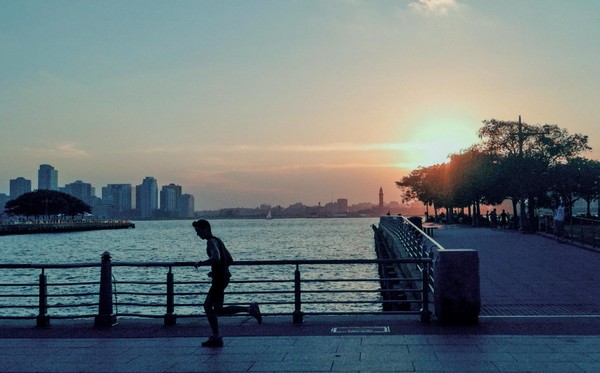
When I lived in Newport in Jersey City, my apartment was right next to the right bank of the Hudson River, with a waterfront path just downstairs. But in winter, it gets pitch dark by 4 p.m., and not wanting to run too far, I would just circle around Newport. Even though only half the time was spent along the riverbank, it was enough to take in the sexy and alluring skyline of Manhattan.
I still remember one freezing winter night when, while running, I looked across the river at the neon lights flickering. At that moment, perhaps due to the endorphins released by exercise, I suddenly fell completely in love with New York. When daylight saving time began in spring and it was still bright out at 7 p.m., I would run south along the waterfront path toward "Exchange Place." Exchange Place faces the Manhattan financial district, and on 9/11, many office workers were able to escape the smoke-filled lower Manhattan — surrounded by water on three sides and with the Twin Towers collapsed on the fourth — thanks to the ferries heading to Exchange Place. After the event, the financial district was left in ruins, and many banks moved to Exchange Place, just across the water, to start anew. The Jersey City waterfront, including Newport, also evolved into what the locals call the "West Wall Street."
Compared to aimlessly circling the stiff and cold residential towers in Newport, the scenery along the way to Exchange Place is much richer. Not only are the skyscrapers of the Manhattan financial district so close they look like postcards right in front of you, but you can also admire the luxurious buildings where the middle class lives and the high-end hotels frequented by businesspeople. When you reach the southernmost part of Exchange Place, you can even catch a glimpse of the Statue of Liberty standing proudly in the bay, as if she’s congratulating me for reaching the finish line.
However, I’m used to jogging during the soft glow of dusk. By the time I reach Exchange Place, it’s when a large number of sharply dressed bankers are heading home from work. I, in my sporty outfit, red-faced and panting, always feel awkward as I become an unintentional focal point among them. And by the time I see the Statue of Liberty, I’m at my physical limit — either I take a half-hour walk or hop on the "Hudson–Bergen Light Rail" to get back to Newport. I don’t mind walking slowly back to my apartment, but Exchange Place, like the financial district, becomes deserted in the evening, leaving behind eerily empty streets and vacant buildings. Even if it’s safe, the atmosphere is still unsettling.
So later, I started running north toward "Hoboken." Hoboken is a middle-class white community, and its scenery is vastly different from the glass-curtain-wall-dominated Newport and Exchange Place. It mostly consists of brownish-red stone-brick houses. Hoboken is also a transportation hub connecting New Jersey to New York. Before the PATH trains and New Jersey Transit routes cross the Hudson River into Manhattan, they all converge at Hoboken Terminal. The station is a deep-brown clock tower building, which stands out prominently in the low-rise buildings of Hoboken and has become a local landmark.
The clock tower, which always glows faintly red in the evening, is my destination every time I run toward Hoboken. Just as I won’t stop until I see the Statue of Liberty when running toward Exchange Place, but by the time I reach the clock tower, I still have enough energy to run back to Newport. Along the way, I can also enjoy the view of the Hudson River and the Manhattan skyline.
After moving to Manhattan, my apartment was just two blocks away from the left bank of the Hudson River. Unlike the right bank, which only has a waterfront path, the left bank features the better-planned "Hudson River Park," stretching from Battery Park City all the way north to Hell’s Kitchen. Living in the West Village, I would usually run south to Tribeca, then north to the Meatpacking District, and finally back to the West Village. I once tried to develop a new route, running all the way north from the West Village to Chelsea, but found that most of the time, whether it was sunlight or scenery, it was blocked by nearby docks and warehouses, so I gave up.
The stretch from Tribeca, the West Village, the Meatpacking District, to Chelsea happens to be the area with the highest density of single young professionals in Manhattan. Men and women are either obsessively trying to fit into those designer skinny jeans bought in SoHo to show off their butts or searching for sex and love in the markets, so naturally, they put effort into sculpting their bodies. Therefore, compared to the right bank, which is always filled with elderly, children, and families strolling and enjoying the scenery, the left bank is lively and vibrant.
On the left bank of the river, the outer side is a pedestrian path where people jog, walk dogs, or take kids out. The inner side is a dedicated bike lane where people cycle, rollerblade, or skateboard. On the lawns, there are yoga classes held outdoors, as well as personal trainers leading core workouts. There are also tennis courts and basketball courts nearby. Don’t forget to bring a book to read while waiting for your turn on the court. Among these groups, some are always hard to ignore, even when I’m running out of breath.
When I run near Christopher Street, I always spot African-American transgender individuals having wild fun (for some reason, it’s always African-Americans). They originally gathered in the Meatpacking District but later moved to Christopher Street, where the West Village is filled with gay bars. This street connects to the Hudson River Park and has several open recreational areas, so it’s common to see slim, dark-skinned, flamboyantly dressed figures lying, sitting, or dancing energetically to Beyoncé songs. Upon closer inspection, you’ll notice that the rough and rugged facial features are hidden beneath heavy makeup, and the sharp, piercing girlish voices are squeezed out by flattening their Adam’s apples.
If the transgender individuals are fully expressing their sensuality and charm, another group makes no effort to hide their masculinity. In the summer, about one in five white men jogging on the left bank of the river is shirtless. Even those lacking self-awareness, with sagging skin, still insist on publicly displaying themselves, but at least the ones who do take off their shirts have well-toned upper bodies — after all, the white men living nearby are either golden bachelors from Tribeca or gay men from Chelsea, all of whom care about their appearance. They go shirtless not just to get a tan but, psychologically, may also hope to catch the attention of passersby, just like the African-American transgender individuals. However, white people are more self-conscious and less ostentatious, but their jogging demeanor still reeks of narcissism.
Parents jogging while pushing strollers are also a major attraction on the left bank. I’m very impressed by how they manage to keep an eye on the stroller while running — some strollers even have more than one child, sleeping all over the place with drool all over their faces. Many couples in New York move to the suburbs after having kids for a simpler environment and lower living costs, but these parents are willing to stay in the crazy city to raise their children. They must have restless blood in their veins, which is why their energy isn’t easily drained by their kids, and they can still go out for exercise.
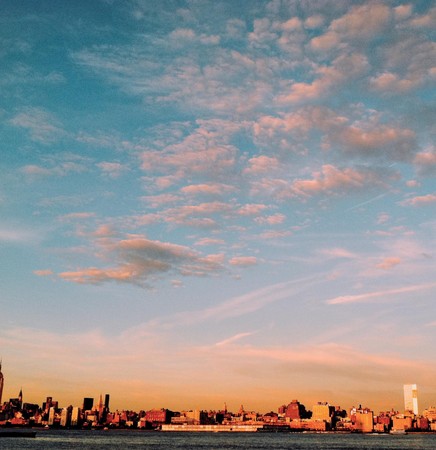
Although the Hudson River Park isn’t as famous as Central Park, there are still plenty of tourists busy taking photos of the riverside scenery. Sometimes I can’t help but stop and take a picture of the sunset painting the sky red. Once, halfway through my run, I noticed a family of four resting on a wooden bench. Just a few hours earlier, I had seen them at an outdoor café table in the West Village, and I never expected them to all end up on the left bank of the river. If they saw me hanging out in a café in the afternoon and exercising on the riverside in the evening, even if they didn’t develop a beautiful misunderstanding about life in New York, they’d probably confirm the established impression that "New Yorkers love to jog."
The stretch from Tribeca to the West Village on the left bank corresponds to Newport to Hoboken on the right bank. Left and right, but the mindset while running is vastly different. Although the right bank offers views of the Manhattan skyline, you always find yourself hoping to one day live in the city. Finally moving to the left bank, instead of missing the view, I feel proud to be jogging in Manhattan while looking at New Jersey.
But whether it’s the right or left bank, my jogging habit doesn’t change with time or place. Whether it’s the humid and stifling heat of early summer in New York, where sweat soaks through my clothes, or the heavy snowfall of deep winter, where I need every piece of cold-weather gear, every time I see New Yorkers sprinting down the streets, I snap out of any laziness and head out for a run.
Jogging is ultimately the most primitive form of physical activity. All it takes is a pair of shoes and yourself — no guidance, companionship, or equipment needed. It’s cost-effective and convenient. Having a running buddy might boost motivation, but if their pace doesn’t match yours, it can throw off your rhythm. That’s why I prefer putting on headphones, entering my own world, and focusing on moving forward. I avoid unnecessary chatter or physical interaction and fully enjoy the brief solitude and ever-changing scenery of the run.
Just like every other New Yorker I pass by, jogging alone.
Share
This article is published by HowToTrip. Sharing and reposting are welcome — please credit the source.
Article URL: https://www.howtotrip.net/views-7799
Related Articles
- Shaoxing's "Grandpa Gourd" hangs the gourds back up: "If there are too many people, we'll interact less — just take a quick look from afar"
- Chinese authorities announce "reciprocal adjustment" to Japan visa fees — single-entry visa jumps from 2,250 to 16,750 yen!
- 旅客携带的“保健石”核辐射超标千倍,同机人员或遭殃!海关提醒!
- 深圳机场深夜通报!出现不明升空物,航班大面积延误!
- “拆盒洗了才说要钱!”高铁200克葡萄卖60元,12306回应!
- 买不了机票?出境被拒?登机被拦?一大波中国游客莫名成了“失信人”
- 不利天气和经济波动影响哥伦比亚咖啡市场
- 海边浴场回应冲脚淡水收费2元/30秒:明码标价!
- 舱门没关好就起飞?机翼出现问题?多个航班途中紧急折返!
- 感受大自然的馈赠!盘点世界十大唯美海岸线