One June, I attended a lecture titled “Photography and Ecotourism.” The promotional email described it as a session on using photography to promote ecotourism, and the speaker was veteran photojournalist Daniel J. Groshong. I expected to learn some photography or marketing techniques, but instead, I discovered a new environmental concept.
 While in Timor-Leste, I also uncovered a pollution-free underwater world. One dive site was even named after him.
The speaker, Daniel, founded a charity in 2011 — The Hummingfish Foundation — based on the philosophy of “adding value to nature.” The aim is to help people in developing countries use natural resources to develop their economy and communities. By relying on nature for their livelihoods, people are more motivated to protect the environment. In the end, environmental conservation and social development can progress hand in hand. Over the years, the foundation has supported projects in places such as Sichuan, Thailand, and Timor-Leste.
After the lecture, I was quite shaken. As a native Hong Konger, my upbringing instilled in me the belief that society must keep moving forward, and improving lives requires economic development. Textbooks said Hong Kong had limited land and a large population, so new towns had to be developed. Back then, Hong Kong people, myself included, had little awareness or concept of environmental protection. Mountains, seas, and farmland could all be bulldozed, destroyed, or abandoned for economic gains. It seemed that environmental protection and social or economic development were always a matter of trade-offs. Even in recent years, as environmental awareness improved, discussions still revolved around how to strike a balance between the two — without giving up development or ecology. Later, I joined this small group as a volunteer, trying to put into practice the idea of co-development between environmental protection and the economy.
After that, I went with Daniel to Timor-Leste to visit two projects.
Upon arriving in Timor-Leste, I was struck by how similar the place and Daniel’s fate were — both having experienced death and rebirth. A former war photojournalist, he had ventured into conflict zones like Cambodia, India, and Pakistan. In the late 1990s, when Timor-Leste was fighting for independence, facing the threat of massacres by Indonesian troops, he stayed behind to report on the events. Walking the streets of Dili, the capital of Timor-Leste, felt like visiting a war memorial. Passing by hotels, he would casually recount how one night over a decade ago, Indonesian soldiers stormed in and fired machine guns wildly — only he survived, hiding under a bed. By a big tree, he showed me how to jump from one rooftop to another to escape. When asked how many times he had faced life-or-death situations, he thought for a moment and laughed, saying, “Oh!Around 20 times.” The last time was in 2011, in Afghanistan. He and a few fellow war correspondents were attacked while reporting; all his teammates died, and he was the sole survivor.
That near-death experience almost pushed him to the brink of collapse. Half a year later, his eldest son was born. That cycle of death and life made him reflect on his existence. So, he decided to move his whole family to Timor-Leste to start anew.
Later, he discovered that this impoverished country actually had abundant natural resources. And because of the poverty, neither the government nor the people could afford chemical fertilizers, which inadvertently led to organic farming. Unfortunately, locals were not familiar with commercial market operations — such as branding, marketing, and quality control — so their agricultural products continued to be sold at low prices.
Take the mountainous region of Laclubar as an example. We trekked through rugged mountain roads to reach the villages and found the hillsides covered with wild coffee trees bearing high-quality beans. So, he helped villagers from 23 villages establish a cooperative, raised funds to buy basic tools, educated them on quality grading, created a brand for the coffee beans, and prepared them for export to Hong Kong. After deducting costs, all profits go toward improving the villagers’ lives.
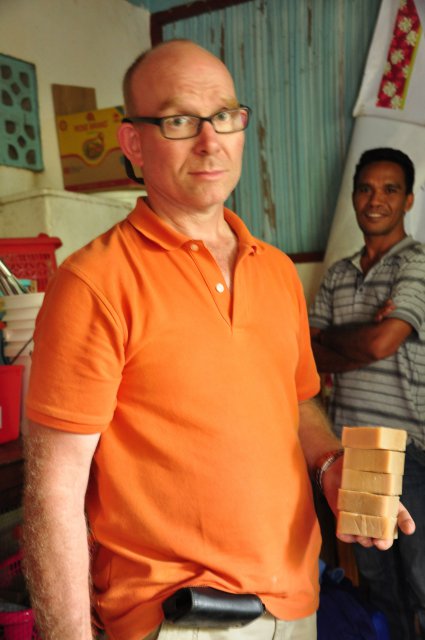
We also visited Baucau, Timor-Leste’s second-largest city, to meet the soap team. A few years ago, a group of women at a training center learned to make small handmade soaps using natural materials, initially selling them only in local low-end markets. Later, he helped the women form a cooperative, naming their soap Ai-Funan, which means “flower” in the Tetum language. He then expanded their market beyond Timor-Leste, entering Singapore and Hong Kong. Now, the soap is sold on Cathay Pacific flights and in some agnes b stores, making it the first locally produced export brand product from Timor-Leste to appear in overseas high-end markets. This achievement also drew the local government’s attention to green business development. While we were in Timor-Leste, the national TV aired a program showcasing local green businesses, and the soap story was a highlight.
Standing on land untouched by large-scale factories, we both hoped that these small natural products — such as soap, coffee beans, and other high-value green goods — could become the development direction for this small nation. We even dream that one day, this tiny country might serve as a model for developing nations, where both the environment and people’s lives can be protected and developed together.
--
Editor’s note: Earlier, Hong Kong was hit by an extreme cold wave, suddenly turning frigid and reminding everyone once again of global climate change. The Sass Beauty Life Charity Fund and Volunteer Tourism recently organized a challenge called “Sass Beauty Life Eco Challenge,” combining social innovation and environmental conservation to encourage cross-sector collaboration and invite participants to contribute ideas to drive green transformation.
By joining the Eco Challenge, you’ll gain a lot:
1. Form a diverse team
2. Solve real challenges faced by businesses
3. Win a $100,000 prize
4. Meet executive advisors
5. Direct entry to the final stage of Sass MT selection
6. A two-week overseas volunteer trip
Note: Participants don’t need to form teams to apply. Teams will be formed on March 4 after selection.
Sign up now: http://www.glocalgreenovation.com/register/