Kanazawa is located in the Hokuriku region of Japan, within Ishikawa Prefecture. It can be considered the economic, commercial, and cultural hub of the Hokuriku area. Due to its relatively remote location from other military fortresses or major cities, Kanazawa suffered less destruction over time, allowing many of its historic buildings to be preserved. As a result, some people refer to it as "Little Kyoto." From the Kansai region, you can take the Thunderbird limited express train from Osaka via Kyoto to Kanazawa, which takes about two and a half hours. From the Kanto region, you can use the Hokuriku Shinkansen, also taking roughly two hours.
On your first visit to Kanazawa, you naturally want to check out its main attractions. The first stop is Kenroku-en Garden. Kenroku-en is one of Japan’s Three Great Gardens and was developed over several feudal lord eras. Originally, it served as the garden of the adjacent Kanazawa Castle. What makes Kenroku-en special is its "strolling-style" garden design. Rather than being able to enjoy the entire garden from a single fixed spot, the garden features elements such as large ponds and rockeries placed throughout, along with tea houses and pavilions strategically positioned. To fully experience Kenroku-en, you must walk along its winding paths and explore the entire garden to see its diverse landscapes.
The name "Kenroku-en" originates from the concept described in the "Record of Famous Gardens in Luoyang" by Li Gefei, a Northern Song Dynasty poet: “The people of Luoyang say that a garden cannot excel in all six qualities at once: grandeur, seclusion, human artistry, antiquity, water features, and scenic views. Only the Lake Garden achieves all six.” Perhaps the feudal lord of the time felt that this garden embodied these six qualities — grandeur, seclusion, human craftsmanship, antiquity, water, and views — capturing the essence of the Lake Garden described in the text, hence naming it Kenroku-en.
Before entering Kenroku-en, you’ll walk along a path lined with traditional-looking buildings, which actually house various shops. During cherry blossom season, the other side of this path is lined with colorful stalls, creating a lively and festive atmosphere. This area is also illuminated at night, offering a uniquely charming experience after dark. One thing that stood out was how, even at open-air stalls, people neatly sorted their trash for recycling — a sign of great orderliness and self-discipline.
Worth mentioning is that in Kanazawa, visitors can rent bicycles as an alternative to buses for exploring attractions. However, we noticed some rental spots had no bikes available, so we didn’t get to try this option this time.
At night, the area outside Kenroku-en lights up, offering a completely different ambiance. The road near the main stall area is separated, so you can quietly take photos of the night cherry blossoms.
Having traveled all the way from Osaka to Kanazawa, as the saying goes, “You only live once,” so I figured I’d splurge for a few minutes and try a local specialty – gold leaf products. This time, I went with gold leaf ice cream. But funnily enough, the gold leaf doesn’t have any taste at all, haha.
During cherry blossom season, entry to Kenroku-en is free. Although I didn’t get to see the famous yukitsuri — the rope structures used to protect ancient pine trees from heavy snow — the garden still has many beautiful spots worth visiting. Some that left a deep impression on me include:
Kyokusui
This feature was built after a fire at the nearby Kanazawa Castle. It was designed to supply water for firefighting in case of future blazes. Nowadays, both sides are lined with cherry blossoms, and petals drift along the stream’s surface as the water flows. Standing on the bridge and admiring this view feels incredibly serene.
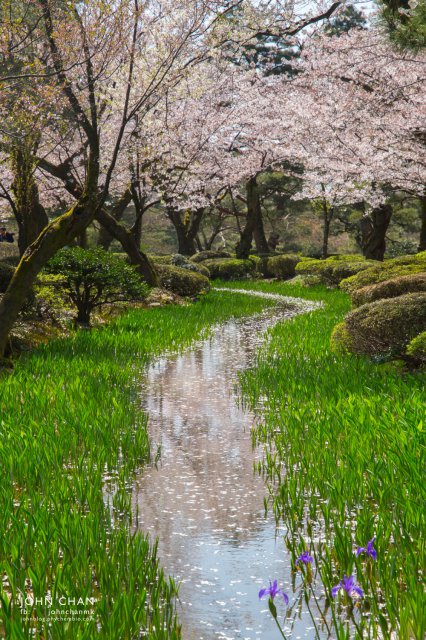
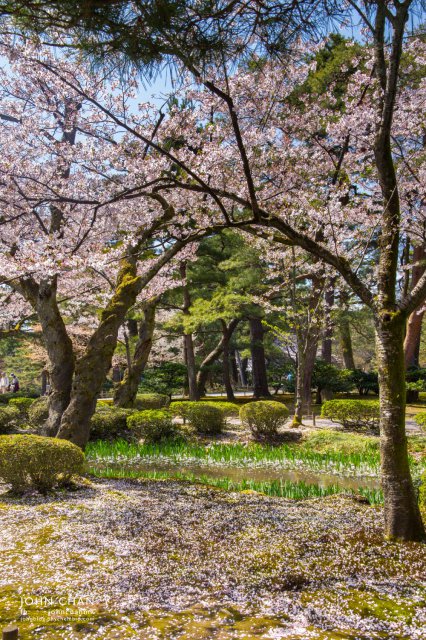
Being surrounded by layers of cherry blossom trees is also a uniquely special experience.
Kankō Bridge
Kankō Bridge is made of 11 pieces of red Akadama stone arranged to resemble wild geese flying in formation across the evening sky. Since the stones are shaped like turtle shells, it’s also called "Turtle Shell Bridge," and it’s believed that crossing it brings long life. However, due to structural issues, walking across it is currently prohibited. (Source: Official Website)
Tangasaki Pine
The black pine tree at Kenroku-en, cultivated from seeds of Tangasaki Pine found along Lake Biwa, is considered the most graceful tree in the garden. In winter, wooden supports are erected, and ropes are stretched from above to cradle the branches, creating a radiating "yukitsuri" that resembles the frame of an umbrella. This is a unique feature of Kenroku-en. (Source: Official Website)
Uchitsubaki Tower
Perhaps because the pond symbolizes the sea, the central stone tower here is named Uchitsubaki Tower (Sea Stone Tower).
w???/strong>
From here, you can... (text garbled) ...a peaceful corner that remains remarkably pristine, making it especially memorable.
For more information on the various scenic spots in Kenroku-en, check out the official website.
It’s impossible to fully grasp the culture and background in a short time, but the garden is well-organized and not overly crowded, making it a great destination.
Transportation:
From Kanazawa Station, take the Shichijo-machi Kanazawa Loop Bus and get off at the Kenroku-en stop.
=================================
My camera setup:
Canon EOS 6D
Canon EF 24-105mm f/3.5-5.6 IS STM
Canon EF 70-300mm f/4-5.6 IS USM
Tokina AT-X 116 PRO DX AF 11-16mm f/2.8
=================================
More photos, other attractions, and highlights from the trip can be found on my blog: John Chan Photography
My Instagram: johnchanmk
My Facebook page: John Chan Photography
Thank you all for your support.