In August, in Dalad Banner, Ordos City, in the southwestern part of Inner Mongolia Autonomous Region, over 100 outdoor hiking enthusiasts carrying various pieces of gear arrived here one after another from all over the country.
From the 23rd to the 25th, this large group with members ranging in age from 18 to 60 was divided into nine small teams to hike through China’s sixth-largest (some say seventh-largest) desert—the uninhabited area of the Kubuqi Desert in Inner Mongolia. They entered directly from the edge of the desert into its heart, spending three days and two nights covering a total distance of about 70 kilometers.
In the early hours of the morning, temperatures in Dalad Banner were below 10°C, with wild winds whipping up sand and stones. Around 5 a.m., when the sky began to lighten in the east and the sun soon climbed high, the sunlight gradually shed its gentle veil and began to scorch the earth—fierce and merciless. “Once you’re inside the big desert, the temperature difference between day and night will be even greater. Add to that the weight of tens of kilograms of drinking water and various equipment, and compared to that, this place is absolutely paradise.” A few “veteran hikers” gazed into the distance and exchanged thoughts...
On the afternoon of August 25, when the last massive sand dune was conquered, someone in the group shouted, “I see the road, I see the power line poles!” At the foot of the mountain, five Mongolian girls lined up to welcome them, each holding hadas (silk scarves) and wine cups. Some people were so excited they threw all their gear into the air, laughing heartily and drinking the strong liquor; others, however, were like deflated balls, collapsing completely to the ground and breaking into tears.
I later learned that those tears were not just an emotional release after finally completing a long trek, but more a mix of sighs and indignation from witnessing firsthand the state of desertification in our country. One woman from Beijing burst into tears when saying goodbye to her teammates: “If next time you and your hiking friends come to trek through the desert again, no matter how tired you are or how hard it is to keep going, please do not step on those green plants!”
The reporter followed one of the nine small teams and conducted a full interview of this nationwide hiking journey through the uninhabited area of the Kubuqi Desert. Here, we restore the three days and two nights in the desert with plain, descriptive accounts.
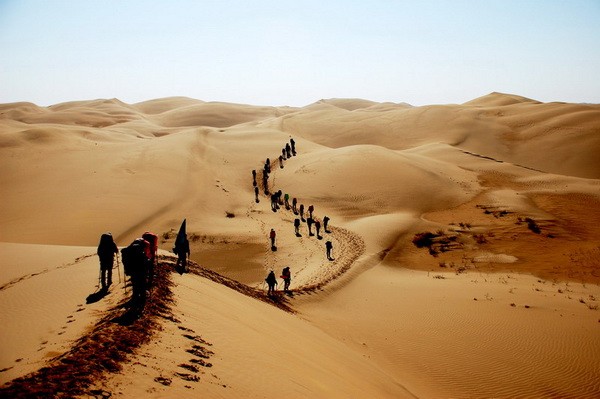
“If you love someone, take them to the desert, because it is vast and beautiful like paradise; if you hate someone, take them to the desert, because it is fraught with danger and harsh as hell.”
This was what Lao Ming said to the team’s 12 members. Lao Ming, 40 years old, with a dark complexion and a stocky, solid build, is experienced—he trekked through the Kubuqi Desert with a group of hikers last summer. He is the only person in the team who has entered Kubuqi twice.
“Be sure to rest appropriately. For example, walk for 40 minutes, then rest for 10 minutes. But don’t rest too long either, or the physical functions and vitality you’ve just activated may become sluggish. During breaks, consciously stretch your limbs and do some bending exercises to aid blood circulation and help your body stay limber and coordinated...”
On the morning of August 23, on the way from Dalad Banner to the Kubuqi Desert in the tour bus, Lao Ming patiently shared his tips with the team, repeatedly emphasizing the key points. When they reached the edge of the desert, the whole team got off the bus, and he carefully checked each teammate’s shoes, socks, hats, headscarves, water bags, protective glasses, gear bags, and more, tightening everyone’s over-the-knee anti-sand leg covers with force. Two off-road vehicles responsible for logistical support for the entire group of over 100 people waited nearby. Over the next three days and two nights, they would deliver food supplies and essential items such as tents for overnight camping at fixed times from outside the desert.
Although there were off-road vehicles available, each person’s load was still no light matter, with backpacks averaging over 15 kilograms. Fleece clothing and sleeping bags for keeping warm at night, raincoats and umbrellas for desert downpours, everyday changes of underwear and socks, precious drinking water and saline solution... These essentials, already pared down to the bare minimum, took up most of the backpack space. In addition, with no extra water in the desert for washing up, items like mouthwash, gum, sunscreen, lip balm, as well as energy-boosting foods like beef jerky and milk tablets, stuffed everyone’s packs to the brim.
In each small team, there were always two people whose backpacks weighed more than average—25 kilograms or even over 30 kilograms. Someone had to take on the daily logistical duties of the team. The gas stove, pots, high-pressure gas canisters, and windbreak boards needed for meals had to be carried by someone, and extra drinking water, saline solution, and food had to be packed in case any team members suffered from exhaustion—otherwise, the consequences could be dire. These naturally ended up in two backpacks exceeding 25 kilograms.
For all the hikers experiencing desert trekking for the first time, the first day’s journey was the most crucial. Lao Ming said, “If you get through the first day, you’ve succeeded 80%.” Before setting off, it was hard to grasp the subtlety of this, but three days later, after completing the whole journey, it became clear that Lao Ming’s words were extremely apt.
Shortly after entering the desert, all mobile phone and wireless network signals disappeared, and communication between people reverted to the most primitive form of word of mouth. As they walked, seeing the seemingly endless road ahead, a sense of panic at not having a concrete goal would occasionally set in—even for those with ample experience in outdoor hiking, desert trekking is entirely different from walking on land or in mountainous areas. For instance, walking 30 kilometers a day on land might be manageable, but once in the desert, walking 30 kilometers in fine sand is equivalent to hiking 60 kilometers on land, throwing off both pace and energy distribution. Even experienced mountain hikers who are adept at handling slopes and even skilled at climbing steep 60-degree inclines will find these skills hard to apply in the desert. Descending sand dunes is not easy, and ascending them is even harder. When encountering steep dunes, the physical exertion often exceeds that of mountain hiking several times over, and success is not guaranteed.
Daily hikes are divided between mornings and afternoons, with a collective lunch break at noon. The location is chosen at the tallest nearby sand dune, where the main group takes a rest at the base of the dune. Lunch consists mainly of dry rations, including compressed flatbread, ham, and canned sausages.
There are four permanent campsites in the Kubuqi Desert. In the evening, all 100+ people set up camp near the base. Compared to the morning, the afternoon hike must be pushed harder—for one, to reach the main camp by evening, and for another, to pitch the tents before sunset. Setting up a two-person tent—from erecting the inner and outer tents, securing the poles, to finally packing soil around the edges—40 minutes is already considered fast. After setting up the tents, the team must finish dinner before natural light fades. To replenish the energy expended throughout the day, dinner includes dry rations plus one instant noodle pack per person, along with fruit. Cooking noodles requires building a fire in a dug-out stove, which takes considerable time and effort... All these activities that must be completed before sunset place high demands on the pace and intensity of the afternoon hike.
The morning sun is already piercing, while the afternoon sun can only be described as scorching. This is the toughest period, with temperatures continuously rising. Touching the desert with your palm feels like being seared by a raging fire. The weight remains unchanged, while the body loses large amounts of salt and moisture. To guard against the fierce ultraviolet rays, hats and neck scarves cannot be removed and must tightly shield the face. The extreme heat can be stifling. Three days later, over half the team developed heat rashes—all due to the inability to sweat normally in the desert...
“Without a team, even the strongest man could face despair in the desert; that loneliness can completely break a person’s psychological defenses!”
As the desert closest to the capital Beijing, the Kubuqi Desert is bordered by the Yellow River on its eastern, western, and northern sides, sloping from high in the south to low in the north. According to locals in Dalad Banner, the southern part of Kubuqi is a structural plateau, the central part consists of wind-formed sand dunes, and the northern part is a river floodplain, with a total area of about 1.45 million hectares, of which about 61% are shifting sand dunes. The desert stretches about 400 kilometers in length and 50 kilometers in width, with dune heights ranging from 10 to 60 meters, and the main forms being dune chains and grid-like dunes.
In Mongolian, “Kubuqi” means “the string of a bow.” Looking closely at the map, you’ll see it resembles a yellow dragon lying across the northern ridge of the Ordos Plateau, spanning Hanggin Banner, Dalad Banner, and Jungar Banner of the Ikh Juu League in Inner Mongolia Autonomous Region. It is precisely because the Kubuqi Desert lies beneath the Yellow River, like a string hanging above it, that it earned the name “the string of a bow.”
Mongolians who have lived here for generations tell us that the Kubuqi Desert is not as romantic or beautiful as its name “the string of a bow” suggests. Even for the indigenous people who live near the desert and are relatively familiar with the terrain, climate, and environment, if the group is too small or not adequately prepared, they would never dare venture into the desert, let alone go alone.
“The desert is the ‘sea of death.’ Only by venturing deep into it do you understand how precious water and food are. For example, it might not be too difficult for a strong man to cross the desert with companions, but if he goes alone, covering the same distance with the same amount of water and food, he probably won’t make it out. You have to realize, the vast, endless desert is like a yellow sea surrounding you terrifyingly from all sides. Going without seeing another living being for a long time, the loneliness can turn into despair, and the psychological pressure and mental torment it brings are immeasurable!”
August 24, the second day of the trek. With the experience of the first day, the younger hikers became more relaxed, while the older ones faced new challenges. By noon, the group of around 100 people began to split up. Initially, the advance team resting on the dunes only had to wait about half an hour for the main group to arrive. Soon, the waiting time grew longer, and by lunchtime, the time gap between the front and back teams reached one hour.
In the afternoon, the main group regrouped and continued marching. Some people began to fall behind. Lao Ming, an experienced “veteran hiker,” walked at the front of the small team, voluntarily carrying the group’s large red flag and holding a GPS satellite positioning system, acting as the point person. Xiao Jun, also in the team, was experiencing the desert for the first time, but due to weekly hiking training in the suburban mountains of Beijing, he was also an experienced hiker. He consciously slowed his pace and kept looking back at the other members of the team. Beside him was A Bin, young and physically fit, but introverted—over the two days of hiking, he hadn’t said much, just silently following the footprints ahead.
Around evening, with about six or seven sand hills left to the base camp, the red flag fluttered faintly atop the last dune, serving as the landmark for the base. “We’re almost there, we’ll be able to rest soon. Look, the advance team is close to the flag,” someone in the group said cheerfully.
“A Bin, slow down a bit, hang back,” said Xiao Jun at this moment. He looked at the teammates behind him and saw two female teammates in their 50s from the same small team struggling, their faces pale and lips cracked. He asked A Bin to slow down and fall back with them. Unexpectedly, A Bin gave a soft “oh,” didn’t look back, and instead quickened his pace, quickly leaving Xiao Jun and the two female teammates behind. Xiao Jun was furious, “That jerk!”
“One key to avoiding fatigue during long-distance hiking is maintaining rhythm. Your stride frequency shouldn’t be too fast, should match your heartbeat, and you should regulate your breathing to keep it even,” Xiao Jun said as he walked alongside the two female teammates. When they encountered large dunes or hills, he led them to take “detours” around them rather than attempting to climb the steep slopes directly, and deliberately chose to walk on the windward side and sand ridges. “The windward side is compacted by wind erosion, making it harder and easier to walk on. The leeward side is looser, causing you to sink deeper and expend more energy... Actually, as long as you regulate your breathing, maintain a calm mindset, and don’t rush, you can reach the end smoothly,” he encouraged his companions.
Just as four hills remained in front of them, the panting A Bin appeared. Holding two bottles of water and pulling out two more from his pants pocket, he handed them to the two female teammates. It turned out he had arrived at the base camp early, dropped off all his gear, grabbed water, and doubled back to meet the stragglers. He shouldered one of the female teammate’s backpacks and silently continued forward. Xiao Jun, standing behind, didn’t know how to express himself for a moment.
At night, countless stars hung in the inky blue sky, seemingly within reach, while the Milky Way was clearly visible above the desert. I chatted with Lao Ming and Xiaojun, while Abin, unusually, sat to the side, quietly listening without saying a word. Two seasoned "veteran hikers" remarked that if travel can reflect a person's true nature, then desert trekking reveals one's most primal character. "If you can't be relied upon in this wild desert, you're even less dependable back in urban life," they insisted. They believed that every hiker willing to leave behind the noise and restlessness of the city to come to the vast desert is inherently respectable. No matter who they were before, the desert journey might just change their long-held thoughts and perspectives.
But no one can expect everyone to be so selfless. In nearly every trek, within every small team, there are always those who think only of themselves. Hei Zhuang, who was on the same team as Lao Ming, Xiaojun, and Abin, scoffed after hearing the stories of two female teammates: "What kind of joke is this? People like that shouldn’t even be out here trekking."
Hei Zhuang wasn’t the only one. On the afternoon of August 23, the advance team at the front of the group—carrying GPS satellite positioning devices and caught up in the excitement—ignored the average pace of the main group and pushed ahead rapidly within an hour. Experienced "veteran hikers" had repeatedly warned before entering the desert that when traveling as a team, some move faster and some slower; mutual consideration is essential, attention must be paid to connecting the front and rear groups, and it’s absolutely unacceptable for smaller groups to surge ahead recklessly, as accidents can easily occur...
On August 26, after returning from the vast desert to Ordos City, Da Peng, the dean from Yunnan University of Finance and Economics who was responsible for rear-guard duties during the trek, told me with sorrow that the "veteran hikers" who had spontaneously organized to handle logistical support often collected over 20 half-empty water bottles discarded along the way. "I personally saw some team members load up with plenty of water before setting off, yet remained indifferent when fellow hikers struggling with exhaustion asked for help along the way. Then, upon reaching the base in the evening and having ample drinking water replenished, they recklessly wasted the reserves in their packs, discarding them after barely taking a few sips—an all too common sight!"
After returning from the Kubuqi Desert to the bustling city, it remains unknown what each team member brings back from the desert, whether each finds their own personal oasis in the sands, or if the desert trek experience changes them. Just as the Kubuqi Desert isn’t always blazingly hot—once the sun sets, what quickly follows is a sharp drop in temperature, along with fierce storms or sudden, unheralded thunder and torrential rain.
"Please do not step on those green plants. You must know, they spend their whole lives protecting this desert!"
On the afternoon of August 25, the main group came across a large expanse of green vegetation, behind which the shadows of high-voltage power poles appeared—the team was approaching its destination. It was only the second time during the entire desert crossing that such dense and tall green plants were seen, the first being at the edge of the desert before entering it.
The Mongolian girls who greeted the team upon arrival at the endpoint told us that on ordinary days, when it doesn’t rain, the winds and sandstorms here are constant, with fine grains of sand whipped up by the gales and scattered everywhere. In fact, not just at the edges of the desert—even in downtown Ordos, on sunny days, one can see dust and sand swirling through the streets, lifted by the wind.
In the Kubuqi Desert, everyone experienced firsthand the power of the yellow sand. While trekking, if you didn’t effectively cover your face and mouth with a scarf, fine grains of sand would relentlessly find their way into your mouth no matter what, and no amount of spitting could completely clear them out. Team members suffering from chronic pharyngitis endured extreme discomfort during this time; every breath was torture, and they had to resort to constant coughing to ease the irritation in their throats caused by the sand.
At night, the entire camp fell into deep darkness, lit only by the faint glow of camp lights and headlamps. When a flashlight was turned on, under its bright white beam, one could see fine grains of sand wildly swirling and tumbling about, as if countless tiny organisms were dancing. Speaking of fine sand, Hua Hua, a teammate, had a painful firsthand experience. This woman, over fifty and a member of the local photography association, was hailed by her teammates as a "photography master." But at noon on the second day, she sadly informed everyone that her camera wouldn’t turn on anymore—it had likely been ruined by the excessive sand infiltration. Whether it’s phones, cameras, MP3 players, or voice recorders, these delicate electronic devices are highly vulnerable to fine sand in the desert. Even when wrapped in layer upon layer of plastic wrap, they still can’t withstand the relentless assault of the yellow sand.
After leaving the desert and reaching the roadside, everyone celebrated the successful completion of the trek with unrestrained joy. Yet Hua Hua, who was on the same team as Lao Ming, Xiaojun, Abin, and Hei Zhuang, shed tears: "Had I not seen it with my own eyes in the desert, I truly couldn’t have imagined such a severe scene of desertification." Throughout the nearly 70-kilometer trek, the hikers occasionally spotted oases, but most were sparse and not well-formed.
Lao Zhang, a local photographer from Hohhot in Inner Mongolia, comforted Hua Hua by saying that the Kubuqi Desert falls under a temperate arid to semi-arid climate type, with 25 to 35 windy days per year. The western and northern parts of the desert, being closer to the Yellow River, have higher groundwater levels and better water quality, allowing vegetation to grow. "The eastern part of the Kubuqi Desert is covered with grassland vegetation, the western part with desert grassland, and the northwest with steppe-desert vegetation. There’s quite a diversity of plant species, with notable differences in vegetation. The main types include perennial grasses in the east, semi-shrubs in the west, alkali-tolerant plants in the river floodplains of the north, and sand-adapted plants growing on the dunes... Our trekking route couldn’t possibly cover all areas, and our line of sight certainly couldn’t encompass everything."
Yet Hua Hua was still deeply saddened. Sharing her sorrow was an older sister from Beijing. At the celebration on August 26, she tried to hold back her emotions but couldn’t help bursting into tears: "The sandstorms caused by land desertification mean we now face far more frequent and intense dust storms than in the past. Successfully crossing the desert is certainly something to be proud of, but looking out at this vast expanse of desert and realizing it’s the result of land degradation really breaks my heart. What can we actually do to stop desertification?" As she spoke, tears streamed down her face.
On the night of August 26, as hikers from all over the country gradually dispersed and returned to where they came from, a question still lingered in my mind: As time goes on, will the hope that the desert won’t keep expanding year after year come true? Will people, on their next trek through the uninhabited desert, witness a spectacular vision of lush oases? Perhaps the oasis in the heart can be found—but what of the real one?