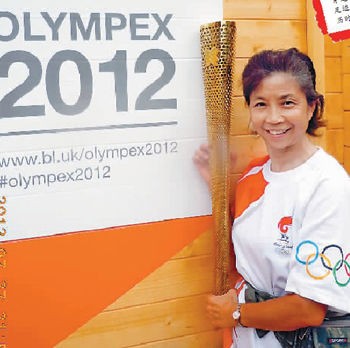
Reinforced Woman Xie Houguo takes a photo with the London Olympic torch.
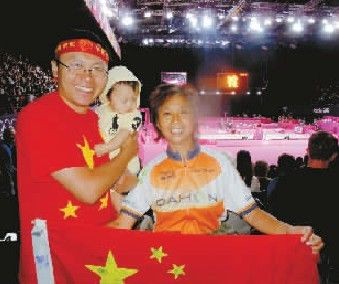
Xie Houguo at the Olympic badminton venue.
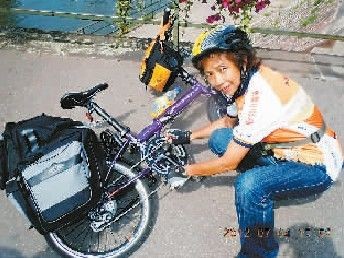
The car broke down, and Xie Houguo had to fix it herself.
Watching the London Olympics, are you sitting in front of the TV or flying to the UK? Xie Houguo, a 63-year-old disabled woman from Chongqing, chose to fly alone from Chongqing to Hungary, then cycle through 11 European countries to the London Olympics to cheer for Chinese athletes.
She spent two months on this journey, filled with hardship, joy, and luck, returning to Chongqing on August 17. Her expedition was covered by Hungarian media such as the United Daily News and Agence France-Presse.
Sketch
Cycled 180,000 kilometers
Beijing Olympic torchbearer
"So many wonderful things—every photo makes me reminisce for ages." Yesterday at 1 PM, in a residential building near Xiejiawan Primary School in Jiulongpo, Xie Houguo smiled as she looked at the photos on her computer.
During the four-hour interview, she remained standing. On January 6, 2006, she was hit by a car while cycling in Hainan, leaving a 30-centimeter steel rod in her pelvis, making her disabled (holding a third-grade disability certificate). "Either cycling or standing—it’s the only way to beat the pain of the injury."
Searching online for "Xie Houguo" yields nearly 10,000 results. Since 1993, she has cycled from Sanya, Hainan, to Mohe, Heilongjiang; from Shanghai's Chongming Island to the Qinghai-Tibet Plateau; scaled the "China No. 1 Glacier" in Xinjiang; crossed the deadly Lop Nur Desert; and ridden along the Qinghai-Tibet Highway... Over 19 years, her travels have covered about 180,000 kilometers—more than four times around the Earth. In news and forums, she’s known as the West’s top female cyclist, the Reinforced Woman, and became a torchbearer for the 2008 Beijing Olympics.
Xie Houguo’s home is modest and simple, with striking displays of her cycling photos, souvenirs from the road, and the Olympic torch. After retiring from the Chongqing Waterworks Company, her monthly pension of over a thousand yuan is saved for cycling, while household expenses rely on her husband, Old Zhang. "All these years of cycling have been thanks to my family’s understanding and support—I’m grateful to them," she said.
Preparation
To go to London for the Olympics
Studied English for 4 years
"My name is Xie Houguo, I want to ride to London." This is the English sentence Xie Houguo speaks most fluently, meaning "My name is Xie Houguo, I want to cycle to London." After the 2008 Beijing Olympics, she began preparing for London by taking English classes.
With four English lessons a week, she cycled over an hour each day from Xiejiawan to the senior university near the Yubei Armed Police Corps. Starting from ABCs and everyday vocabulary, she persisted for four years. "This time in Europe, basic conversations like asking for directions or shopping were no problem—my English studies paid off."
Being older and disabled made getting a London visa difficult. After over a year of preparation and help from fellow cyclists in Guangdong, Xie Houguo finally secured a visa to Hungary just before the Olympics. She got the visa on June 13 and flew to Hungary on June 15.
Departure
Spent half a day going in circles around the city
Language barrier was the biggest challenge
When her plane landed in Budapest, she was instantly overwhelmed. "I didn’t know where to pick up my checked bicycle, couldn’t understand the announcements, and everything around me was incomprehensible." She wandered the airport for an hour before breaking down in helpless tears. A Zhejiang businessman eventually helped her find her luggage, took her to a hotel by taxi, and encouraged her to keep cycling.
At 4 AM on June 18, Xie Houguo set off on her bike. According to her route, she needed to reach the small town of Komárom before dark. "I kept asking for directions but kept going the wrong way, even ended up on the highway and had to turn back into the city." Recalling the moment, she frowned. "I got lost four times, just circling around Budapest until a police officer finally guided me out of the city." Compared to roads she’d cycled before, Europe’s roads were great—the language barrier was the biggest hurdle.
Adventure
Fell down escalator with her bike
Bandaged herself and kept going
Having cycled for years, Xie Houguo has faced countless dangers. "When accidents happen, fear still kicks in," she said.
By July 8, she had passed through eight countries: Hungary, Slovakia, Austria, Germany, Liechtenstein, Switzerland, France, and Luxembourg. In Luxembourg, after a police warning, she opted to take a train to the Netherlands. "Time was tight—I needed to reach London before the Olympics, so for longer distances, I took trains."
After unloading the bike in Amsterdam, she placed it in a cart and took the escalator out of the station. Just as she was about to exit, the escalator suddenly malfunctioned—the cart and bike crashed into her forehead, sending her and the bike tumbling down the moving stairs.
“My head and face were covered in blood, and I had injuries on my arms and body. I was pinned under the bike and couldn’t move,” she said. All she could hear was people around her shouting “Help!” When station staff rescued her, she used the medicine she had on hand to do a quick bandage-up before summoning her courage again. “I’ve cheated death so many times—I must have a strong life. I’ll keep riding, no fear!”
Happiness
63rd birthday in Munich
Celebrated with Chinese international students
“I’ve met so many kind people along the way, both Chinese and foreigners—they’ve all been friendly and good-hearted.” Xie Houguo’s diary records the names and stories of these good Samaritans.
On June 17, she ran into Ms. Zhou, a woman from Wenzhou, in Budapest and stayed at her home that night. Knowing Xie had to set off at 4 a.m., Ms. Zhou got up at 3 a.m. to fry three portions of Yangzhou fried rice and boil six eggs. “This should be enough for you for the day. The six eggs are for good luck—wishing you smooth sailing. Keep going!”
On June 27, her 63rd birthday, she had thought she’d be celebrating alone on the streets of Munich, Germany, with dry rations. But instead, she met several Chinese international students. That evening, they treated her to a meal in Chinatown to celebrate her birthday. “When they heard I was from Chongqing, they even ordered me a dish of twice-cooked pork.”
Hearing that Chinese Olympic athletes were training at the University of Leeds in the UK, she rushed to the university on July 16. But her bike broke down, so she took it to a repair shop. When it came time to pay, the shop owner refused to take her money. “You rode your bike all the way from China to the UK—that’s amazing!”
On her way out of the repair shop, Fan Yishan, a University of Leeds international student, recognized her: “I read about you on Weibo—you’re an amazing old lady.” Fan gave her a phone, topped up the credit, and left her own contact information.
The Olympics
Badminton championship finals
Hugging Olympic champion Lin Dan
“Thinking back on the whole journey, it’s been full of miracles and incredible luck—especially watching the Olympic events,” Xie Houguo said excitedly about the London Olympics. Arriving in London on July 25, she met up with a group of Chinese cycling enthusiasts, and the former Deputy Mayor of London visited them at Trafalgar Square. That day, she also met the president of the Britain-China Cultural Association, who gave her two tickets to the Olympic finals.
The luckiest moment was watching the men’s badminton final up close. “Lin Dan had a tough fight—Lee Chong Wei had chances to win. Watching it live was nerve-wracking.” She unfurled her self-designed Olympic flag, rushed to the front row, and shouted “Go China, Go China!” until she lost her voice. When Lin Dan won, she cried tears of joy.
After the match, Lin Dan and Li Yongbo came over to shake hands and hug spectators, and Xie Houguo was one of them. “Hugging an Olympic champion for the first time—this experience will stay with me forever.”
Back in Chongqing, Xie Houguo began planning her next expedition—in 2016, she aimed to cycle to Brazil to watch the Olympics.
Cycling to a foreign land
Check out the grandma’s travel tips
“If an old lady like me can cycle across China and all the way to London, why can’t young people challenge themselves and seek a bit of adventure?” Xie Houguo said. For those wanting to join the ranks of international cyclists, she has accumulated some money- and time-saving tips that could serve as useful references.
Gear
The bike she rode to London was a new folding bicycle weighing over ten kilograms. Because she set off in a hurry without time to break it in, it gave her quite a few minor issues along the way. She advises fellow cyclists not to use brand-new bikes for such trips—let the bike and rider get used to each other first.
Navigation
Upon arriving in a city, get a map from the train station or hotel first, then plan the route for the evening. Before setting off, ask police officers about the distance to the next stop. If time is tight, opt for trains or other transport for longer distances.
Meals
Xie Houguo kept her daily food expenses under 10 euros, mostly eating milk, bread, biscuits, and chocolate—all relatively cheap in Europe. Every couple of days, she’d buy some fruit for vitamins. “You can’t go hungry on the road—you must keep your strength up.”
Accommodation
Finding a place to sleep was a constant headache. Over 64 days, about a third of the time she slept on the street, a third she paid for a hotel, and the remaining third was thanks to the kindness of strangers. Each day, she aimed to reach a small town to sleep. The cheapest option was youth hostels at 10 euros per night, while the most expensive was 69 euros. She recommends that young travelers book hostels in advance for affordability. If no lodging could be found, she’d spend the night at train stations. Once, she even spent the night in a police station, where officers served her hot tea. “Often, I’d ask the police to recommend or contact hotels for me—that way, it’s safer.”
Her condition
Age 63, height 1.58 meters, weight under 50 kilograms. She’s been injured in seven car accidents, has a 30-centimeter steel rod implanted in her body, and holds a third-degree disability certificate.
Her gear
A folding bicycle, a bag of changes of clothes, a set of basic bike repair tools, and 8 homemade Olympic flags — totaling over 30 kilograms.
Her journey
On June 15, she flew from Chongqing to Hungary, then cycled through 11 European countries including Germany, France, Belgium, and the United Kingdom, visiting more than 30 cities. She returned to Chongqing on August 17, completing the trip in 64 days.