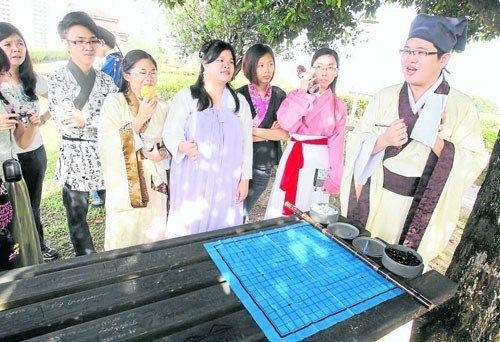
The organizer arranged for instructors to teach participants how to play Go (Malaysian Guangming Daily).
Today, the ninth day of the ninth lunar month (October 23) is the Chongyang Festival. Around 50 ethnic Chinese men, women, and children in Malaysia upheld the traditional Chinese custom of hiking on this festival by climbing to the top of Bukit Commonwealth Park on the 21st, where they drank chrysanthemum tea and ate Chongyang pastries, symbolizing the avoidance of disaster.
“Double Ninth, Wear Hanfu, and Climb High” is an event organized by the Malaysian Hanfu Movement. This year marks the third edition of the Chongyang Hiking Event, attracting 50 participants aged between 3 and 40.
On the morning of the 21st, male and female participants of all ages, dressed in a variety of traditional Hanfu outfits, gathered at Bukit Commonwealth Park in Bukit Jalil to prepare for the hike. Their distinctive traditional attire in the lush green park caught the attention of joggers, who momentarily felt as if they had stepped into a time tunnel and traveled back to ancient times.
After reaching the top of the park, Jiang Zhifa, one of the co-founders of the Hanfu Movement, explained the origins of the Chongyang Festival one by one. He pointed out that as far back as the Eastern Han Dynasty, in Runan County, there was a man named Huan Jing who studied Taoist arts under the immortal Fei Changfang. Fei Changfang told him that a plague would strike on the ninth day of the ninth lunar month, so he should take chrysanthemum wine and dogwood leaves and climb a high mountain.
“Huan Jing took his family up the mountain to avoid the plague. When they returned home, they found all their poultry dead, but they themselves had narrowly escaped disaster. After the story spread, people began to celebrate the Chongyang Festival, adopting the custom of climbing high on the ninth day of the ninth month. On this day, people climb mountains, drink chrysanthemum wine, and wear dogwood to ward off evil and disasters.” He explained that the ancients used the concept of “Yin and Yang” as a view of nature, even distinguishing numbers this way—even numbers were Yin, odd numbers were Yang; “nine” being the largest single digit, thus the ninth day of the ninth month became “Chongyang.”
“On the ninth day of the ninth lunar month, Yang energy is at its peak, and climbing high carries the meaning of avoiding disaster. During the hike, people drink chrysanthemum wine, eat Chongyang pastries, and wear dogwood. We, on the other hand, have arranged ancient activities such as playing Go and practicing Tai Chi to revive Chinese culture while also allowing everyone to experience traditional festive customs.”
He lamented that the Chongyang Festival is not as widely celebrated as other traditional Chinese festivals such as the Dragon Boat Festival in early May or the Mid-Autumn Festival on the 15th of August. Therefore, he hopes that celebrating Chongyang by wearing Hanfu will help more people learn about and pay attention to the festival. “The meaning of Chongyang Festival is still evolving. In the past thirty years, it has also come to include ancestor worship and respect for the elderly.
How to pass on the Chongyang Festival in the future depends on how our generation promotes this holiday.” Zheng Yongtian, Acting Chairman of the Youth Movement’s Federal Territory Chapter, believes that greater participation of the younger generation in cultural revival movements helps in understanding and clarifying the contradictions among various Chinese traditional festivals.