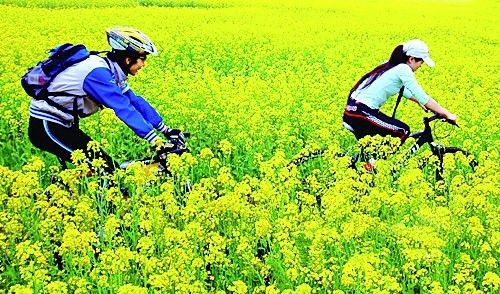
Every weekend, colorful clusters of cyclists weave through the western foothills of Shijiazhuang, their vibrant helmets darting across the green fields.

On the Western Foothills Avenue of Shijiazhuang, under the blazing sun, groups of cyclists—varying in size—ride one after another, gliding over the hills like flocks of wild geese.
Every weekend, colorful clusters of cyclists weave through the western foothills of Shijiazhuang, their vibrant helmets darting across the green fields. The concentration of cyclists serves as an indicator of air quality in the western foothills area, with the southwest region remaining the top choice for riders.
From showing off gear to showcasing cycling skills, and then progressing to the pursuit of unity between rider and bike, or even rider and nature, every cyclist has their own story. Cycling has quietly transformed people’s outlook on life.
What are you guys doing here?
“What are you doing here?” an elderly farmer, hoe in hand, curiously eyed the unexpected visitors.
“We’re here to exercise and enjoy the scenery,” replied the “Iron Roses,” with the silent green mountains and surrounding clear waters as their backdrop, as they breathed in the fresh air contentedly.
“You’ve got nothing better to do. Like me, working the fields every day keeps you strong!” the old farmer muttered before heading back into his field, choosing not to engage further.
Reflecting on that experience from a few years ago, the “Iron Roses” now laugh it off. These days, cyclists clad in tight outfits and bright helmets are no longer seen as out of place in the countryside. They’ve become trailblazers for scenic spots—wherever more helmets appear, villages quickly move to enclose the hills and develop tourist attractions.
“Iron Roses” is a veteran cyclist, known by her online nickname within the cycling community.
As longtime teammates, JET and “Old Ox” have joined several adventure trips. It wasn’t until recently this year that “Old Ox” learned JET’s real name from the employee ID plaque on his office door.
“When we ride together, we enjoy ourselves and help each other along the journey. We don’t really care about what others are called or what they do for a living,” “Old Ox” said with a smile.
From being a casual rider to founding a cycling website and gathering fellow enthusiasts together, the journey of “Old Ox,” a math teacher, has taken such an unexpected turn that even he is amazed.
Like most cyclists, “Old Ox” initially took up biking just to stay fit. In September 2008, during a day back-to-school shopping with his wife, he happened to glance at a bicycle shop. Staring at bikes priced at several thousand yuan, “Old Ox” was bewildered—his most expensive bike before had only cost 600 yuan. His wife noticed his interest. “If you like it, I’ll buy it for you!”
He rode home a mountain bike worth over two thousand yuan—and that marked the beginning of his cycling life. “I realized I was ‘addicted’!” The car-buying plan was shelved indefinitely.
Approaching the age of fifty, “Old Ox’s” life radius expanded with every rotation of his bike wheels. From initially riding dozens of kilometers a day to now covering 300 kilometers daily, he’s become a “legend” among cyclists. Since falling in love with cycling, his symptoms of dizziness, headaches, and high blood pressure have all disappeared. His amateur teammates have also achieved remarkable results in various competitions.
Unlike the extreme-sports-driven “Old Ox,” “Desert” enjoys the mental and physical pleasure brought by the journey. This sun-tanned man has used only one mountain bike in his five years of cycling and is known among peers as the cyclist with the lowest per-kilometer cost. Aside from cycling through the villages around Shijiazhuang, he also loves “big wheel, small wheel” travel—dismantling his bike to carry it on a train, then riding it at the destination. His travels have taken him across the Qinling Mountains and the northwest.
Back in 2008, “Rider” first encountered competitive cycling. Liberated from his dull and oppressive office job, he became a well-known figure in the cycling scene and even discovered a hill named after his online moniker—“Rider Ridge.”
It’s a relatively fair sport. Cyclists can freely choose activities organized by clubs or teams, but it’s also a process of being chosen. Within the natural groupings, ability and reputation matter most. Teams actively recruit the “talented,” while those who prefer to ditch the group, act recklessly, or flaunt gear are often shunned by fellow cyclists or clubs.
A Life-and-Death Contract
With autumn in full swing, on October 27—a regular weekend—the sun shines brightly over the Western Foothills Avenue of Shijiazhuang, where groups of cyclists—varying in size—ride one after another, gliding over the hills like flocks of wild geese.
In just a few short years, this mass-participation sport has made significant progress in this not-so-cutting-edge city. According to incomplete industry statistics, Shijiazhuang now has around forty to fifty cycling clubs, with approximately 150,000 active cyclists. In Shijiazhuang’s urban villages, cycling groups are especially active, with many villages boasting multiple cycling teams.
However, alongside the growth of the cycling community, there has also been an increase in traffic accidents. On related websites, cyclists post photos of accident scenes they’ve taken, reminding others to stay safe. “At least four cyclists have lost their lives on the Western Foothills Avenue this year,” “Desert” said with regret.
In August of this year, a series of cycling accidents occurred on the Western Foothills Avenue. After inspecting the sites, “Old Ox,” “Desert,” and others identified the main causes of the incidents. They used their own paint to mark prominent warning signs in the accident-prone areas, and repeatedly communicated with local government departments, called the mayor’s hotline, and sought help from the media—eventually eliminating the dangers.
Nearly every cyclist has taken a fall or two and carries scars that mark their experience. But most accidents involve beginners or solo riders. “Newbies tend to chase speed, especially when coasting downhill. Obstacles or potholes become extremely dangerous. Some don’t even wear helmets, which amplifies the risk. The longer you cycle, the more cautious you become, and the better your protective measures,” they say.
Like many hiking enthusiasts, cycling clubs mostly operate on an “AA system” when organizing rides or treks. Not only are meals and expenses shared equally, but risks are as well. Before setting off, most clubs have members sign contracts stating that they assume their own risks—commonly referred to as “life-and-death contracts.”
The growing prevalence of these “life-and-death contracts” among outdoor enthusiasts remains legally controversial. One view holds that traveling together is akin to peer pressure in drinking—if someone dies from drinking, the others could be held responsible. Another argues that if organizers and team leaders are professional enough, fulfill their duty of care, provide warnings and precautions, and ensure mutual aid during the trip, they shouldn’t bear unfavorable legal consequences. In case of an accident, members without fault may only need to consider humanitarian aid. “From many domestic cases, the tendency is toward self-responsibility for risks. But we know that once something happens, everyone involved is implicated. We can only try to work meticulously within the boundaries and in organizing events,” “Old Ox” explained. He noted that Rider Ridge in southwestern Shijiazhuang, famous for its steep slopes and long climbs, is a “holy land” for cyclists. He once organized a race there but ultimately decided against holding it again the following year due to safety concerns.
Experienced cyclists explain that although cycling may seem like a casual, aimless activity, it’s actually a team sport requiring cooperation. Clubs dread teammates with a strong “independent streak,” and “asking them to leave” is a common approach. Without teamwork in remote, road-less areas with no communication tools, the unknowns of the journey are unimaginable. On group rides, “talented” cyclists serve as leaders and sweepers. The leader sets the pace at the front to prevent riders from going too fast, but the hardest role is the sweeper. As a seasoned rider, they can’t maintain their usual fast pace. While others rest, they stay behind to assist stragglers.
A responsible team never leaves a single rider behind. "Desert" has taken on the role of sweep rider multiple times and enjoys an excellent reputation among cyclists. Once, a teammate took a wrong turn, and "Desert" chased over 50 kilometers in the direction of Shanxi before finally catching up with the rider. On a recent cycling trip, some members, lacking experience, exhausted their energy prematurely and could only push their bikes back along the Mountain Front Avenue. "Desert" had to accompany him, pushing the bike all the way, and didn’t get home until nearly 2 a.m.
Cycling changes lives
"Where there's a road, there's a way." But to truly reach remote, rarely visited places, one often has to rely on the feet of cyclists and the wheels of mountain bikes. As they cheerfully conquer the unknown, they also open another window to the world for city dwellers.
"Iron Rose" is a fire safety officer. Her job is simple, monotonous, and long. Born and raised in the city, her life has never extended beyond urban surroundings. Before she accidentally fell in love with cycling, her main ways of passing the long hours were engaging in aimless conversations with others about topics she wasn’t interested in, and thinking about what to eat for her three daily meals.
By chance, a friend invited her to go cycling. It turned out this friend wanted to lose weight through cycling but was often "asked to leave" the group due to her slow pace. So, she started inviting people around her to join her for rides. Although that friend still doesn’t cycle often, "Iron Rose" has become an active member of the cycling community.
Pedaling past the clear waters of Taiping River and through the tree-lined Mountain Front Avenue, her journeys grew longer, and "Iron Rose" began to feel a sharp contrast between the world she was touching and the known world within her. "Although I’m not well-off myself, you wouldn’t believe that some houses in the mountains have paper windows, and the children wear clothes covered with patch after patch."
That scene lingered in her mind: an elderly, lonely woman living in a dark, old house, her cloudy eyes brimming with tears under the dim light—it pierced her heart. Back in the familiar city, she thought about what she could do to help them.
"Yes, send warm clothes." She acted immediately. But when she shared what she saw and felt in photos and words in the cycling group and called on everyone to donate clothes, few responded. What was going on? Was it a lack of compassion, or something else? "Iron Rose" started communicating with more active members in the group, gradually building rapport and earning their trust. After work, she rode her bike door-to-door to collect clothes, asked local businesses for donations, and some cyclists spontaneously joined in. In just over 20 days, the collected clothes filled a small van to the brim. Before winter arrived, "Iron Rose" and over 20 cyclists delivered the warm clothes to the mountain village. Seeing the smiles on the villagers’ faces, she felt a kind of happiness she had never experienced before.
So, doing charity work is also a skill. After this rewarding start, "Iron Rose’s" free time became filled with various charitable initiatives. She organized multiple clothing donation drives, raised funds to treat elderly widows in Zanhuang, encouraged cyclists to save five jiao from each meal as activity funds to buy towels, soap, and other items to give to impoverished farmers along cycling routes...
"At first, my mom worried no one would respond to what I was doing, and that it might even be awkward meeting friends. But later, her attitude changed. I used to live without purpose, doing nothing all day. Now I have ideals," she said, laughing as she looked up.
Like "Iron Rose," it has become common in cycling clubs to enjoy the sport while doing what one can to contribute to public welfare and help vulnerable groups. Helping farmers sell unsold produce, aiding the elderly, sick, and disabled, donating books and warm clothes... In these small acts of kindness, the figures of many cyclists can often be seen.
Cyclists are bridging the gap between urban and rural areas. While bringing some income to the original inhabitants of mountain villages, they are also deeply moved by the simple and honest local customs. "In the city, you wouldn’t dare ride a decent bicycle outside; in the mountains, you can just leave your mountain bike at the foot of the hill, and no matter how late you come back, it’ll still be there. Bringing the guarded mindset from the city into the mountains will only make you blush unconsciously."
From initially exercising and seeking physical and mental joy, to savoring every moment of being immersed in nature, and even achieving spiritual communion with nature, every cyclist consciously avoids wide highways. On those rugged mountain trails, many have found the broader paths of life.