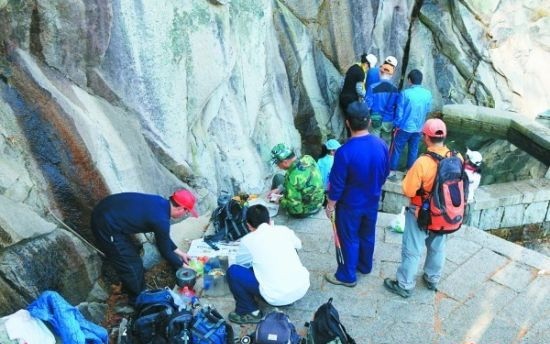
Some tourists have weak awareness of fire prevention, using alcohol stoves to cook after entering the mountain, creating potential fire hazards.
From October 26, 2012, to May 31, 2013, is the fire ban period for Laoshan Scenic Area. Due to the dry, rainless, and windy conditions since autumn this year, which pose high forest fire risks, the forest fire prevention situation is extremely severe. On November 1, reporters learned from the Laoshan Scenic Area Management Bureau that the bureau will launch a forest fire prevention rectification campaign. While promoting forest fire prevention knowledge to residents and tourists, joint law enforcement actions will also be carried out. In addition, the scenic area plans to develop reminder text messages for visitors upon entering the mountain to alert them to forest protection and fire prevention.
Multiple Mountain Entrances Pose High Fire Risks
On October 28, reporters at the Dahe East Community at the foot of the Taiqing Tourist Area in Laoshan saw a continuous stream of hikers descending from the mountain. “According to incomplete statistics, there are currently 77 entrances to Laoshan Scenic Area, including both official tourist routes and mountain paths in local communities,” said Gong Baoju, a staff member of the Laoshan Forest Farm. Nowadays, hikers prefer climbing higher-altitude mountains, mostly concentrated in scenic areas such as Jufeng, Jiushui, Taiqing, and Qipanshi.
However, Gong Baoju said these routes are all unofficial and not open to the public, so the scenic area is very concerned about ecological safety and the personal safety of hikers. Liu Qiang, Deputy Director of the Laoshan Scenic Area Management Bureau and Commander-in-Chief of the Laoshan Scenic Area Forest Fire Prevention Command, said that according to scenic area statistics, the number of people engaging in off-trail hiking in recent years has surged sharply. As deep autumn and winter arrive, the number of visitors entering the mountain has shown an increasing trend, peaking on Saturdays and Sundays with up to several thousand people. There are nearly 30 concentrated gathering spots where hikers often dine and rest together. Most of these hikers enter unrestricted areas through these entrances for sightseeing, resting, using fire, and dining, posing a serious threat to forest fire prevention.
Unofficial Trails Becoming Common, Fire Awareness Lacking
Veteran hiker Cai Ting said that over a decade ago, almost no one used the unofficial trails in Laoshan, but in recent years, the number of people on some of these trails has become as high as those on official scenic routes. “In recent years, hiking unofficial trails has become more mainstream, attracting people from children to the elderly,” Cai Ting said. As the number of hikers on these trails has grown, differences in knowledge levels and overall quality have become more apparent. In a large group walking together, it’s inevitable that someone might want to smoke, creating potential hazards.
“Years ago, we had dedicated clubs, but now with online forums, all it takes is a shout-out and people gather,” Cai Ting said. Sometimes he leads groups of over a hundred people up the mountain, but not everyone knows each other well. Even though he is leading the group, some hikers don’t heed warnings. “Besides, Laoshan is huge—once you’re in, it’s a full-day trip, and even a six-hour hike is considered short. It’s very difficult for scenic area enforcement officers to patrol effectively,” Cai Ting said. After a full day on the trails, everyone wants something warm to eat, so many hikers carry alcohol burners up the mountain, which easily poses a threat to forest fire prevention.
Strict Checks on Vehicles and People During Fire Ban Period
Recently, the Laoshan Scenic Area Management Bureau’s Forest Fire Prevention Command issued the “Laoshan Scenic Area Forest Fire Emergency Plan” and the “Notice on Strictly Prohibiting All Open Fires in the Wild.” According to the notice, from October 26, 2012, to May 31, 2013, is the fire ban period for Laoshan Scenic Area. All forested areas within the scenic area and their peripheries are designated as no-fire zones (excluding permanent residential areas in Laoshan communities). It is reported that during this period, the Qingdao Laoshan Scenic Area Management Bureau’s Forest Fire Prevention Command will set up checkpoints at major mountain entry points to strictly inspect vehicles and individuals entering the mountain, register them, and confiscate any sources of fire, fire-starting tools, and other fire-related equipment. Additionally, more prominent warning signs such as “Don’t Forget Fire Prevention When Traveling – No Fire Sources Allowed on the Mountain” and “Strictly Prohibit All Open Fires in the Wild” will be installed, adding 110 new signs to the existing 200-plus.
Liu Qiang explained that during the fire ban period, individuals who violate regulations will be dealt with severely in accordance with relevant national, provincial, and municipal laws and regulations. For those who smoke or use fire in violation of rules in the wild, the “Four Absolutes” policy will be strictly enforced: non-public officials caught illegally or improperly using fire in forested areas will be subject to economic penalties or administrative detention under the “Public Security Administration Punishment Law”; public officials will be dismissed from their positions; leaders who fail to intervene will be removed from office; and any case of outdoor fire use causing a forest fire, regardless of the extent of damage, will be strictly investigated. “Fire sources and fire-starting materials are prohibited in closed mountain areas, inside forests, or within 100 meters of forest edges. Except in permanent residential areas, agricultural activities such as burning fields, burning crop waste, or setting fire to firebreaks—all forms of production or domestic fire use—are strictly forbidden. Cooking or barbecuing and smoking in forested areas are also not allowed,” said scenic area staff.