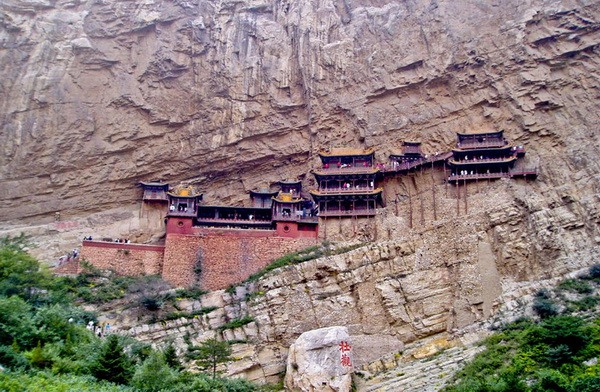
Shanxi’s Hengshan Hanging Temple
Shanxi’s Hanging Temple, known as the “Temple in the Sky,” has recently become a focal point of attention again. Time magazine recently ranked it among the world’s “most dangerous” ten buildings. A comparison by reporters found that, aside from structures listed for their extreme tilting, the Hanging Temple and others stand out simply because they are built on cliffs. Located on the western side of the entrance to Hengshan Mountain in Hunyuan County, Shanxi, the Hanging Temple was first built in the late Northern Wei Dynasty (417–523 AD). The entire temple complex stands about 50 meters above the ground and is the world’s oldest surviving wooden structure built on a sheer cliff. Ancient Chinese craftsmen constructed the Hanging Temple in accordance with Taoist principles that called for “no sound of crowing roosters or barking dogs.” Its architectural features can be summarized in three words: “peculiar, hanging, and ingenious.”
From a distance, the Hanging Temple looks like an exquisite relief sculpture inlaid among towering cliffs. Up close, it gives the impression of being on the verge of flying. The temple complex consists of 40 halls and pavilions, seemingly supported by just over a dozen tree-trunk-thick wooden pillars. In reality, some of these pillars bear no weight at all, which contributes to the temple’s dramatic, perilous, and spectacular appearance.
What’s particularly “remarkable” is that the Hanging Temple is situated in a small basin within a mountain valley, hanging entirely within the middle of a rocky cliff. The protruding parts of the cliff’s summit act like an umbrella, shielding the ancient temple from rain erosion. During floods in the valley below, the temple also remains safe from inundation. The surrounding mountains also reduce the amount of direct sunlight it receives. This prime geographical location is one of the key reasons the Hanging Temple has been so well preserved.
According to records, Hunyuan County has experienced numerous earthquakes throughout history. In the past 50 years alone, there have been three earthquakes of around magnitude 6, one of which caused one-third of the houses in the county seat to collapse. Yet the Hanging Temple remained unscathed.
“At 1:48 in the afternoon, we had just finished lunch and were resting in the reception area when suddenly there was a loud rumble outside. Many rocks came crashing down, and the Hanging Temple was engulfed in dust. Fortunately, the temple remained undamaged. At the time, we were hosting a group of 42 German tourists who were all inside the temple complex and none of them were hurt,” recalled Wang Xia, a former staff member of the Hanging Temple management office who personally experienced the 1991 Hunyuan earthquake.
The late Chinese ancient architecture expert Luo Zhewen revealed the reason why the Hanging Temple survived multiple earthquakes. He explained that the temple’s beams and columns use a mortise-and-tenon structure, whose most significant feature is its seismic resistance. When subjected to strong external forces, the components of such structures shift against each other but can return to their original positions once the force is gone, thus preventing complete destruction.
Although the Hanging Temple has stood for a thousand years, Chinese cultural heritage experts have pointed out that it is now facing the issue of excessive foot traffic and the resulting structural stress, hoping that local authorities and visitors will take this seriously.
It is reported that during peak tourist seasons, the Hanging Temple receives over 2,000 visitors daily. Although local authorities have implemented restrictions allowing only 100 people to climb up to the temple at a time, these limits are difficult to enforce during busy tourist periods.