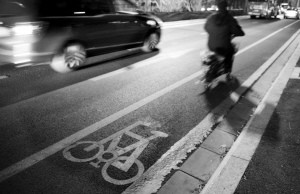
Shenyang now has a “narrowest-ever bike lane” measuring less than 70 centimeters wide.
On the renovated road, the bike lane is less than one meter wide. Because it’s so narrow, many locals have dubbed it a “micro” bike lane.
Traffic police stated that road markings are determined based on specific road conditions, and they will consider whether improvements are needed after observation.
Encountering a “micro” lane
Bicycles “forming a line” to pass through
Early yesterday morning, Mr. Liu, a resident of Shenyang, was riding his bicycle to visit relatives. He was heading south along Heping Avenue when he gradually found the road ahead becoming increasingly “difficult” to navigate...
At first, he could ride side by side with other cyclists on the road, but later he gradually moved closer to the bicycles traveling alongside him, and eventually he had to join them in a single file, with bike handlebars touching rear fenders, forming a “line” within the lane, and the speed getting slower and slower.
“The road gets narrower the further I ride.” Mr. Liu noticed that the reason for this situation was that the bike lane was gradually getting “thinner,” and on a lane less than one meter wide, bicycles could only line up single file, handlebar to rear fender.
“It’s good to have bike lanes marked, but when the road is too narrow, it actually becomes inconvenient.” Mr. Liu felt that such planning didn’t seem to bring much convenience.
Lane too narrow
Many cyclists encroach on motor vehicle lanes
Yesterday at 5 PM, a reporter drove north to south along Heping Avenue. Along the way, the bike lanes on both sides of the road were about two meters wide, but when the reporting vehicle entered the section of Heping South Avenue between Shayang Road and the South Second Ring Road, the bike lane on the road suddenly “slimmed down.”
The reporter observed that on both sides of the four-lane road, two bike lanes, each about 1 kilometer long, stretched into the distance. On a lane less than one meter wide, occasional bicycle symbols indicated that the area was designated for bicycle traffic.
Due to the narrow lane and the raised height of the roadside curb, many cyclists found it difficult to ride onto the sidewalk. Some impatient riders simply pedaled onto the adjacent motor vehicle lane, competing for space with cars.
At 5:30 PM, a No. 244 bus pulled into a stop, completely occupying the bike lane. To avoid the bus, cyclists had to weave into the northbound motor vehicle flow. A reporter stopped a cyclist riding in the motor vehicle lane, who admitted it was dangerous, “but there’s no choice, this area (the motor vehicle lane) is much wider.”
Locals explained that this road section was renovated and completed in October, and the subsequent road markings reduced the width of the bike lane to its current size. Due to the narrowness, cyclists often found themselves at the mercy of motor vehicles.
Most locals said they had no choice but to ride in the motor vehicle lane, and many were concerned about how liability would be determined in case of an accident with a car.
Traffic police department:
Will consider whether to re-plan after observation
Yesterday, reporters learned from the traffic police department that there are no strict rules for marking vehicle lanes on roads, “it’s often analyzed on a case-by-case basis, ensuring traffic volume while maintaining safety.”
Traffic police said that during marking, bus lanes are generally around 3 meters, motor vehicle lanes around 2.8 meters, and bike lanes around 1.5 to 2 meters, with priority often given to motor vehicles.
Regarding the overly narrow bike lanes on Heping South Avenue, the traffic police stated they had also noticed the situation, “the dimensions were set during the design phase by the road company.” They explained that Heping South Avenue itself is not very wide, and the central divider occupies a certain amount of space. After ensuring motor vehicle passage and conducting actual tests on bicycle traffic volume in the area, the lanes were marked as they are now.
“Initially we considered not marking bike lanes at all, but mixed traffic led to even more chaos, which is why we marked them.” The traffic police said that the current markings are an effort to maximize road traffic flow, but in light of the actual conditions on this section, they will observe further before considering whether a re-plan is necessary.