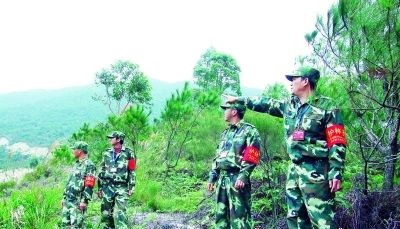
The daily work of rangers is repetitive, year after year—ordinary yet respectable.
Rangers may have an ordinary job, but they carry unique hardships. They spend their lives in the deep mountains and forests, working on the front lines of forest conservation. A water bottle and a sickle are all they need for their patrols. They walk nearly 10 kilometers of mountain trails daily, encountering venomous snakes or wild boars as a matter of course, sometimes even facing the dangers of boar attacks or falling off cliffs. Their achievements may not be spectacular, but day after day, year after year, they repeat the same work. On rugged mountain paths, they guard those stretches of forest.
The 18th National Congress of the Communist Party of China called for more active ecological protection and the building of a Beautiful China. Currently, Huizhou is also striving to become a National Forest City. Achieving these goals relies on the rangers’ persistent guardianship of forest resources.
Recently, a reporter accompanied several rangers from Hengshe Village in Xiqu Subdistrict, Daya Bay District, into the deep mountains to experience their daily patrol work.
Wild grass grows as tall as a person, making progress difficult
At 7 a.m., the reporter set off by car from the central area of the Daya Bay Development Zone. After passing through bustling streets, the vehicle entered rugged mountain roads, winding through countless turns to reach Hengshe Village, a mountainous village at the border between Xiqu Subdistrict and Pingshan, Shenzhen.
Upon hearing that the reporter was coming for an interview, ranger Lai Riqiang got up early to wait. After a quick wash, breakfast, and putting on his army-green camouflage uniform and red armband labeled “Ranger,” he grabbed his water bottle and sickle and came to the village entrance to greet the reporter and the team. Soon after, three other rangers from the village—Huang Xijin, Liao Qiliang, and Huang Jianjun—also arrived by motorcycle one after another. They were ready to start the day’s patrol.
The four rangers not only wore matching uniforms but also shared one common trait: their deeply tanned skin.
At the village entrance, the reporter saw layers of mountains surrounding the village. Although it was late autumn, the forests of southern Guangdong remained lush and green, and the fruit trees at the foot of the mountains were growing well.
Lai Riqiang pointed to the distant mountains and told the reporter that the visible range belonged to Hengshe Village and fell within the patrol area of the four of them, covering about 10 square kilometers.
Then, the reporter followed Lai Riqiang and the others into the mountains to begin the patrol.
The trails at the foot of the mountain were relatively easy to walk, but the higher they went, the more complex the terrain became. With overgrown wild grass and scattered rocks, the reporter experienced what it meant to “struggle to move forward,” having to rely on vines along the path for support to climb up, while the rangers moved swiftly.
“This is considered one of the easier paths for patrolling!” said Liao Qiliang, who has six years of patrolling experience, casually.
After walking for an hour, the reporter felt physically drained and looked back to see that they hadn’t gone very far. Clearly, the reporter’s pace was holding the patrol team back.
“For you, one kilometer of mountain trail takes an hour; we can do it in 20 minutes,” said Lai Riqiang.
Heading further uphill, the team walked for another 30 minutes. Ahead, there were only towering trees and wild grass as tall as a person, with steep slopes... “Where’s the path?” the reporter asked in surprise. “The path is made by walking. When there’s tall grass ahead, we cut through it with the sickle as we go,” Lai Riqiang said calmly as he led the way, using his sickle to hack away at the vegetation. He added that walking diagonally helps prevent slipping.
Assisted in apprehending two suspects during patrols
Lai Riqiang pointed to a distant mountain and said, “That mountain is called Yanhang. It’s another two kilometers from here. Our task for the morning is to patrol from here to there.” When the reporter expressed surprise at the distance to Yanhang Mountain, ranger Huang Jianjun, standing nearby, said, “What’s that? Walking ten kilometers of mountain trails round trip in a day is nothing special. That’s not even the farthest mountain. Going to Jiaozyuan (mountain name) requires a one-way trip of ten kilometers. We’ve even done thirty kilometers in a single day!”
Considering the reporter’s safety and physical condition, Lai Riqiang insisted that the reporter not continue with the patrol.
The time Huang Jianjun mentioned walking thirty kilometers actually happened earlier this month. “Not long ago, during our patrols, we often encountered two people carrying backpacks heading deep into the mountains. At first, we thought they were regular hikers, but after seeing them so many times, we started to get suspicious,” Lai Riqiang said. On November 1, they followed the group into the deep mountains. Later, they discovered the pair were illegally harvesting agarwood resin, severely damaging the nationally protected second-class plant, agarwood. “That day, we walked from 10 a.m. to 3 or 4 p.m., covering over thirty kilometers round trip. We were completely exhausted by the end,” Lai Riqiang recalled, still somewhat shaken by the experience. However, he said he was grateful that, with their help and coordination, forest police successfully apprehended the two suspects.
In fact, Hengshe Village is rich in forest resources, and illegal harvesting and logging occur from time to time. Last October, rangers also discovered and helped crack down on an illegal agarwood resin harvesting case.
Besides preventing theft, fire prevention is also a key focus for rangers. Lai Riqiang said that with autumn and winter arriving, the dry and brittle conditions make it a critical period for forest fire prevention, requiring utmost vigilance. “We’re in the downwind direction of the northwest wind. If a fire starts downhill, it can easily spread uphill. Once a forest fire ignites, it’s hard to control. Moreover, this area is close to the Daya Bay Petrochemical Zone and Shenzhen. If the fire spreads there, the economic losses would be enormous,” Liao Qiliang added.
“The ecology here is well-preserved, and there are reservoirs. The scenery is beautiful,” Lai Riqiang told the reporter. Hengshe Village is adjacent to Shenzhen, and many people come to hike during holidays. Therefore, from September to April each year, the rangers intensify their mountain patrols. Additionally, they take turns setting up checkpoints at the foot of the mountain to promote fire safety awareness among hikers, temporarily confiscating lighters and other fire sources to prevent fires caused by human activity. During patrols, they also frequently remind villagers and hikers to stay vigilant about fire risks.
The job of patrolling the mountains is tough. Lai Riqiang said he had already worn out three pairs of military boots this year. Moreover, the mountains harbor many dangers. The rugged trails often lead to occasional falls, and bee stings are commonplace. Lai Riqiang told the reporter that in recent years, the forests have been well-preserved, leading to an increase in wildlife. In the vicinity of pristine old-growth forests, wild boars are frequently spotted. “When we go to these areas, we’re usually extra cautious. We carry knives or sticks at hand, always on guard.”
“A better ecological environment means a more comfortable life for us”
Lai Riqiang used to farm in the village and also served as the village’s epidemic prevention officer. Last year, when Daya Bay expanded its recruitment for rangers, he applied. Although patrolling requires six to seven hours a day, forcing him to put most of his farming work aside, and his monthly salary is only about 1,000 yuan, with little chance for outstanding performance, Lai Riqiang has never regretted his choice.
“The job is tough, but climbing the mountains every day is also a form of exercise. As rangers, protecting the ecological environment of our hometown makes us feel comfortable living here,” Lai Riqiang said. Every time he climbs to the mountaintop, breathes the freshest air, and gazes at the vast green forests and the clear water in the reservoir, the sense of exhilaration makes him forget the physical fatigue.
“The 18th National Congress of the Communist Party of China was held last month, and the report emphasized respecting, adapting to, and protecting nature, as well as building a Beautiful China. What we rangers do is protect nature and contribute to the construction of a Beautiful China. We take great pride in that,” said Lai Riqiang, a veteran Party member. Despite having worked in agriculture in the countryside for a long time, he remains engaged with national politics, following relevant news daily through TV and newspapers.
He proudly told reporters that out of the four forest rangers in the village, three are Party members. “Protecting the forests is everyone’s responsibility, but as Party members, we have an even greater duty to lead the way.”