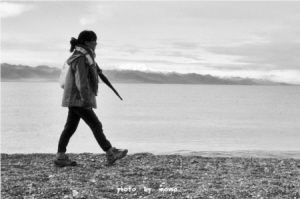
Liang Weiqing
A distance of 9,100 kilometers covered in 42 days, spending less than 4,000 yuan. For Liang Weiqing, a first-year master's student in the School of Geography at Nanjing Normal University, this was an extraordinary journey. She took a train from her hometown Qingdao to Kunming, Yunnan, where she met up with her teammates, then hitchhiked and hiked along the Yunnan-Tibet Highway all the way to Lhasa, and from Lhasa continued through Xining, Lanzhou, Xi’an, and Jinan, finally returning to her hometown Qingdao. In total, she traveled through 12 provinces.
Influenced by Sanmao, she wanted to go on a journey of self-discovery
Liang Weiqing told reporters that her longing for Tibet might have been sparked by the allure of the mysterious Motuo region in Annie Baby’s novel “Lotus,” or perhaps by the “temptation” of Sanmao’s wandering philosophy: “If I don’t go on a complete journey of self-discovery, I’ll never be satisfied for the rest of my life.”
All along, Liang Weiqing had been planning how to make her graduation season more meaningful. Having long dreamed of going to Tibet, entering Tibet became her top priority. “Lhasa has always been a dream of mine. And graduation is probably one of the few times in our lives when we can afford to be impulsive. I just want my youth to be without regrets.”
Since being admitted to a master’s program last October, Liang Weiqing had plenty of free time to plan her trip to Tibet. So she began taking action quietly. “Back then, I worked part-time jobs to save money, traveled alone, and even slept on couches—all to prepare for Tibet.”
Starting in mid-May this year, Liang Weiqing began posting on various travel websites and social media groups to find people to join her on the trip to Tibet. Finally, she found teammates who shared her dream in the “College Students’ Travel Buddy Plan” group. “There were seven of us in total—four guys and three girls, all college students from different provinces and cities. We decided to meet up first in Kunming, Yunnan, and then travel together along the Yunnan-Tibet Highway toward Lhasa.”
Hitchhiking and hiking, it took two days to get out of the Lancang River area
Liang Weiqing’s journey to Tibet was completed by a combination of hitchhiking and hiking. The Yunnan-Tibet section is sparsely populated, with few vehicles passing by. Liang Weiqing and her companions had to flag down rides. “We’ve ridden in vans, tractors, and cargo trucks… the drivers were all very kind, usually giving us a lift if it was on their way and not charging us. But when no vehicles came by, we had no choice but to walk.” For Liang Weiqing and her team, the toughest part was the stretch from Deqen to Markam, where they barely saw any vehicles and had to hike the entire way. It took them two days to get out of the Lancang River area.
Food and shelter were also simple. Along the Yunnan-Tibet route, they mostly relied on compressed biscuits and flatbreads to stave off hunger. Whenever possible, they found places to stay, but in remote areas, Liang Weiqing had to camp outdoors. One memory that still stands out is the time she pitched a tent in the wild and it poured rain in the middle of the night. “If you ask me what the biggest takeaway from this trip to Tibet was, I’d say it’s learning to simplify and live a minimalistic life,” Liang Weiqing said.
9,100 kilometers, filled with touching moments
During this long journey spanning 9,100 kilometers, Liang Weiqing felt that what she cherished most were not the landscapes along the way, but the people and experiences she encountered. Many drivers they met on the road would voluntarily stop and give them a ride, which warmed Liang Weiqing’s heart.
On the road from Deqen to Markam, the group didn’t see a single vehicle for two days, which made everyone anxious. The only vehicle they encountered was heading in the opposite direction. “When we first saw the car, everyone got excited, but then we realized it was going the wrong way, and we all deflated,” Liang Weiqing said. “Unexpectedly, the driver stopped when he saw us and gave us a Xinjiang Hami melon to cheer us up. We were deeply moved.”
Liang Weiqing said that this melon gave them tremendous encouragement and support when they were almost at their breaking point. After two days of hiking and eating only dry food, the group quickly shared the melon.
Liang Weiqing told reporters that there were many people along the way who helped them: soldiers at checkpoints who helped them flag down cars; drivers who gave them a lift; a kind tour guide sister who dropped them off at the Yarlung Tsangpo Grand Canyon and then brought them back to Bayi Town that night; as well as the couchsurfing hosts who hosted them...
“For me, this was an experience of challenging myself, a ritual to bid farewell to my youth.” This is how Liang Weiqing described her trip to Tibet.