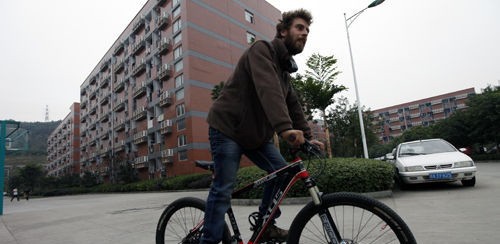
Bentier told reporters that along the way, he encountered different people and experienced different things. It gave him a long-lost sense of warmth.
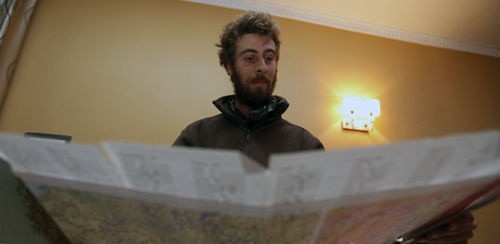
Bentier completed the 269-day cycling journey relying solely on a map as his "guide."
"A belated gap year," said 26-year-old Bentier in his French-accented English. This year marks his belated gap year. From February 16 to November 10, 2012, he spent a full 269 days cycling with only his essential luggage, starting from Paris and passing through 17 countries including Italy, Slovakia, Turkey, and Iran, before finally arriving in Hechuan, Chongqing, China.
"Being on the road" is what Bentier believes is the meaning of this gap year for him.
The meaning of travel lies in the journey itself.
A gap year refers to taking an extended period of time (usually a year) to travel or engage in volunteer work with non-governmental organizations. Since gap years most commonly occur after university graduation, Bentier described his long cycling trip as a "belated" gap year.
After 269 days of cycling, Bentier already had a full beard. Previously, Bentier worked as a deliveryman in Paris, cycling through the streets of the city to deliver goods for many luxury brands, serving their VIP clients. He saved up enough money for the trip through his job, which enabled him to embark on this journey.
"Actually, there was another purpose to this trip," Bentier said. "My dad is a visiting scholar at the Yitong College of Chongqing University of Posts and Telecommunications in China, and I came to visit him." Bentier’s father, Michel, has been a visiting scholar at Yitong College for nearly a year, during which time he and his family have not been able to reunite.
At the start of the trip, his father asked him via email: "What do you think is the meaning of choosing to cycle across Europe to reach China?"
Bentier replied briefly and casually: "On the road. As for deeper meanings or the meaning of life, I need to find them along the way."
Passing through the Taklamakan Desert with temperatures of 55 degrees Celsius
When he set off from Paris, Bentier had 8,000 euros with him. The first country he passed through was Italy, then he crossed the Italian border, went through Slovakia, and entered Eastern Europe. Since he only carried a single backpack with limited space, aside from essentials, he tried not to acquire new items. At each stop, he would discard unused items such as maps and postcards before continuing on. By the time he reached China, he only had a map of Kyrgyzstan and a map of China left.
Bentier told reporters that along the way, he encountered different people and experienced different things. He still remembers when he was in Iran, the weather wasn’t great. He pitched a tent in an open area in the suburbs to sleep, but a nearby farmer, worried he might get sick from the cold outdoors, kept insisting he wanted to learn English as an excuse to invite him into his house. The host’s kindness gave Bentier a long-lost sense of warmth in a foreign land.
Compared to the hospitable locals, nature brought not only breathtaking beauty but also frequent challenges.
Bentier had many "battles" with nature along the way. When passing through the Taklamakan Desert, he decided to take a shortcut marked on the map, which required crossing part of the desert and took three days.
Bentier stuffed his backpack with bottled water and began the desert crossing. He told reporters that it was the height of summer, and when he cycled to the middle of the sand sea, he checked the thermometer he was carrying—it read a staggering 55°C.
Bentier recalled that he was relatively okay with the temperature and environment. During the journey, he only had one incident in Turkey: he came down with gastroenteritis, which forced him to stop and rest for several days. Only after recovering did he continue his journey.
Along the way, Bentier also met many other people who were cycling like him. They traveled together when their routes aligned and parted ways when they diverged.
Cycled the entire journey, only forced to take a plane once
In Bentier’s view, among the various mishaps he encountered during the trip, bicycle repairs were the most troublesome. Although his bike had a global warranty, the procedures and repair time still made him wait for long periods. To his relief, his bicycle only needed two repairs and never completely "broke down."
Throughout the journey, Bentier stuck to cycling and did not switch to other modes of transportation. There were only two emergencies that forced him to take a truck and a plane.
The first happened in Turkey, where his beloved bike suddenly broke down in a rural area of a Turkish city. He had to carry it to the road to hitchhike. Fortunately, a kind truck driver gave him a ride and dropped him off in a nearby city before leaving.
Bentier said that when his bike broke down, he didn’t panic. "Then I just stopped and rested for a few days." His solution was to wait, and the waiting time allowed him to fully explore the local scenery.
The other time he took a plane was due to sudden conflict. While passing through a Central Asian country, due to small-scale warfare in the border area, he was informed that he could not enter. Left with no choice, he opted to fly over the border, landing in Tashkent, the capital of Uzbekistan, before continuing to cycle. Eventually, after traversing Tajikistan and Kyrgyzstan, he arrived in China.
When reporters met Bentier, he was planning a major overhaul of his bicycle. He had applied for maintenance, and the necessary parts were being sent from Chengdu to Chongqing. He hoped that both he and his bicycle could get ample rest in Chongqing.
He showed the reporters his currently disassembled bicycle. His bike mainly consists of two parts: besides the main frame, he also assembled a trailer at the back where he placed his luggage while cycling. A flag was attached to the front of the trailer so he could easily check the status of the trailer and luggage through the bike’s rearview mirror.
Chongqing is "spicy" and straightforward—I want to find a wife here
Bentier said that along the way, he passed through many unique cities, but his impression of Chongqing could be summed up in one word: "spicy."
He told reporters that when he first arrived in Hechuan and saw his father, both were extremely emotional. His father invited him to a restaurant serving Chongqing cuisine, and the lavish spread of dishes made him ravenous after living on the road and roughing it for most of the past year. As a result, his first night in Chongqing was spent in the bathroom.
“I rarely eat spicy food in France. Suddenly having so many spicy dishes really stirred up my body a bit,” Benteil said half-jokingly.
After staying in Chongqing for nearly two weeks, Benteil became more or less accustomed to the people and life here. He told reporters that every city is unique, but none has a personality as distinct as Chongqing’s, as straightforwardly spicy as the local flavor preferred by its residents.
After talking with his father for a long time, Benteil finally understood his father’s fondness for this city. He said, “I don’t feel a sense of strangeness here. Maybe it’s because this is where my dad has lived for so long—it feels more like another home.”
In an email to his close friend, Benteil joked, “I might find love here and settle down.”
Next stop is Kathmandu. Plans to end the bike ride in Australia.
In fact, Chongqing is not the final destination of Benteil’s entire cycling plan. He intends to rest up and then continue his bike journey. The next destination is Kathmandu, the capital of Nepal, and from there he will enter India. He said he might visit some other countries along the way, but his final stop will be Australia, where he plans to conclude his entire cycling adventure.
When asked about specific plans, Benteil said he doesn’t have a very strict schedule and is quite flexible with time. He doesn’t want to impose too many constraints on his trip. “Go where the road takes me, stop where I feel like it, and earn money while traveling.”
Benteil said that although his father is willing to fund part of his travel expenses, he believes he should rely more on himself to make the journey more complete. In Benteil’s view, traveling is about seeing different people and experiencing different things, broadening one’s horizons so that one can face life in the future with greater openness and composure.
By a twist of fate, Benteil’s travel route happens to align with that of Larry in the novelist W. Somerset Maugham’s novel *The Razor’s Edge*. Even more coincidentally, like Larry, Benteil is also searching for the meaning of travel along the way, seeking to make his life more complete. When the reporter asked if Benteil was influenced by *The Razor’s Edge*, he replied mysteriously with a sly smile: “Maybe I am Larry.”
Benteil said he will continue cycling, with Kathmandu as the next stop. Plans to end the ride in Australia.