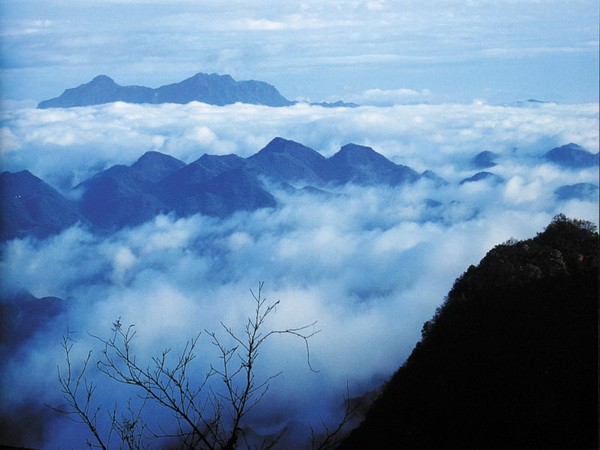
Hupingshan Mountain, Changde
A team of seven will live on only 5 pounds of flour and 6 pounds of cereal for seven days in the freezing cold at an average altitude of 2,000 meters on Hupingshan Mountain in Changde. This crazy idea will become a reality.
At 2:30 pm today, the extreme survival team organized by Changsha Langtu Culture Communication Co., Ltd. departed from Shipingzi Valley in Shimen’s Hupingshan Mountain, and they are set to challenge this survival limit.
On December 28, 2012, Changsha Langtu recruited “wilderness extreme survival team members” through websites such as Rednet Forum, detailing requirements, activity fees, preliminary schedules, and the basic itinerary.
Aluminum pots, chopping boards, knives, flint, windshields, disposable bowls and chopsticks… At 8 pm on December 31, 2012, in an apartment on Wanjiali North Road in Changsha, team members were preparing essential survival tools before taking a train to Shimen County, Changde City, Hunan Province, where they would climb Hupingshan Mountain.
What kinds of stories will unfold over the seven days? What dangers will they face? According to poster Lei Hongze, he will stay in touch with Pi Jian, who is responsible for documenting the wilderness activity, and provide timely updates on Rednet Forum.
【Recruitment】A web post calls for six members — “No impulsive or overly reactive types”
Have you ever thought about leaving the city to survive in the wild? Ever imagined heading deep into the mountains with a small group for seven days under limited conditions?
On the morning of December 28, 2012, a recruitment post titled “2013 Wilderness Extreme Survival Experiment (Season 2)” appeared on Rednet Forum, detailing requirements, activity fees, preliminary schedules, and the basic itinerary.
Previously, Changsha Langtu also posted recruitment info on professional outdoor websites. However, many applicants backed out after learning about the tough restrictions such as “no showers” and “no contact with the outside world.”
“After initial assessments and training, we finally selected six members, one of whom is waiting for us in Shimen County,” said Pi Jian. “The training covered outdoor knowledge, wilderness survival skills, self-rescue methods, and included a final assessment.”
Pi Jian said: “There are no strict criteria for selecting members; we don’t divide by physical ability, but mainly look at outdoor survival awareness.” The so-called “outdoor survival awareness” refers to being cautious and steady. He further explained: “The dangers of the outdoors can be avoided, but once danger strikes, you can’t escape.”
He gave an example: “Experiments show that a snake’s reaction speed is 0.095 seconds, while a human’s instinctive reaction is 0.13 seconds. So we can only avoid. If we know there are many snakes, we just don’t go into tall grass.”
【Itinerary】11 pounds of flour-based food for seven people surviving in the wild — wildlife may be encountered
Food is essential for wilderness survival.
“This time, we’re only bringing non-protein foods: just 5 pounds of flour and 6 pounds of cereal,” said Pi Jian. “These foods are enough to get the team through seven days.”
Pi Jian, who calls himself a “southerner who acts like a Northeasterner,” is quite knowledgeable about the outdoors. He explained: “In the desert, you can die without water in three hours; in normal temperatures, you can die without water in three days; with water, you can survive three weeks. The six essential elements for the human body are sugar, vitamins, minerals, protein, fat, and carbohydrates. Vitamins and minerals are ‘optional’ and can be obtained by picking wild fruits or mushrooms. Carbohydrates eventually convert to sugar for absorption, and flour and cereal are carbohydrates. The body stores fat, so the key is how to find protein.”
“During this outdoor trip, we might end up eating insects raw — such as grasshoppers, worms, or eggs,” said Pi Jian. “Half our route will involve stream trekking and the other half mountain crossing, possibly including rock climbing. We might also encounter wildlife, so we need to stay alert and act cautiously.”
【Departure】Standard gear weighs 40 pounds — there's a female team member
In Changde, the first snowfall of winter has just melted. Hupingshan Mountain, located on the northwestern edge of Hunan, generally sits above 2,000 meters in altitude, with undulating peaks and unpredictable weather.
Facing unknown dangers, the team members were afraid of forgetting anything potentially useful. A member nicknamed “Black Pineapple” had initially thrown away his knife but then put it back in his bag. “Good for gutting fish,” he said. Du Kang, the youngest member, after much deliberation, decided to bring along a fishing rod that was otherwise inconvenient to carry.
“This is the standard gear weighing 40 pounds,” Pi Jian said, lifting “Black Pineapple’s” backpack. The other members’ packs were equally stuffed.
“I’m really looking forward to this wilderness activity, very excited,” said Jiang Yu, the only female team member and a second-time participant in the “Wilderness Extreme Survival Experiment,” just before departure. “Never been to Shimen. Bringing so little stuff, in ice and snow, for seven days — still a bit scary.”
Zhu Weibing arrived in Changsha from Suzhou on December 29. He had previous outdoor survival experience in regions like Jiangsu-Zhejiang and Henan, but this limited-point style of adventure was his first.
Last night, the team took a train to Changde. This morning at 8 am, they took a vehicle to the starting point at Shipingzi Valley, Hupingshan Town, Shimen County. At 11 am, Pi Jian told reporters by phone that all team members had gathered. But due to icy roads, they weren’t moving yet and were resting on-site.
At 2:30 pm, news came from the front that the team had set off from the designated location and everything was normal.
Further reading:
Hupingshan Mountain is located in northwestern Hunan, serving as the border between Hunan and Hubei provinces. It generally sits above 2,000 meters in elevation, with its main peak reaching 2,098.7 meters, and is known as the Roof of Hunan. (Later confirmed that Hupingshan is not the highest peak in Hunan. The highest is Ling Peak, located at the border of Hunan and Jiangxi in Yanling County, reaching 2,115.2 meters according to measurements by authoritative research institutions commissioned by the Hunan Land and Resources Department, making it the highest peak in Hunan.) The top of Hupingshan Mountain is surrounded by high ridges with a low center, resembling a kettle’s spout — hence the name Hupingshan.
Hupingshan covers an area of 15 square kilometers, teeming with rare trees and exotic plants. It currently has 40,000 acres of primeval forest, 831 species of woody plants—including 28 under national key protection—1,019 species of medicinal plants, and over 350 kinds of wild animals. Biological experts have praised it as a “green treasure trove hiding immense value.” Legend has it that the Tang Dynasty poet Li Bai was once exiled here and wrote the timeless verse: “Hupingshan’s cascading falls, with peach blossoms drifting from cave mouths.”