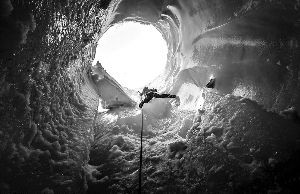
Climbers scale ice walls inside a glacier cave
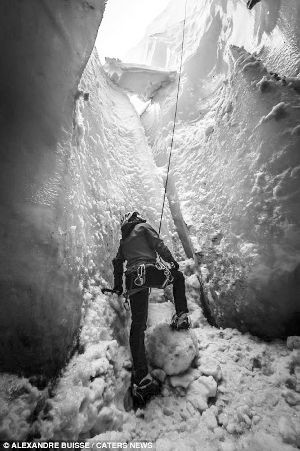
Preparing to climb
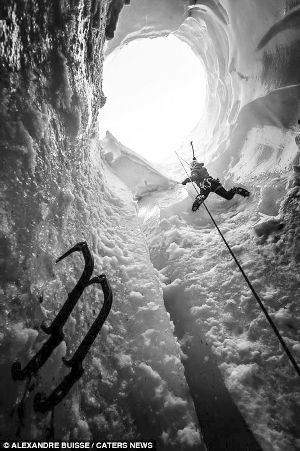
Approaching the cave entrance
According to the UK's Daily Mail, a new extreme sport has recently emerged in France—glacier cave climbing. Photographer Alexandre Bousse captured photos of his friends climbing the ice walls inside Alpine glacier caves in Chamonix, France.
High risk
A single rope ensures safety
These stunning photos show climbers scaling the inner walls of massive caves made entirely of ice. Their only way out is to climb upward to the glacier cave’s exit. The icy walls are extremely slippery and nearly vertical to the horizon, putting the climbers at constant risk of falling.
To capture these photos, Bousse had to brave freezing temperatures and the danger of falling. His only support was a rope attached to ice screws fixed into the glacier walls.
As sunlight streams into the narrow glacier cave, the ice walls may appear unstable, but in reality, these frozen, steep cliffs are solid enough to hold the weight of climbers. Bousse said: "I secured the ice screws into the ice walls, and they supported the ropes that held my body. I hung on the ice walls inside the cave to take the photos. While tightening the climbers’ ropes, I photographed them as they scaled the icy walls. The walls were incredibly steep and slippery—I climbed out of the cave as soon as I finished taking the pictures."
Challenging to shoot
Low temperatures, narrow caves, and difficult lighting control
"The first cave is about 20 meters deep and 3.6 meters wide. The second cave is deeper, around 30 meters, but even narrower—about 2 meters wide," Bousse continued. "Both caves have natural tunnels beneath them, but either they’re too narrow or already blocked by ice. It takes five to twenty minutes to climb out, depending on the angle of the ice wall chosen."
Bousse explained that photographing the ice wall climbs isn’t easy: "Taking photos is difficult—the lighting is hard to manage, and most of the time, falling ice chips from the climbers make it even more challenging, as I’m usually positioned directly beneath them."
Bousse’s second photo session went much more smoothly: "The temperature was relatively higher then. In fact, it was raining on the glacier, so some raindrops fell directly on me. By the time I finished shooting and climbed out of the cave, my clothes were soaked, so I still felt very cold. But usually, the final results prove that the hardships are worth it—the photos turned out absolutely stunning."
Rare opportunity
Only climbable in November and December
These magical caves are actually a special type of glacier fissure, commonly referred to by the French as "glacier potholes." They form in spring and summer when melting water flows into the glacier, creating vertical, well-like ice cavities. Sometimes, this water can even reach the base of the glacier, forming complex tunnel systems.
People only get the chance to climb these glacier caves in November and December each year, as by then the water flow has stopped and the cave entrances haven’t yet been sealed by snow.
Bousse added: "I love photographing climbers scaling ice walls—it’s a fresh and photogenic subject. What particularly fascinates me about glacier cave climbing is the perspective—it offers a view into the interior of glacier fissures, something rarely seen. When sunlight shines through the cave entrance onto the ice walls, it creates a strong, beautiful contrast of light that’s both breathtaking and impossible to replicate."