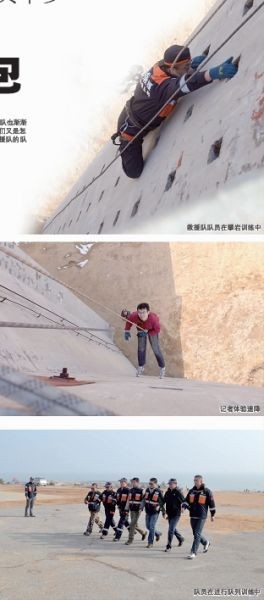
The team members organize training every Sunday, covering physical fitness, rock climbing and rappelling, loaded hiking, medical rescue, fire emergencies, and logistics support, among other areas.
Not long ago, the rescue operation to find the missing hiker Lao Gao attracted widespread public attention. The rescue team has gradually come into the spotlight. Many citizens are curious about how the rescuers train regularly and how they joined the rescue team. On January 13, a reporter from City News followed members of the Qingdao Life-Saving Association Shibao Special Rescue Team to their training base deep in the Laoshan Mountains to uncover the story behind the rescue team.
Personnel: Diverse Professional Backgrounds, Mostly Avid Hikers
On the morning of the 13th, when the reporter arrived at the training base deep in the Laoshan Mountains, they found eight rescue team members and several volunteers already gathered there. The reporter learned that these team members were from the Chengyang Branch of the Shibao Special Rescue Team.
According to Zhang Yuzhong, the 40-year-old team leader, he has been involved in search and rescue for over four years and has participated in countless rescue missions. Just in 2012 alone, there were operations such as the Jiaonan flood rescue and the search for hiker Lao Gao. He and his team have almost climbed every peak in the Laoshan Mountains. In the office of his rescue team, there is also a hand-drawn topographic map of the Laoshan Mountain range. Speaking of this map, he feels very proud: "This map was created based on our own climbing experiences. Many of us are seasoned hikers who have climbed almost every peak in Laoshan. We also used our map during the search for Lao Gao—the commercially available maps are not as detailed as the ones we drew ourselves."
The reporter later learned that the Chengyang Branch under Zhang Yuzhong's leadership currently has over 50 rescue team members, aged between 24 and 42, with varying levels of training. There are also over 200 untrained volunteers. Their professions are quite diverse. Zhang Yuzhong himself used to work as an auto mechanic for many years, while other team members have varied backgrounds, including individual business owners, company employees, and veterans.
Training: Weekly Sunday Sessions with Varied Content and Locations
Upon arriving at the training base, the reporter saw a small hill about 100 meters above sea level, with a large open sandy area at the foot of the hill, an abandoned old building, and some routine training facilities such as horizontal bars, parallel bars, and a balance beam. Captain Zhang told the reporter that they organize training every Sunday, covering physical fitness, rock climbing and rappelling, loaded hiking, medical rescue, fire emergencies, and logistics support. The training locations often change depending on the content. On that day, the main focus was on rock climbing and rappelling, which is why they came to this base.
Captain Zhang explained: "We arrange the use of these training sites by negotiating with various organizations ourselves. We really cherish every training opportunity. Rock climbing and rappelling are mainly done here; fire emergency and firefighting drills take place in Shangma Town; loaded hiking and wilderness first aid training are conducted in the deep mountains. Actual loaded hiking training usually involves carrying around 30 jin (about 15 kg) of gear and walking 20 li (about 10 km) of mountain trails. Theoretical aspects like medical rescue can be discussed and studied in our own office. Once all the training is completed, one can basically become a qualified lifeguard."
At 9:30 AM, the rescue team’s training finally began. After a brief formation drill, everyone did some light warm-up exercises. Around 11 AM, with two sharp whistle blasts, the team regrouped to begin the day’s main training activity: rock climbing and rappelling.
Accommodation and Meals: Mostly Covered by Team Members Themselves
The rock climbing and rappelling took place on the abandoned old building. The reporter saw that the four-story, 13-meter-high building had many square holes on its outer walls for climbing. While the team members trained, the reporter took the opportunity to try it out. What looked easy for the team members turned out to be quite challenging for the reporter. During the rappelling, the reporter stopped halfway after just a short descent. Thanks to Captain Zhang’s continuous guidance on techniques, the reporter mustered the courage to continue.
By the time the rock climbing and rappelling training ended, it was already past 1 PM. Speaking of training equipment and accommodations, Captain Zhang expressed some helplessness: "Most of the training materials and equipment are resolved by the team members themselves. Last time when we rescued Lao Gao, the total cost was over 90,000 yuan, with most of the mountain expenses covered by the team members themselves, but no one really complained. For example, today, two team members who had cars gave everyone a ride from Chengyang, saving a lot of costs. Our rescue team doesn’t have much funding either. When we eat well, we use a large field kitchen, and everyone can have a group cookout or camp after training. Sometimes, team members just figure it out on their own."
During the interview, team member Liu Chuanbao said optimistically: "Actually, training is also like going hiking for fun for us, and we get to meet a lot of new friends along the way. Joining the rescue team is just a way to contribute our skills and strengths for the benefit of everyone. As for the so-called give-and-take, we don’t really think about it." Hearing the team members say this, Captain Zhang was also deeply moved: "I don’t know how to repay them, I can only say thank you."
Division of Labor: Both Men and Women, with Clear Roles
During the training, the reporter noticed that besides the physically strong male team members, there was also a female participant. Captain Zhang explained that one-third of the Chengyang Branch are female members, mainly responsible for logistics and first aid tasks, playing an equally significant role in rescue operations.
"Rescue operations aren’t something that can be accomplished with just enthusiasm. They require proper division of labor and correct command. Take the case of Lao Gao, for example. When the rescue team arrived, everyone wanted to charge in all at once. But considering the weather and terrain, we predicted the rescue would be difficult, and a single team wouldn’t be enough. So we gathered elite members from our subordinate rescue teams to form the first wave, to scout the mountain and set up markers for the following teams. Besides the mountain team, those responsible for logistics, communication command, and first aid supplies are equally important. During the search for Lao Gao, no one expected it to be so tough—the team didn’t bring enough clothing or food, so someone had to handle logistics. Many team members even paid out of their own pockets for food and water. Some team members also proposed setting up an advance camp at Mingxia Cave Taoist Temple to save time and fuel, which required coordinating certain relationships. We also received strong support and enthusiastic help from the relevant authorities, and we’re very grateful to them."
The reporter then contacted Wang Chao, the president of the Qingdao Life-Saving Association. Regarding the current state of the association, President Wang also expressed considerable concern: "Many of our team members are volunteers with their own jobs. For example, Tang Guolin, who found Lao Gao, is usually a plumber for water and drainage installations. Due to his involvement in the rescue, he couldn’t do much work and lost several hundred yuan in earnings. Although Old Tang himself has no complaints, if this continues long-term, his family might not be able to handle it. Some team members’ families don’t understand this kind of commitment, thinking that rescue work doesn’t earn money and even costs money, leading to family conflicts. Some team members have even lost their jobs because of participating in rescue operations."
◎Challenges: The Biggest Issue Is Funding
President Wang also mentioned that these rescue team members have no guarantees whatsoever. "It’s common for team members to suffer minor injuries, and they usually cover the medical expenses themselves. Personal insurance coverage has always been a major obstacle for the development of the rescue team. All the insurance companies we’ve approached have refused coverage—'they don’t compensate for actions where danger is known and voluntarily entered.' So we’re trying our best to find ways to eliminate the worries of these team members when they participate in rescue operations."
Regarding the development of the association, President Wang is most worried about funding. Wang Chao revealed to the reporter that since the association’s establishment, only 10% of funding and equipment-related expenses have come from the support of a few enterprises and clubs. The remaining 90% of daily expenses have been covered by him personally as the president. He owns a business, and although investing several hundred thousand yuan can temporarily sustain the association, he’s unsure how long the association can continue like this. What brings President Wang some relief is that, despite the tough conditions, no one has thought about quitting yet: "I hope their actions can spread positive energy in society and encourage more people to get involved."