"When I stand atop the highest peak, all other mountains seem small" — this is one of the most alluring slogans for rock climbing enthusiasts. But only after becoming a climber do you realize what an ambitious target it is. There’s a group of people who live in urban areas but love outdoor rock climbing. Confronted with steep cliffs, they demonstrate strength, bravery, optimism, open-mindedness, and the life belief of daring to scale great heights and never surrendering.
Guangzhou Leads the Trend in Rock Climbing
Rock climbing has been popular in Europe for over 100 years as an outdoor sport, but it has only developed in China for just over 20 years. In fact, Guangzhou’s rock climbing scene has always been at the forefront of the country. It’s recorded that in 1993, Coach Lü Tiepeng from the Mountaineering Association shared knowledge about climbing and protection techniques in Guangzhou. After 2000, the sport saw rapid development. Zhou Lichao, current Deputy Secretary-General of the Guangzhou Extreme Sports and Mountaineering Association, recalls that at the time, Guangzhou already had multiple clubs and rock climbing training institutions, with nearly 10 climbing venues in the region at its peak, and many top climbers emerged. In late 2000, the 2nd China.com Cup competition hosted by the Beatles Club saw Zhu Xiujuan become the “Queen of Lingnan,” joining the ranks of top domestic climbers.
In 2001, Guangzhou athletes frequently appeared in national championships, elite climbing competitions, and various regional events. Among them, Zhu Xiujuan won first place in the Yangshuo Elite Climbing Competition, Yuan Tian came fourth in the 2001 Zhuji National Elite Climbing Competition, and in 2002, the women’s amateur group championship at the City Games was also claimed by a Guangzhou athlete. The Guangzhou Bitian Sports Club, with Zhu Xiujuan on board, achieved excellent results in four consecutive national championships. In 2004, after Xie Weicheng joined the Guangzhou Moon Mountain Climbing Team, the city’s climbing strength significantly increased.
Due to various reasons, several climbing venues gradually closed or stopped being open to the public by the end of 2003. Climbers then turned their attention to outdoor locations, with places like the Longdong Forest Park, Kemu Lang Huolu Mountain Park, and Luogang Tourist Resort becoming new climbing havens. With the strong support of the local government, the Huaiji Yan Cave, which has a long history of freehand climbing, even built a large competitive climbing venue and hosted international invitationals and national championships for two consecutive years.
Climbers’ Sharing
Strong Donkey:
Climbing Up Is a Natural Urge
Strong Donkey was born in Inner Mongolia and used to be a firefighter, having undergone plenty of climbing training during his military service. He loves outdoor sports, and after being discharged, he naturally took to rock climbing. He quickly gained some recognition in the climbing circle.
"Climbing up is a natural human urge," Strong Donkey says when asked why he fell in love with rock climbing.
Unlike most climbers, Strong Donkey avoids indoor climbing gyms and sticks to outdoor climbing. On weekends, he usually heads to Baiyun Mountain, where there are natural outdoor climbing walls, and during longer holidays, he goes to Yangshuo, considered a mecca for rock climbers around the world. This is thanks to the karst landscape of Yangshuo, where limestone formations make many cliffs ideal for climbing. "There are more than 1,000 climbing routes scattered across Moon Mountain, Tongmen Mountain, Thumb Peak, Golden Cat Cave, Wine Bottle Mountain, and Big Banyan Tree, offering options for climbers of different levels," Strong Donkey says. His favorite is Moon Mountain, which features nearly 20 routes with expansion bolts, eight of which are on vertical walls and the rest have varying degrees of overhang. "On one side, you have the picturesque scenery of the Li River, and on the other, the natural beauty of the cliffs. And when you're hanging in mid-air, your perspective on the landscape is completely different."
When talking about the difficulty and danger of rock climbing, Strong Donkey laughs. "Misunderstanding, absolute misunderstanding. Rock climbing isn’t as hard as you think. It's like running — if you can run, you can climb. It just tests your brain and intelligence more." As for speed climbing and difficulty climbing, it's like running — there are sprinters and hurdlers. It’s something you aim for once you’ve reached a certain level and want to improve. As for danger, professional climbing venues have safety ropes, harnesses, and specialized instructors. As long as you prepare well, the risks are minimal.
Strong Donkey reveals that recently, 21 climbing gyms across the country have launched an annual pass program allowing reciprocal use. Members who purchase an annual pass at a local gym can use it at participating gyms in cities nationwide, including Beijing, Shanghai, Guangzhou, and Chengdu. "This is great news for climbing enthusiasts." Moreover, there are many climbing competitions. On January 19, the Guangzhou Bouldering Finals were held at Rock Cube Bouldering Gym. Not long before that, the largest and highest-level Guangdong Provincial Rock Climbing Championships, surpassing the scale of the national championships, were held at the Olympic Sports Center, attracting 200 participants from Macau and 60 climbing teams from 10 cities in Guangdong. These events have significant promotional value for the sport.
When discussing climbing experience, Strong Donkey says courage, self-confidence, and balance are key. Climbers are often called “spidermen” on the wall, and the basic posture — “three points fixed, one point moving” — relies entirely on balance.
Ya Shen:
Rock Climbing Can Make Your Posture More Graceful
Ya Shen is widely regarded as a beauty in the climbing circle, exuding a kind of health and charm rarely seen in modern urban girls. She’s from Taiwan, and before taking up climbing, the most dangerous activity she’d done was riding a motorcycle on the streets of Taipei. But influenced by American climbing goddess Sasha DiGiulian and Spanish climbing icon Daila Ojeda, along with some peer pressure, she “took a wrong turn” and joined the climbing community.
Ya Shen says that three years ago, she met a friend who loved climbing and told her stories about Sasha DiGiulian and Daila Ojeda. Later, she read in a magazine about four beautiful female climbers in China and noticed how graceful they looked, which inspired her to join the climbing world.
She started indoors on artificial walls. She’s climbed at both Guangzhou’s Rock Cube Bouldering Gym and Huagong Qingtian Climbing Gym. “At first, it felt difficult. A single wall has dozens of holds, which can create numerous route combinations. Choosing a route and deciding which moves to make is all up to the climber,” Ya Shen says. “Every time you reach a hold, it’s like solving a math problem. Should you grab with your left or right hand? How should you position your feet? Where should you apply force? Especially for women, you also need to maintain the beauty of your body on the wall. You have to plan every move. It’s tense and exhausting, but also fun and exciting — that’s the joy.”
Ya Shen says that for women, climbing helps tone an enviable posture. Rock climbing requires balanced strength and beauty in both hands and feet, and girls are definitely not inferior to boys in this. Improving flexibility and coordination are key skills in climbing, even more important than physical strength. Through this process, climbers get more of a workout compared to typical urban women.
Gentleman:
Touching Nature and Challenging the Self
The Gentleman looks rather gentle, even a bit beer-bellied, and his 350-degree myopia makes him seem a bit out of place among climbers. But in reality, he not only enjoys playing football but also loves solo travel, and he’s a loyal fan of outdoor rock climbing. He’s nicknamed “Gentleman” because of his polite demeanor and mild temperament.
Among climbing enthusiasts, the Gentleman could be considered quite generous. His greatest reward for his employees is taking them outdoor climbing. “It’s much better than regular team-building activities.”
First is self-confidence. Facing a cliff that’s at least ten times your height naturally requires a stronger mindset than usual. Then there’s focus. Climbers must concentrate fully on the footholds beneath them and the handholds above, paying attention to every detail of their body’s movement on the rock. This builds concentration. Then there’s ambition. When you’re hanging from a rope, suspended high on a cliff or tower, the choice is not just about courage — it’s willpower, pride, and the determination to surpass yourself.
“Back in middle school and university, we all had experiences of climbing walls or fences instead of using the main entrance. That desire to overcome gravity, break free from constraints, and express individuality perfectly matches the spirit of climbing,” the Gentleman emphasizes. He loves climbing not to become a pro athlete, but to challenge himself. Whether traditional or sport climbing, it’s all about finding your way up. Physical fitness is essential, but so is perseverance. “If others can climb up, why can’t you? If no one else can finish a route, why can’t you be the first?” The Gentleman says every decision a climber makes on the wall comes with personal responsibility — just like life. “Reach the top, take a break, enjoy the view, then look for another peak or cliff. Not there yet? Just keep climbing.” That’s life.
Good Gear Boosts
Climbing Safety
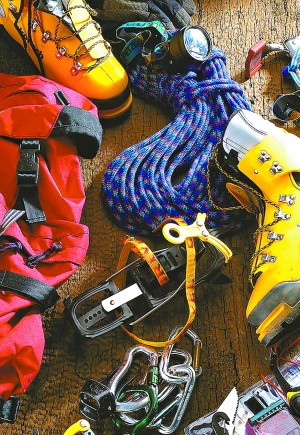
Climbing equipment is an essential part of rock climbing and a critical safety guarantee for climbers, especially indispensable when ascending natural rock faces.
Harness: Climbing harnesses differ from mountaineering harnesses—they are specialized for climbing and not suitable for mountaineering, though mountaineering harnesses can be used for climbing. Most climbers in China use mountaineering harnesses because there are no domestic manufacturers of climbing harnesses, and many climbing enthusiasts are also mountaineers, leading to the interchangeable use of both types. Mountaineering harnesses now mostly feature sit-style designs, with two main types: one called "diaper style" (which goes between the legs and connects to the waist belt), and the other known as "Swami," currently the most popular design on the market. Foreign brands like Black Diamond are priced between 600–800 yuan, while domestic Limit brand harnesses are available for around 300 yuan.
Descender: The figure-eight descender is the most commonly used device, available at prices ranging from tens to over a hundred yuan.
Carabiners and slings: These are used to connect protection points and are essential for bottom-rope climbing techniques. They also serve for self-protection during rests or other maneuvers while climbing, costing a total of just several dozen yuan.
Helmet: A helmet is a must-have for rock climbing, but prices vary greatly—from around 200 yuan to over 1,000 yuan. Generally, imported models under 500 yuan are preferred.
Climbing shoes: These are specialized shoes with high friction, which can save a lot of energy while climbing. Prices range from 300 to 1,000 yuan.
Chalk and chalk bag: When your hands get sweaty, applying a bit of chalk from the bag instantly prevents slipping. This can be had for around 100 yuan.
Rope: Climbing typically uses a main rope with a diameter of 9–11mm, preferably 11mm. Even steel-cored ropes cost less than 100 yuan, and dynamic ropes are even cheaper, available for as little as 10–20 yuan.
Entry-level climbing gear isn’t expensive. Just three basic items—the climbing shoes, chalk bag, and harness—can be had for under 1,000 yuan. However, other items such as ropes, protection devices, backpacks, and helmets can be purchased based on your budget.