While Chinese cities are trapped in the vicious cycle of "traffic jams—road widening—more traffic jams," the Ruhr region of Germany and many European cities have been building an upgraded version of regular bike lanes: bicycle highways. Moreover, more advanced, enclosed bicycle highways with airflow assistance are also under development.
While bicycle enthusiasts outside Europe still regard Amsterdam and Copenhagen as paradises, Germany—a major automobile industry nation—is quietly expanding its network of bicycle highways.
These fully enclosed highways dedicated solely to bicycles, a brand-new road transport project, are gradually becoming the new favorite in European cities. They can reach speeds of up to 40 km/h, have no intersections or traffic lights, and even feature illuminated signage for nighttime use.
In Germany’s traditional industrial heartland, the Ruhr region, the Regional Association Ruhr is currently collaborating with the government on this transport project. The route is 5 meters wide, approximately 60 kilometers long, and connects several cities within the Ruhr area.
After the frenzied evolution of the Western second industrial revolution that prioritized cars, car-centric road transport is seeing a shift from the “four wheels” back to the “two wheels.”
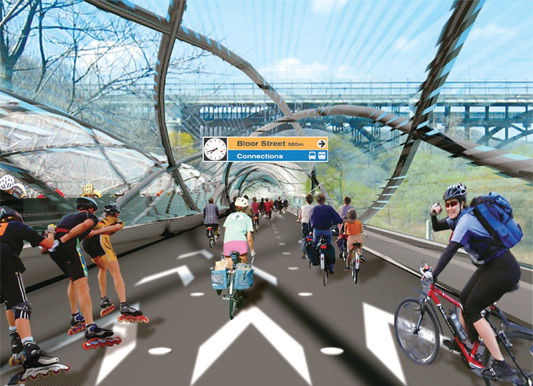
An imaginative rendering of an enclosed bicycle highway, which can shield riders from weather changes such as rain, and may feature airflow assistance in the future. It could serve as an alternative to car highways for city connections.
Bicycle Highways Born Out of Congestion
The German news website "Der Spiegel" once reported on an almost crazy battle for road space on an ordinary Tuesday in late August 2011 in Munich: congested roads, bicycle commuters weaving through streams of cars, with 11 bicycle-related traffic accidents occurring in just one morning. The unrecorded number of minor scrapes, verbal altercations, and physical conflicts is even harder to quantify.
The long-established car-dominated road culture is beginning to change. Car drivers are becoming the disadvantaged: it’s not uncommon for cyclists to tap on the windows of cars blocking their path, as if occupying the road is an unforgivable offense. At red lights, cyclists often zip through with nonchalant flair, as if to say, “Hey, we’re contributing to reducing carbon emissions!”
The original balance of road rights is tilting as the cycling community grows. This issue has long plagued the Ruhr region. According to Harald Spiering from the Traffic Quality Management Department of the Regional Association Ruhr, as a traditional industrial zone and one of Germany’s most densely populated areas, traffic congestion has long been severe. Take the A40—the oldest east-west highway in the Ruhr region—for example, with over 100,000 vehicles passing daily, and speeds barely reaching 20–30 km/h during peak hours.
As early as the mid-1990s, Spiering and traffic expert Winfried Sagolla came up with the idea of a bicycle highway, but the initial concept was a “bike-friendly” initiative calling for the highway to close for one day to give way to cyclists. However, it didn’t gain support at the time. It wasn’t until 2010 that the dream came true. The A40 was indeed closed for one day, replaced by numerous cyclists, inline skaters, and pedestrians.
The “Highway Open Day” not only successfully engaged the public and media attention, but some local governments along the route also began to show interest. Currently, the Regional Association Ruhr is planning a bicycle highway connecting Duisburg and Dortmund, and five smaller towns have expressed willingness to cooperate.
Sagolla is very optimistic about the immense convenience this bicycle highway will bring in the future. Once completed, it is expected that 2 million people will choose to use it, especially appealing to cyclists whose daily commuting radius ranges between 10 to 20 kilometers.
Germany has quietly become Europe’s largest bicycle consumer, with over 70 million bikes—approximately 1.6 times the number of cars. In 2002, the German government spent €200 million building bike paths. Today, nearly half of the country’s 38,000-kilometer federal highway network has dedicated bike lanes.
What’s even more exciting for cycling enthusiasts is a German media report stating that Germany is developing an enclosed bicycle highway with airflow assistance: large airflows inside the lane would assist riders, making cycling easier, faster, and sweat-free. Although there hasn’t been a true technological breakthrough yet, Germany’s well-developed network of dedicated bike paths has laid a solid foundation for further upgrades.
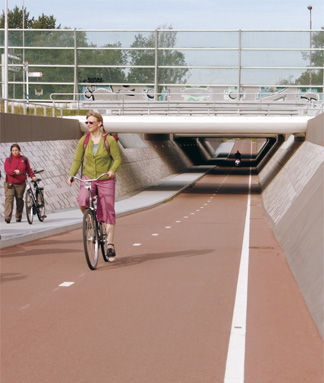
A bicycle lane photographed by a Dutch cycling enthusiast while riding to the suburbs for a picnic. There are no cars to compete with, and a sunken tunnel goes directly under the highway.
The Future Favorite in Urban Planning
In fact, this approach of “upgrading” regular bicycle lane networks isn’t unique to Germany. The ideal of a low-carbon, efficient bicycle highway network is now spreading across Europe.
As a renowned biking nation, the Netherlands—with a population of 16 million—has around 18 million bicycles. When entering the old city center of Amsterdam from the new district LJBURG by car, one must take a long detour, but the dedicated bicycle highway connects the two areas directly. Along the way, there is a Nassau Bridge that only allows bicycles and pedestrians.
Local planning officials summarize the functions of bicycle highways in four major ways: reducing noise, air pollution, obesity among citizens, and the unsightly urban scenery dominated by cars.
Currently, the Netherlands has five bicycle highways, and that number continues to grow.
Denmark’s capital, Copenhagen, known alongside Amsterdam as one of Europe’s two great biking cities, boasts around 400 kilometers of bike lanes—equivalent to eight times the length of Beijing’s Third Ring Road. By the end of 2011, two bicycle highways totaling 15 kilometers, connecting the urban area and the suburbs, were completed, with a third one to be finished in 2012.
Unlike Germany, countries like the Netherlands build bicycle lanes primarily around the capital to directly alleviate traffic pressure. Bicycle highways connecting urban centers with the suburbs are gaining favor among city leaders and commuters. With strong promotion by London Mayor Boris Johnson, an 8.5-mile bicycle highway from south London to the city center was launched in July 2010, meeting the commuting needs of suburban workers. The highway uses bright blue as its color code, symbolizing the freedom of cycling.
This is one of the first experimental routes in London’s planned 12 bicycle highways. Currently, about 5,000 bikes pass through daily. The London Assembly’s goal is to increase daily bicycle trips to 27,000 by 2013, and by 2025, bike ridership is expected to be four times higher than in 2000.
Safety for bicycle highway users is also a consideration for traffic experts and government practice. The first priority is enhancing cyclist safety. The Dutch model provides cyclists with ample freedom while establishing a comprehensive set of safety guidelines. From kindergarten onward, safe cycling behavior and essential cycling courtesy—such as signaling before turning—are included in the education curriculum.