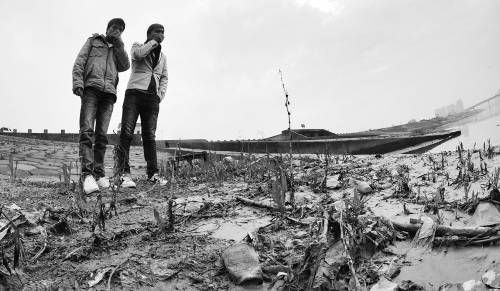
A Changsha resident covers his nose while looking at the riverbank near a drainage outlet along the Liuyang River (photographed on February 24).
Recently, reporters trekked along both banks of the Liuyang River in Changsha and documented scenes of “sewage flowing freely and garbage floating” on the river. At the Yangjiawan section of the Liuyang River, they observed several pipe outlets continuously discharging sewage, where foul odors and piles of garbage were present at stagnant backflow points. It is understood that since the fourth quarter of 2012, the water quality of the Liuyang River in Changsha has been concerning, with major pollutants including chemical oxygen demand and ammonia nitrogen.
The causes of the above phenomena are as follows: First, direct sewage discharge. The urban section of the Liuyang River has not achieved full sewage interception. There are currently 35 discharge outlets, with tens of thousands of tons of sewage and treated tailwater being discharged into the Liuyang River every day. Second, there is a severe imbalance in the ratio of clean water to sewage in the urban section of the Liuyang River. After the operation of the Zhushuqiao Reservoir drinking water project in Changsha, the water volume of the Liuyang River has decreased, and its tributary, the Guitang River, has almost no clean water inflow. During dry seasons, the clean-to-sewage ratio in the urban section of the Liuyang River in Changsha is only 1:2, far below the conventional standard (which is generally no less than 3:1), seriously affecting the normal ecological function of the river section. Third, the water quality of the Liuyang River is also affected by the backwater pressure from the Xiangjiang Reservoir area. After the impoundment of the Changsha Xiangjiang Navigation-Power Junction Project, the water level of the Xiangjiang River in Changsha has continued to rise. As a result, the flow rate of the Liuyang River has slowed down, weakening its ability to disperse pollution. Currently, local authorities are increasing the frequency of water quality monitoring on the Liuyang River and stepping up enforcement against water-related enterprises to ensure drinking water safety.