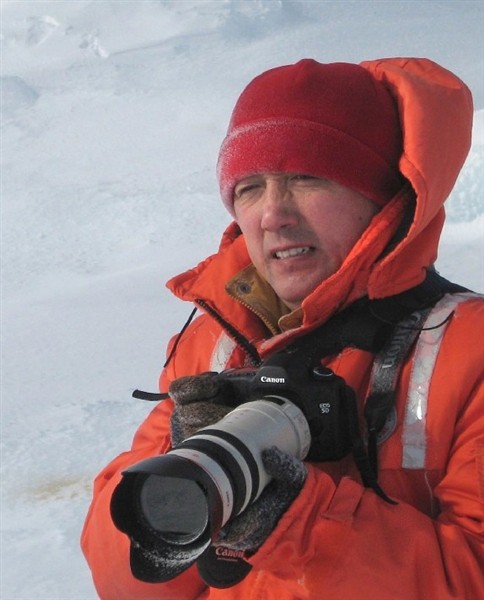
A couple, two cameras, one car, and $100,000 spent over seven years on 17 trips deep into the Arctic. Through photos and travel accounts, they have shown the Chinese public the real Arctic. The other day, Wang Jiannan, a photographer in his sixties, was invited to give a speech titled “The Real Arctic I’ve Seen” at Ocean University of China, presenting the true face of the Arctic to teachers and students. Years ago, having resigned as editor-in-chief of the Harbin Daily, Wang made another major decision: selling the online TV station he ran in Canada and setting off resolutely for the Arctic with his wife, taking on the mission to document the Arctic and visit indigenous communities. Seven years later, the Wangs have entered the Arctic 17 times, covering 100 indigenous villages or settlements.
Expedition
Exploring the far north of eight countries
Wang Jiannan told reporters that since his first trip to the Arctic in 2005, he made an extreme decision: “I want to pick up my camera to investigate the ecological status of the Arctic, record the real Arctic, and spread the word.” He named his endeavor the Circumpolar Eco-Photography Expedition. The so-called “circumpolar” refers to all iconic human settlements and surrounding areas within the “Arctic Human Sphere.” The “Arctic Human Sphere” is a region designated by the United Nations Development Programme in 2004 based on the current living conditions of Arctic indigenous peoples. This area covers the Arctic territories of eight countries—Canada, Denmark, Finland, Iceland, Norway, Sweden, the United States, and Russia—spanning approximately 27 million square kilometers with a population of about 3.6 million.
From 2005 to 2012, over seven years, he and his wife made 17 trips to the Arctic, ranging from one week to over 20 days each time, spending a total of $100,000. Their footsteps covered the far north of eight Arctic countries, visiting hundreds of settlements and ecological zones, taking around 30,000 photos, and writing nearly one million words of various notes.
Adventure
Car rollover into a snow ditch, nearly costing their lives
The couple’s Arctic expeditions revealed nothing but endless ice and snow, with no signs of human life for hundreds of kilometers—a clear indication of the dangers involved. Wang Jiannan said the most dangerous time was when he and his wife drove from Canada, entering the Arctic Circle in a sedan to photograph reindeer. “It was lightly snowing, with no people or cars along the way. There was only my car on the snow-covered road. The horizon had become a straight line, and for some reason, the car suddenly plunged into a deep ditch by the roadside and broke down,” Wang recalled. At the time, there was no navigation in the car, and mobile phones had no signal once inside the Arctic Circle. The vehicle was stuck in the snow, with half of it buried, and after many attempts, they couldn’t get it out.
“We were scared at the time. We waited by the roadside for more than two hours. The snow got heavier, not a single car passed by, and we were cold and hungry—it really felt like we were on the verge of death.” Wang didn’t give up easily. He found a shovel in the car and spent nearly an hour clearing the snow around the vehicle, then dug out a driving path, finally managing to get the car out.
Surprises
Indigenous life is surprisingly modern
What is the real Arctic like? Wang Jiannan said it completely defies people’s imagination. There are long, snowy winters with extremely low temperatures, which aligns with what people expect, but the Arctic also has summers, with temperatures reaching up to 20°C. The biggest difference lies in the residents, including various ethnic groups such as the Inuit and the Sami. They do not live in snow houses, eat raw meat, or rely on hunting for survival as people imagine. Most have embraced a modern lifestyle.
“There are schools, supermarkets, restaurants, bars, billiard rooms—every house has one or more cars or snowmobiles parked outside. The ground is covered in snow, but indoors it’s warm as spring, with dozens of TV channels... People there live comfortably, supported by the government, and no longer hunt. But over time, their ethnic identity is gradually fading, and they may be assimilated by modern society,” Wang said. The Arctic world is vast, and its reality is different from what Chinese people imagine. “As far as I know, there are 200 to 300 villages or settlements in the Arctic Human Sphere, and I’ve been to 100 so far—more than half remain. Although I’m already 63 years old, I must keep going, to see all the indigenous communities. I hope to show the Chinese public a true picture of the Arctic through photos and words.”